

Key Takeaways
- Headlights typically illuminate only 160-250 feet ahead, but stopping distance at highway speeds can exceed that range.
- The human eye loses much of its depth perception and peripheral sensitivity in low-light conditions.
- Glare from oncoming vehicles temporarily impairs night vision for several seconds after exposure.
- Pedestrians and cyclists are dramatically harder to detect at night, especially away from intersections.
- Fatigue compounds every night-driving risk factor, slowing reaction time in ways that feel invisible to the driver.
Why Night Driving Demands a Different Kind of Attention
Most drivers feel reasonably confident behind the wheel after dark - but confidence and actual safety are two different things. Nighttime accounts for a disproportionate share of fatal crashes relative to the miles driven during those hours. The reasons aren't always dramatic; many stem from subtle perceptual shifts that accumulate quietly.
Low light doesn't just make things harder to see. It alters how the eye processes motion, distance, and contrast. It slows the brain's ability to make spatial judgments. And because drivers rarely receive feedback when they misjudge something at night (a near-miss is still a miss), the risks often go unlearned. Understanding the specific blind spots - literal and cognitive - that darkness creates is the first step toward driving through them more safely.
Annual Eye Exams Matter for Night Driving
Night vision tends to decline with age, and conditions like cataracts or uncorrected astigmatism can dramatically worsen glare sensitivity and contrast perception after dark. Many drivers are unaware their vision has changed until the symptoms are significant. An annual vision check with an eye care professional can surface issues that affect nighttime safety before they become serious.
The Blind Spots You're Probably Driving Through Right Now
Your Headlights Don't Reach as Far as You Think
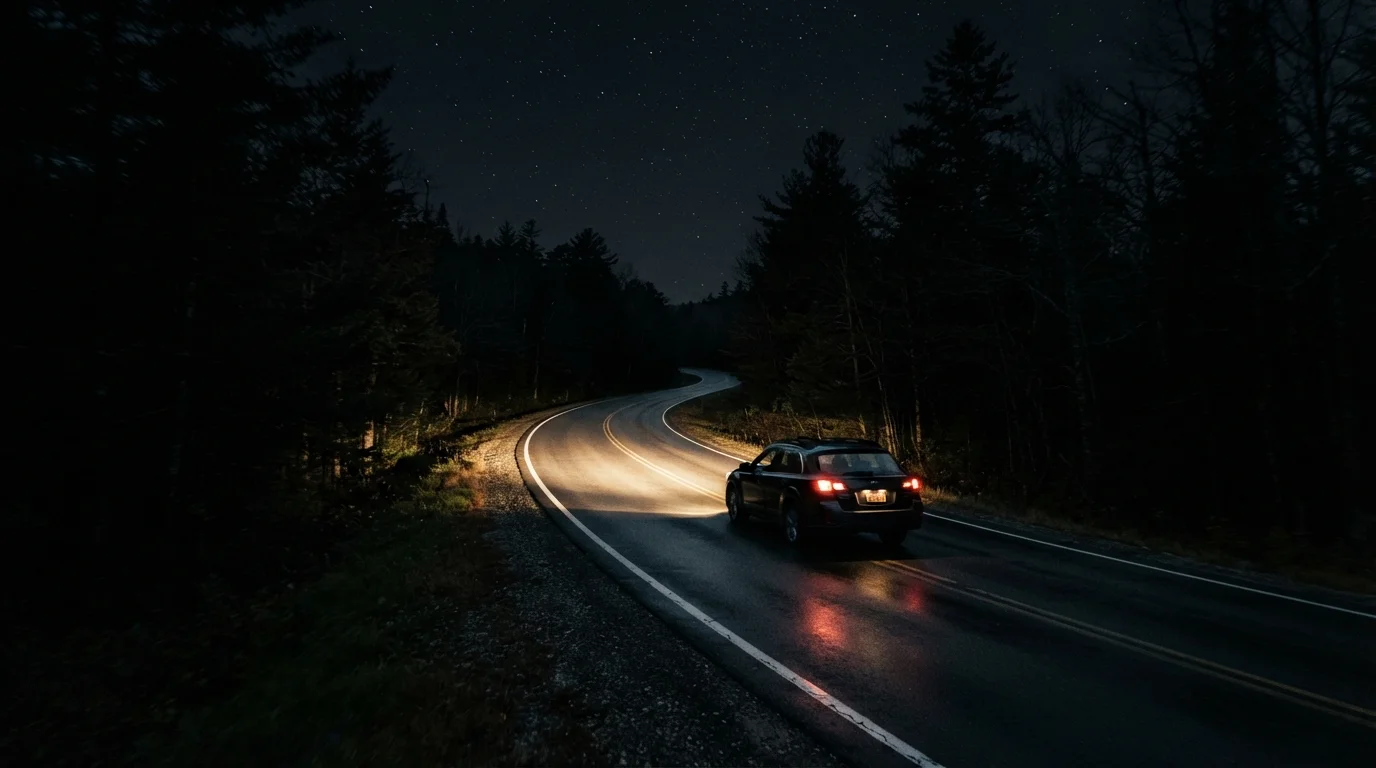
Standard low-beam headlights illuminate roughly 160 feet ahead. High beams extend that to around 500 feet - but most drivers don't use them consistently on unlit roads. At 60 mph, a vehicle travels about 88 feet per second. Factor in reaction time (typically 1.5 seconds) plus braking distance, and your total stopping requirement can easily exceed what your headlights reveal.
This phenomenon - driving faster than your headlights can support - is sometimes called overdriving your headlights. It's common, rarely noticed, and means that an obstacle appearing at the edge of your light range may already be within your stopping distance. Reducing speed on unlit roads, and using high beams when no oncoming traffic is present, directly addresses this gap.
At 60 mph, your stopping distance can easily exceed what standard low beams illuminate.
Glare Recovery Takes Longer Than You'd Expect
When an oncoming vehicle's headlights sweep across your field of view, your pupils constrict to protect the retina from excess light. After the glare passes, the pupils must dilate again - a process that takes anywhere from several seconds to nearly a minute to complete, depending on age and overall eye health.
During that recovery window, you're effectively driving with reduced night vision. Older drivers are especially affected, as the eye's ability to adapt to rapid light changes slows with age. Looking slightly to the right edge of the road rather than directly at oncoming lights is a practical way to reduce the adaptation burden without sacrificing situational awareness.
After glare exposure, full night vision can take up to a minute to recover - a window most drivers ignore.
Pedestrians and Cyclists Are Nearly Invisible in Many Scenarios
A pedestrian in dark clothing on an unlit road may only become visible at 50-80 feet under standard low beams - a distance that may not allow safe stopping at even moderate speeds. Unlike intersections or crosswalks, pedestrians at night often appear where drivers don't expect them: mid-block, on the shoulder, or emerging from between parked vehicles.
Cyclists present a similar challenge, particularly when they lack adequate reflective gear or lighting. Slowing down in areas where pedestrian and cyclist activity is possible - near bars, parks, bus stops, or residential neighborhoods - is more effective than trying to spot them in real time.
A pedestrian in dark clothing may only become visible at 50-80 feet - potentially within your stopping distance.
Depth Perception Degrades Significantly in Low Light
The human visual system relies on several cues to judge distance: binocular vision, motion parallax, contrast, and relative size. At night, contrast drops sharply and color information largely disappears, which undermines the brain's ability to accurately gauge how far away an object is or how fast it's approaching.
This matters most when judging the speed of oncoming vehicles, estimating gaps when merging or turning, and assessing whether a slowing vehicle ahead has fully stopped. The dangers of tailgating are meaningfully amplified at night precisely because these depth cues are weakened - a vehicle that appears to be at a comfortable distance may be much closer than it seems.
Depth perception relies on contrast and color - both of which largely disappear after dark.
Urban Night Driving Has Its Own Overlooked Risk Profile
Many drivers treat city driving as inherently safer at night because streetlights are present and speeds are lower. But urban environments at night introduce a different category of hazards: more pedestrian activity, more cyclists, more vehicles making unpredictable movements, and significantly more glare from storefronts, digital signage, and traffic signals competing for visual attention.
The contrast between lit and unlit zones is also sharper in cities, making it harder to spot people in shadowed areas between light sources. As our coverage of accident risk on highways vs. city streets shows, lower speeds don't automatically mean lower risk - the type of hazard just changes.
In cities, glare from signage and sharp light contrasts create distinct night-driving hazards that low speed alone doesn't solve.
Fatigue and Darkness Form a Compounding Risk Pair
Drowsiness doesn't just make you feel tired - it impairs the brain's ability to process visual information, slows reaction time, and narrows attention in ways that directly worsen every other night-driving hazard. The challenge is that fatigued drivers are often poor judges of their own impairment level; people who feel only slightly tired may already be operating with reaction times similar to someone at the legal alcohol limit.
Night hours also coincide with the body's natural circadian dip in alertness, which typically occurs between 2 and 4 a.m. and again in mid-afternoon. Recognizing this overlap - and planning long drives, route stops, or passenger arrangements accordingly - is a practical strategy rather than a precaution reserved for emergencies.
Fatigued drivers are often poor judges of their own impairment - a dangerous gap that night conditions widen.
Use High Beams Strategically on Open Roads
High beams can more than triple your effective visibility range on unlit roads. Switch to high beams whenever there is no oncoming traffic or vehicles directly ahead of you, and return to low beams when another vehicle comes within approximately 500 feet. Many drivers underuse high beams out of habit - making a conscious effort to activate them on dark stretches meaningfully reduces overdriving risk.
Building Safer Night Driving Habits
The good news is that awareness itself is protective. Once you understand what changes after dark - your stopping envelope, your visual range, your susceptibility to glare and fatigue - you can compensate with deliberate adjustments rather than relying on instinct alone. Reducing speed even modestly extends your reaction window substantially. Increasing following distance gives your stopping distance the room it actually needs - a dynamic explained in depth in our guide to stopping distance.
Night driving also intersects heavily with fatigue risk. If you've been awake for more than 17 hours, your reaction time and judgment can be measurably impaired in ways that aren't obvious from the inside. Our article on how fatigue affects driving covers the warning signs worth knowing before a long evening trip. Treating night driving as a different task - not just the same drive with the lights on - is the mindset shift that makes the biggest difference.