

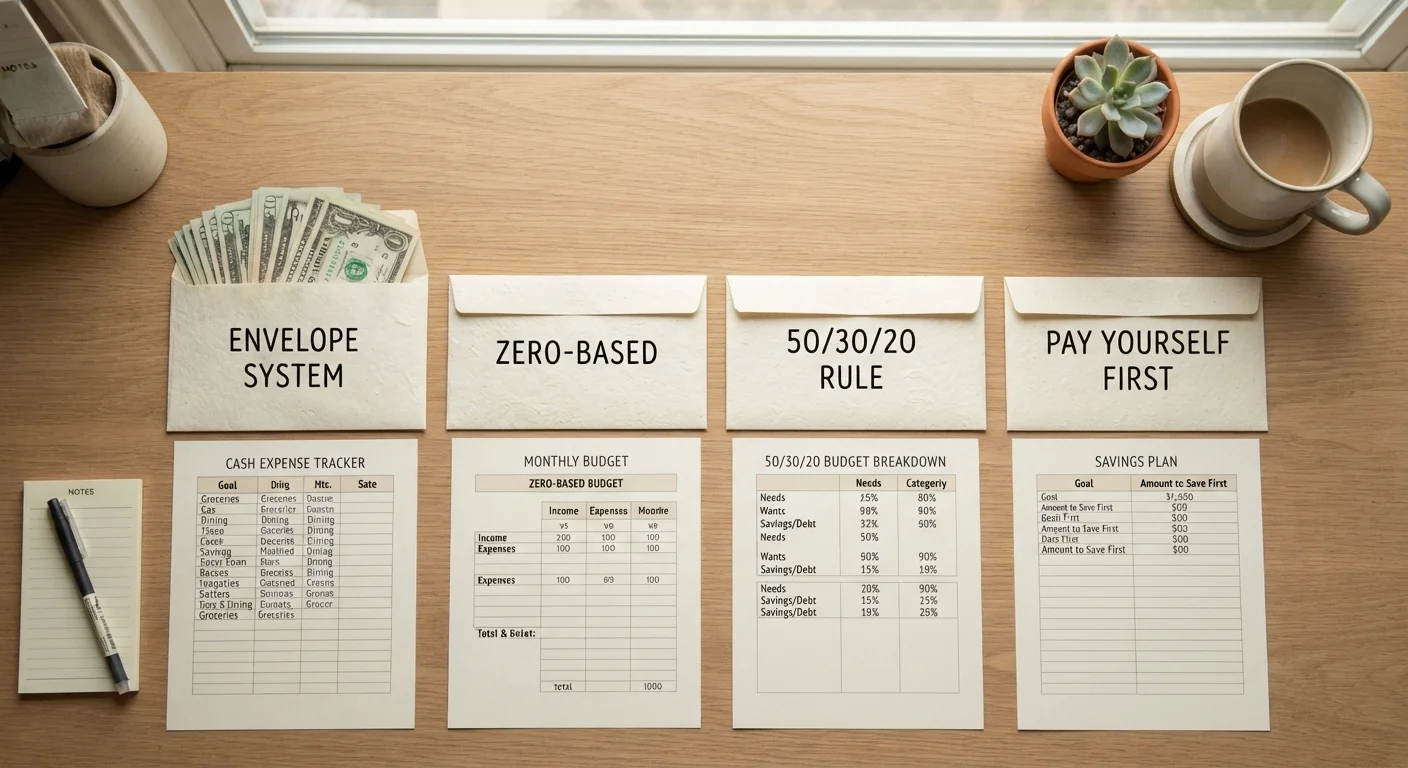
Key Takeaways
- Zero-based budgeting assigns every dollar a job each month, leaving no income unaccounted for.
- The 50/30/20 rule divides income into needs, wants, and savings using fixed percentages.
- Envelope budgeting uses physical or digital spending limits per category to prevent overspending.
- Pay-yourself-first prioritizes savings before discretionary spending, automating the habit.
- No single method fits everyone - the best framework is one you will actually stick with.
Our Verdict
Each of these four budgeting methods is built on sound principles, but they suit different personalities and life situations. Zero-based budgeting rewards detail-oriented planners; the 50/30/20 rule fits those who want simplicity; envelope budgeting helps people curb impulsive spending; and pay-yourself-first works best for those motivated by building savings. The right choice depends on your income stability, the time you can invest, and where your financial weak spots lie.
| Best for | Recommended |
|---|---|
| Those who want total control over every dollar | Zero-Based Budgeting |
| Those seeking a simple, low-maintenance framework | 50/30/20 Rule |
| Those who tend to overspend in specific categories | Envelope Budgeting |
| Those whose primary goal is building savings consistently | Pay-Yourself-First |
Why Budgeting Method Matters
Choosing how to budget matters as much as deciding to budget at all. A method that feels overwhelming gets abandoned; one that feels too loose won't change spending habits. If you're new to the basics, our introduction to personal budgeting covers the foundational concepts before diving into specific frameworks.
The four methods below represent the most widely discussed approaches in personal finance. Each one has a distinct philosophy, a different level of effort, and trade-offs worth understanding before you commit.
The Four Methods at a Glance
Here's how the four frameworks stack up across the dimensions that matter most to everyday budgeters.
| Zero-Based | 50/30/20 Rule | Envelope | Pay-Yourself-First | |
|---|---|---|---|---|
| Core principle | Assign every dollar a job | Split by fixed percentages | Spend only what's in each envelope | Save first, spend the rest |
| Time commitment | High - monthly rebuild required | Low - set and revisit occasionally | Medium - track per category | Low - automate and move on |
| Best income type | Stable, predictable | Stable or variable | Stable, predictable | Any - especially stable |
| Savings emphasis | Built into allocation | Fixed 20% target | Varies by setup | Savings are the first priority |
| Flexibility | Low - very structured | High - broad categories | Low - hard caps per category | Medium - leftover spending is flexible |
| Difficulty for beginners | Steep learning curve | Easy entry point | Moderate | Very easy to start |
| Main risk | Burnout from over-tracking | Overspending in 'wants' | Impractical without cash use | Underfunding daily expenses |
The table above captures the structural differences. The sections below unpack what each method actually looks like in practice.
How Each Method Works
Zero-Based Budgeting
Every dollar of take-home income is assigned a specific purpose - expenses, savings, or debt payments - until the remaining balance reaches zero. You're not spending everything; you're allocating everything. This method demands a monthly reset and works best for people with predictable income. See how it directly compares to a percentage-based approach in our article on zero-based budgeting vs. the 50/30/20 rule.
The 50/30/20 Rule
Income is split into three buckets: 50% toward needs (rent, groceries, utilities), 30% toward wants (dining out, subscriptions, entertainment), and 20% toward savings and debt repayment. It's flexible by design and requires no line-item tracking. For a deeper breakdown, see The 50/30/20 Rule Explained. One limitation: in high-cost cities, housing alone can exceed 50% of income, forcing adjustments.
Envelope Budgeting
Cash is divided into labeled envelopes - one per spending category. When an envelope is empty, spending in that category stops for the month. Traditionally done with physical cash, the method translates well to digital tools today. Envelope budgeting in a digital world explores how the concept adapts to apps and virtual accounts.
Pay-Yourself-First
Before paying any bill or making any discretionary purchase, a fixed amount is moved directly to savings or an investment account - often through automatic transfer. You then live on whatever remains. This approach makes saving the default behavior rather than an afterthought. It pairs naturally with strategies like dollar-cost averaging for long-term goals. For a side-by-side look at this versus a more flexible approach, see Pay Yourself First vs. Spend-Then-Save.
Start With One Month of Data
Before committing to any method, spend 30 days tracking what you actually spend - not what you plan to spend. Most people discover their real spending patterns differ significantly from their assumptions. That data makes whichever framework you choose far more realistic from day one.
Which Method Fits Your Situation
Income variability is one of the clearest deciding factors. If your paycheck changes month to month - as it does for freelancers or gig workers - zero-based budgeting requires rebuilding your plan each cycle, which can be useful but time-consuming. The 50/30/20 rule adapts more easily to variable income because it scales with whatever you actually earn. For practical guidance on this challenge, see budgeting on an irregular income.
If your main struggle is impulse spending in specific areas - say, restaurants or online shopping - envelope budgeting creates a hard stop that percentage rules don't. If your main struggle is never getting around to saving, pay-yourself-first removes willpower from the equation entirely.
Ready to put one of these into practice? Building your first monthly budget in seven steps walks through the setup process regardless of which method you choose.
Switching Methods Too Often Backfires
It can be tempting to jump from one budgeting method to another when the first one feels hard. In most cases, the friction is part of building a new habit rather than a sign the method is wrong for you. Give any new system at least two to three full months before drawing conclusions about whether it fits.
This article is for general informational purposes only and does not constitute personalized financial advice. Consider speaking with a qualified financial professional about your specific circumstances.