

Key Takeaways
- Needs cover survival and functioning; wants cover comfort and preference.
- The line between needs and wants shifts based on your income, location, and life circumstances.
- Honest categorization is more useful than a rigid checklist - context always matters.
- Clarifying needs vs. wants doesn't require deprivation; it requires intentionality.
- Most people find that some "wants" masquerade as needs until examined closely.
Needs vs. Wants
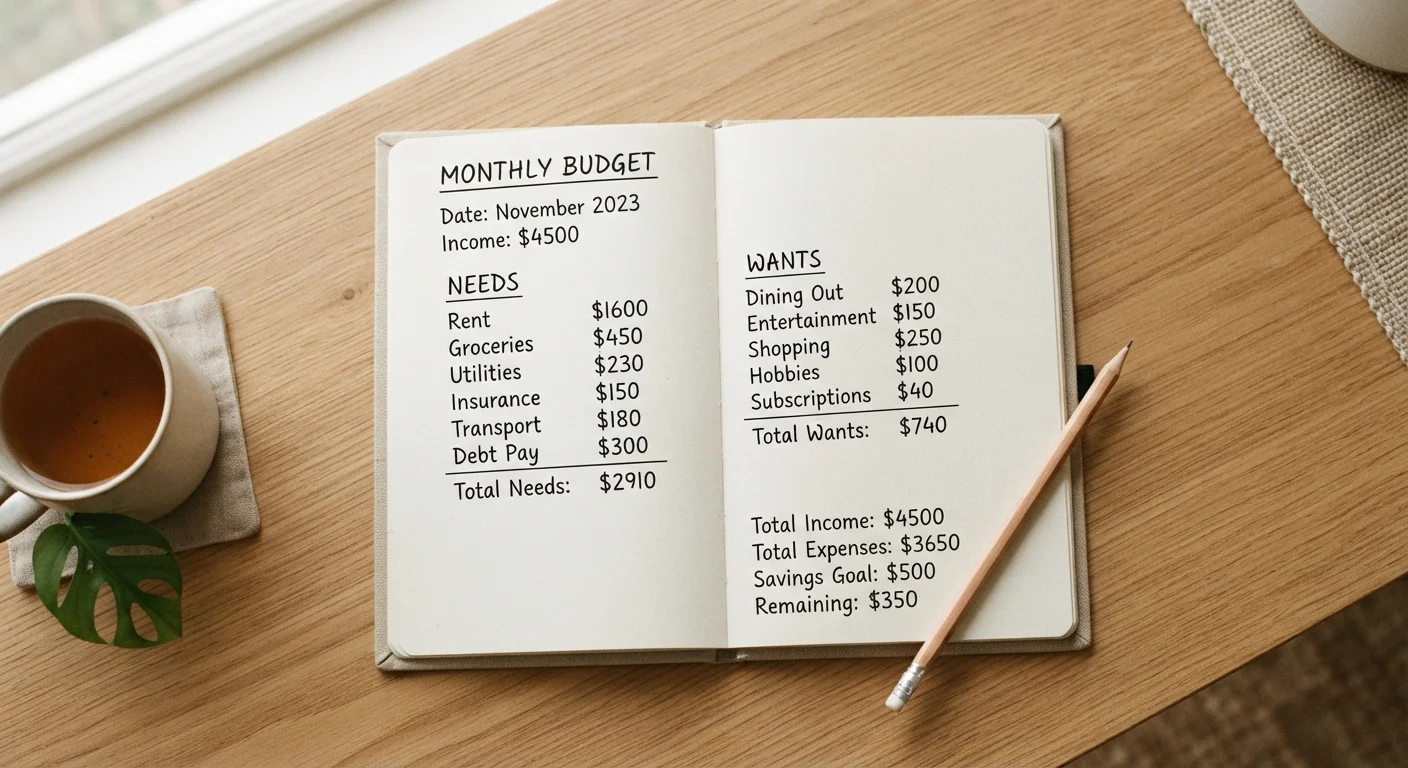
In personal budgeting, a "need" is an expense required for basic health, safety, and functioning - such as housing, food, utilities, and transportation to work. A "want" is anything beyond that baseline: spending that improves comfort or enjoyment but isn't essential to survival or employment. The distinction matters because it gives every dollar a defensible role in your budget.
In the widely cited 50/30/20 budgeting framework, needs and wants occupy two of the three spending categories - roughly 50% of after-tax income for needs and 30% for wants - though these percentages are guidelines, not rules.
Why the Line Is Blurrier Than You Think
Every budgeting guide tells you to separate needs from wants. Few of them admit how genuinely difficult that can be in practice. The reason the distinction matters - and the reason it's hard - is that context does most of the work. There is no universal list.
Take internet service. For someone who works remotely, it's as essential as electricity. For a retired person with no work obligations and a library nearby, it leans toward a want. Neither answer is wrong. The honest question isn't "is this a need?" - it's "is this a need for me, given my actual life?"
This nuance is worth sitting with before you start labeling your expenses. If you approach the exercise with too rigid a checklist, you'll either deprive yourself of something genuinely necessary or give yourself a free pass on spending that's really discretionary. Building a strong budgeting foundation starts with honest self-assessment, not textbook categories.
Needs Vary by Income Level
What counts as a need can shift with income. A reliable car may be a need for a nurse working overnight shifts, but the same vehicle purchase could represent a discretionary upgrade for someone with multiple transportation options. There's no shame in acknowledging that some needs are relative - what matters is being honest with yourself about the reasoning, not matching someone else's definition.
A Practical Framework for Sorting Expenses
Rather than hunting for a perfect definition, use this two-part test for each expense:
- Survival or function test: Would skipping this expense put my housing, health, employment, or basic safety at serious risk? If yes, it's a need.
- Minimum-version test: Is there a cheaper version of this expense that would still meet the underlying need? If yes, the minimum version is the need - everything above it is a want.
This framework reveals something important: most expenses aren't purely one or the other. Groceries are a need; the premium brand of olive oil is a want. A cell phone plan is a need for most working adults; unlimited international data probably isn't. You need some clothing; designer clothing is a want.
Once you've sorted your expenses this way, you're in a much stronger position to understand where your money is actually going. This becomes especially useful when you start comparing budgeting methods like zero-based and 50/30/20, both of which depend on this categorization to work well.
~33%
Americans with no monthly budget
Surveys conducted by the National Foundation for Credit Counseling have consistently found that a significant share of U.S. adults do not track their spending against a budget.
50%
After-tax income suggested for needs
The 50/30/20 rule, a widely referenced budgeting guideline, allocates up to half of take-home pay to essential needs - though this threshold varies significantly by household income and location.
$1,000+
Average annual subscription spending per household
Research from financial services firms suggests many U.S. households underestimate their total recurring subscription costs, with actual spending often exceeding their own estimates.
Common Expenses That Fool Most Budgeters
Several categories routinely trip people up because they feel essential but often contain significant want-spending layered on top of genuine needs.
Food and Groceries
Basic nourishment is a need - but grocery bills frequently include convenience items, premium brands, and specialty products that are wants. Dining out is almost always a want unless extraordinary circumstances apply. Even within grocery spending, there's usually meaningful discretionary room.
Housing
You need a safe place to live. Whether you need a two-bedroom apartment to yourself is a different question. Renting a larger space than you strictly require is partly a want. The rent vs. buy decision also carries this complexity - the choice itself often reflects preference as much as necessity.
Subscriptions
Monthly subscriptions are where want-spending most reliably hides. Streaming services, app subscriptions, gym memberships, and meal kits feel routine - and routine spending feels essential. Run through your recurring charges and ask: would I notice if this disappeared tomorrow, or would I only notice the extra money?
Try the 30-Day Subscription Audit
Pull up your last two bank or credit card statements and highlight every recurring charge. For each one, ask: do I use this regularly, and would I miss it? Cancel one subscription you're uncertain about and see if you notice its absence after 30 days. This is one of the fastest ways to convert unconscious want-spending into intentional saving.
Using the Distinction Without Judging Yourself
Sorting needs from wants isn't about labeling certain spending as "bad." Wants are a legitimate and important part of a budget. The goal is intentionality - knowing which spending is which so you can make deliberate trade-offs rather than accidental ones.
When money is tight, this clarity lets you protect what's truly essential first and identify where you have flexibility. When money is comfortable, it prevents gradual lifestyle inflation from quietly consuming the margin you could be saving or investing. Either way, the same skill applies.
Common budgeting myths often revolve around the belief that budgeting means giving up everything enjoyable. In reality, people who categorize spending clearly tend to feel more in control of their wants - not less. They spend on what they value and cut what they don't, rather than wondering where the money went. For a side-by-side look at frameworks that use this distinction practically, see how popular budget methods compare.
This article is for general informational and educational purposes only and does not constitute personalized financial advice. Consider consulting a licensed financial professional for guidance specific to your situation.