

Key Takeaways
- Active investing attempts to outperform market benchmarks; passive investing aims to replicate them.
- Active strategies typically carry higher fees due to ongoing research and frequent trading.
- Research consistently shows most actively managed funds underperform their benchmarks over long periods.
- Passive investing through index funds offers low costs and broad diversification with minimal effort.
- Neither approach is universally superior - your goals, timeline, and cost tolerance all matter.
- Many investors use a blend of both strategies rather than committing exclusively to one.
Option A
Active Investing
The hands-on, beat-the-market approach.
Best for: Investors who want portfolio customization, can tolerate higher costs, and seek opportunities to outperform market averages.
Option B
Passive Investing
The steady, match-the-market approach.
Best for: Investors who prioritize low costs, broad diversification, and long-term consistency over market-beating ambitions.
If you want to minimize costs and invest for the long term
Passive Investing
Lower expense ratios compound significantly over decades, and passive funds have historically matched broad market returns reliably.
If you want targeted exposure to specific sectors or themes
Active Investing
Active managers can focus on niche opportunities or adjust holdings in response to changing conditions in ways that broad index funds cannot.
If you are new to investing and building foundational knowledge
Passive Investing
Passive strategies require fewer decisions, carry less behavioral risk, and allow beginners to participate in market growth without needing deep expertise.
If you want to combine both approaches
Active Investing
A 'core and satellite' approach - using passive funds as the portfolio foundation and active positions for specific goals - is a common middle-ground strategy.
The Core Philosophy Behind Each Approach
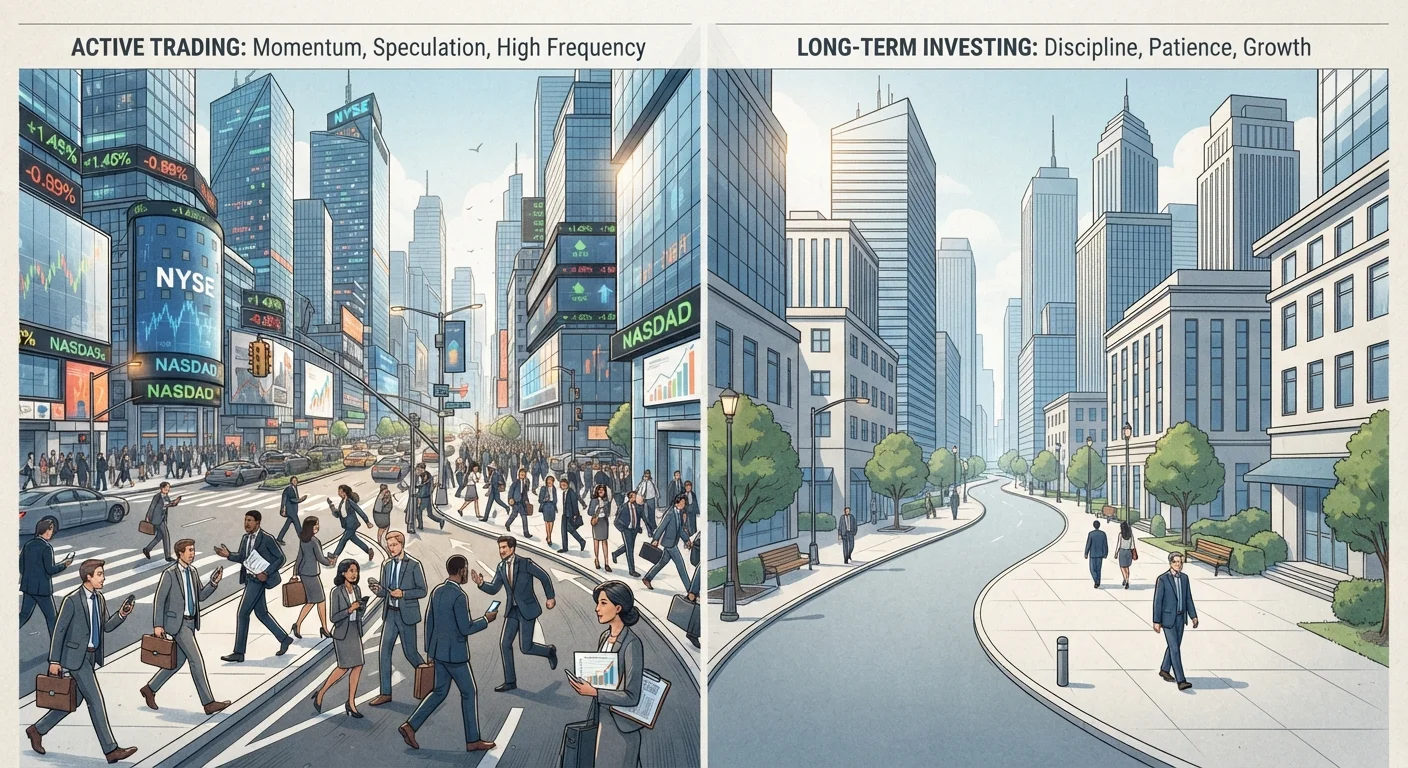
At its heart, the debate between active and passive investing comes down to one question: do you believe it's possible - and worthwhile - to consistently outperform the broader market? If your answer is yes, active investing is your framework. If your answer is no, passive investing follows naturally.
Active investing involves a portfolio manager (or an individual investor) making deliberate decisions about which securities to buy, hold, or sell, and when. The goal is to generate returns that exceed a benchmark index, such as the S&P 500. Achieving that requires ongoing research, market timing judgments, and frequent trades.
Passive investing takes the opposite stance. Rather than trying to outguess markets, a passive strategy seeks to mirror a market index by holding the same securities in the same proportions. Returns track the index closely - no more, no less. As a starting point, see our grounded introduction to investing for the foundational ideas underpinning both approaches.
| Criterion | Active Investing | Passive Investing |
|---|---|---|
| Primary Goal | Beat the market benchmark | Match the market benchmark |
| Typical Expense Ratio | 0.5%-1%+ per year | Often below 0.1% per year |
| Trading Frequency | Frequent, based on research | Infrequent, index-driven |
| Management Style | Human judgment and analysis | Rules-based, automated |
| Tax Efficiency | Lower - more taxable events | Higher - fewer taxable events |
| Long-Term Track Record | Most funds lag benchmarks after fees | Reliably tracks index returns |
| Effort Required | Ongoing research and monitoring | Minimal ongoing involvement |
Costs, Fees, and What They Mean Over Time
One of the starkest differences between the two approaches is cost. Active funds employ research analysts, portfolio managers, and trading infrastructure - all of which are reflected in higher expense ratios (the annual percentage of your investment deducted as fees). Expense ratios for actively managed mutual funds commonly range from 0.5% to over 1% per year.
Passive index funds, by contrast, require minimal management. Many broad-market index funds carry expense ratios well below 0.1%. That gap may sound small, but compounded across 20 or 30 years, it can represent a meaningful difference in ending portfolio value. To understand the vehicles through which both strategies are commonly implemented, see our article on stocks, bonds, and funds.
~85%
Active large-cap funds underperforming over 15 years
According to S&P Dow Jones SPIVA scorecards, roughly 85% of actively managed U.S. large-cap funds have underperformed the S&P 500 over 15-year periods.
0.03%
Expense ratio of some broad index funds
Some of the most widely held passive index funds carry annual expense ratios as low as 0.03%, illustrating the cost advantage of passive strategies.
10-20×
Cost difference between active and passive funds
Expense ratios for active funds can be 10 to 20 times higher than comparable passive funds, a gap that compounds meaningfully over long investment horizons.
Active strategies also generate more taxable events. Frequent buying and selling can trigger capital gains taxes in taxable accounts - an added drag that passive, buy-and-hold approaches largely avoid.
Performance: What the Evidence Shows
The performance record of active management is well-documented and, for many investors, sobering. Broad industry research - including the S&P Dow Jones SPIVA reports published over many years - consistently finds that the majority of actively managed funds underperform their benchmark indexes over periods of 10 to 15 years, after fees.
That doesn't mean active management never works. Some managers do outperform - the challenge is identifying them in advance and knowing whether their track record reflects skill or favorable market conditions. Past performance does not guarantee future results, a point worth keeping front of mind.
Why Outperformance Is Structurally Difficult
Markets are competitive environments. When millions of informed participants trade the same securities, prices tend to reflect available information quickly - a concept known as market efficiency. Active managers must not only identify mispriced assets but do so consistently enough to overcome their higher fees. Because most participants cannot beat the collective wisdom of the market after costs, outperformance becomes structurally difficult to sustain over long periods.
Passive investing sidesteps this uncertainty by design. Index funds, which are a primary vehicle for passive strategies, are covered in depth in our piece on what index funds are and why they're so widely discussed. For a broader look at common misconceptions that trip up new investors, see what the evidence actually shows about markets.
Choosing What Fits Your Situation
Neither active nor passive investing is right for every person in every situation. Your choice - or blend of the two - should reflect your financial goals, timeline, risk tolerance, and how much ongoing involvement you want with your portfolio.
Passive strategies are well-suited to investors who want broad market exposure, simplicity, and low costs without needing to monitor markets frequently. A complementary strategy worth understanding is dollar-cost averaging, which pairs naturally with a passive approach by removing the temptation to time markets.
Active strategies may appeal to investors with specific objectives - targeting particular sectors, managing concentrated risk, or pursuing opportunities in less efficient corners of the market where research-based insight may add value.
Many investors combine both approaches, using low-cost index funds as a core portfolio foundation while reserving a smaller portion for active positions. Whichever path you consider, reviewing the glossary of essential investing terms can help you evaluate your options with confidence.
This article is for general informational and educational purposes only and does not constitute personalized financial, investment, tax, or legal advice. Consult a qualified financial professional before making investment decisions suited to your individual circumstances.