

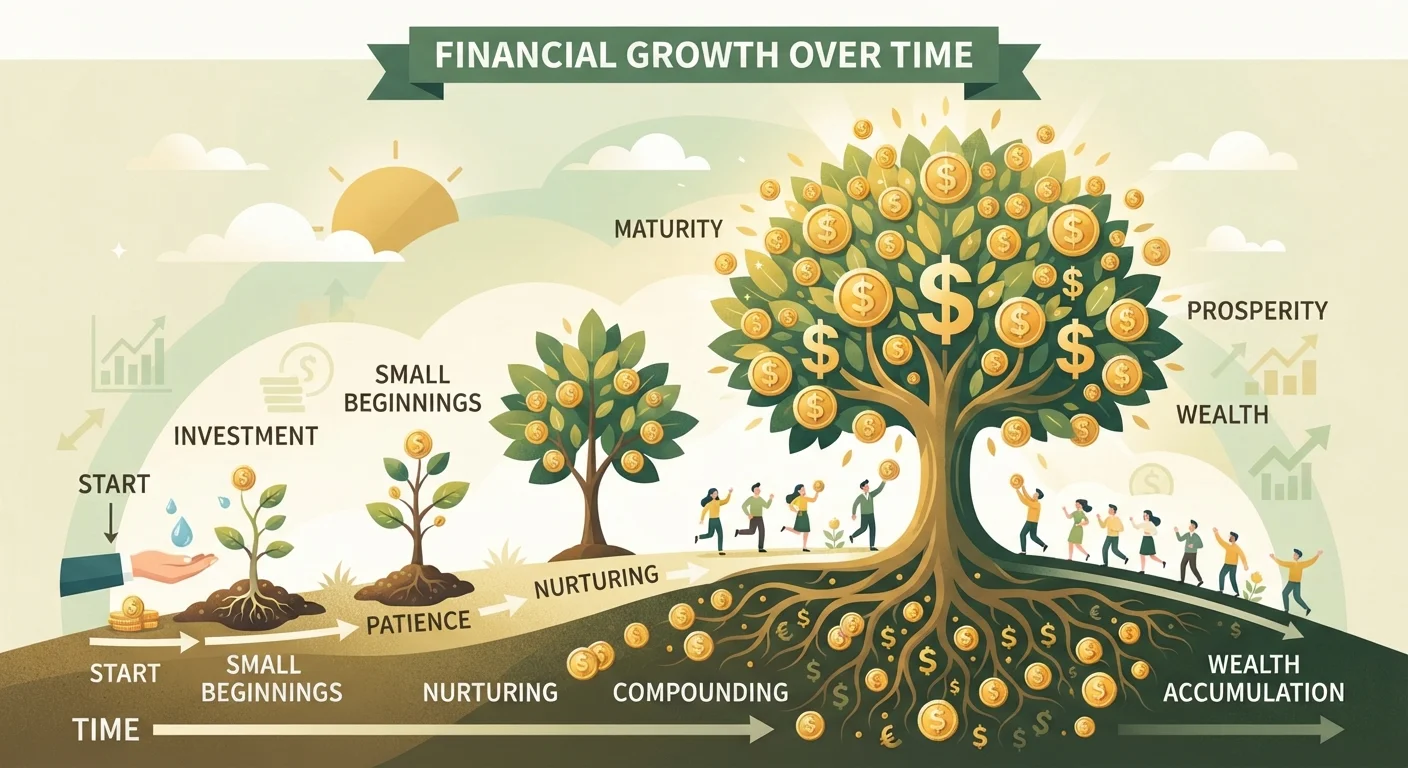
Key Takeaways
- Compound interest earns returns on both your principal and your previously earned interest.
- Starting earlier dramatically increases long-term growth, even with smaller contributions.
- Compounding works against you on debt just as powerfully as it works for you on savings.
- Time in the market - not timing the market - is the core driver of compounding's power.
- Even modest, consistent contributions can grow substantially over decades.
Compound Interest
Compound interest is interest calculated not just on your original deposit or investment, but also on the interest you've already earned. Over time, this creates a snowball effect where your money grows faster and faster without any additional effort from you. It applies to both savings and investments - and, importantly, to debt as well.
The frequency of compounding (daily, monthly, annually) affects how quickly interest accumulates. More frequent compounding periods result in slightly higher effective annual returns, described by the formula A = P(1 + r/n)^(nt).
The Core Idea: Interest on Interest
Most people learn about simple interest in school: borrow $100 at 5%, and you owe $5. Compound interest works differently. Instead of applying the rate only to your original amount, it applies to the growing total - principal plus any interest already accumulated.
Think of it like a rolling snowball. At first, it's small and gains mass slowly. But as it grows, its surface area increases, and it picks up more snow with every rotation. The bigger it gets, the faster it grows - not because anything external changed, but because size itself becomes an advantage.
That same dynamic applies to money sitting in an interest-bearing savings account or a broad market investment vehicle over many years. The longer it rolls, the more momentum it builds.
Compounding Frequency Matters
Not all accounts compound at the same rate. A savings account compounding daily will produce slightly more interest than one compounding annually, even at the same stated rate. When comparing savings accounts or investment vehicles, it's worth checking how often interest compounds, not just the headline rate. This detail is usually disclosed in the account terms.
Why Starting Early Matters More Than You Might Think
The most counterintuitive truth about compounding is how much starting date matters compared to contribution size. Consider two hypothetical savers, both earning the same average annual return:
- Saver A begins at age 25, contributes for 10 years, then stops entirely.
- Saver B waits until age 35, then contributes for 30 consecutive years.
In many mathematical illustrations of this scenario, Saver A - despite contributing for far fewer years - ends up with a larger final balance because their money had more time to compound. This is sometimes called the "early bird" effect, and it underscores why financial educators consistently emphasize starting as soon as reasonably possible, even with small amounts.
This doesn't mean late starters are out of luck. It simply means every year of delay has a real cost in forgone compounding cycles. The best time to start is early; the second-best time is now.
Rule of 72
Years to double your money
Divide 72 by your annual interest rate to estimate how many years it takes to double an investment - a widely cited mental math shortcut in personal finance education.
10x+
Potential growth over 30-40 years
Hypothetical illustrations using historical average market return assumptions often show long-term investments growing to more than 10 times the original principal over multi-decade periods, though actual results vary and are never guaranteed.
Compounding Works Both Ways: The Debt Warning
The same force that grows your savings can quietly grow your debt. Credit card balances, for example, typically compound daily or monthly. If you carry a balance from month to month, interest accrues on what you owe - including previously charged interest. Over time, a manageable balance can balloon into something much harder to pay off.
This is why paying only the minimum on revolving debt can feel like running on a treadmill. Most of each payment goes toward interest rather than reducing the principal, and the balance barely shrinks. For a deeper look at how this dynamic plays out in real terms, see The True Cost of Carrying Credit Card Debt.
Understanding this dual nature of compounding - powerful ally for savers, relentless opponent for borrowers - is one of the most practically useful things any consumer can internalize.
Automate to Keep the Snowball Rolling
One practical way to harness compounding is to set up automatic contributions so money moves before you have a chance to spend it. Even small recurring amounts - added consistently over years - benefit from every compounding cycle. Automation removes the decision friction that often causes people to delay or skip contributions.
Applying This Concept to Your Financial Life
You don't need to master the math formula to benefit from compound interest. What matters is grasping the behavioral implications:
- Start contributions as early as you can, even if the amount feels small. Time is the ingredient you can't buy back.
- Reinvest earnings rather than withdrawing them. In investment accounts, this often happens automatically, but it's worth confirming.
- Minimize high-interest debt to prevent compounding from working against you.
- Stay consistent. Frequent interruptions reset the snowball's momentum.
Compound interest is a foundational concept that connects to almost every other aspect of personal finance, from retirement planning to debt management. It's also a key reason why time in the market - rather than trying to perfectly time the market - is so often cited as the more reliable long-term strategy. For more context on that principle, Things New Investors Misunderstand About How Markets Work is a useful companion read.
If you're just getting started, Financial Concepts Worth Understanding Before You Start Investing offers a broader checklist of foundational ideas worth knowing before putting money to work.
This article is for general informational and educational purposes only and does not constitute personalized financial, investment, or tax advice. Please consult a qualified financial professional before making decisions based on your individual circumstances.