

| Equipment required | None - floor space is sufficient for most movements |
| Muscle groups addressed | Lower body, upper body, and core covered with basic movements |
| Beginner-friendly modifications | Available for every movement listed (e.g., knee push-ups, partial squats) |
| Minimum space needed | Approximately 6 × 4 feet for most floor-based exercises |
| Physical activity guidelines | US adults: 150-300 min moderate activity per week, plus muscle-strengthening 2+ days (U.S. Department of Health & Human Services, Physical Activity Guidelines for Americans, 2nd ed.) |
What Bodyweight Training Actually Means
Bodyweight training uses your own mass as the primary source of resistance - no dumbbells, machines, or gym memberships required. The movements are among the oldest forms of human conditioning, and decades of research confirm they can meaningfully build strength, improve cardiovascular fitness, and support healthy body composition when performed consistently.
This reference covers the most practical bodyweight movements, organized by the muscle groups they primarily target. For each exercise you'll find a brief mechanics note and simple form cues to reduce injury risk. If you're new to structured exercise entirely, see Starting a Workout Routine from Absolute Zero before diving into individual movements.
Before beginning any new exercise program, it's worth reviewing your personal readiness. A personal readiness checklist can help you set realistic expectations and begin safely - particularly if you have an existing health condition or have been inactive for an extended period.
| Equipment required | None - floor space is sufficient for most movements |
| Muscle groups addressed | Lower body, upper body, and core covered with basic movements |
| Beginner-friendly modifications | Available for every movement listed (e.g., knee push-ups, partial squats) |
| Minimum space needed | Approximately 6 × 4 feet for most floor-based exercises |
| Physical activity guidelines | US adults: 150-300 min moderate activity per week, plus muscle-strengthening 2+ days (U.S. Department of Health & Human Services, Physical Activity Guidelines for Americans, 2nd ed.) |
Lower-Body Movements
The lower body contains the body's largest muscle groups, making these movements highly efficient for both strength and metabolic demand.
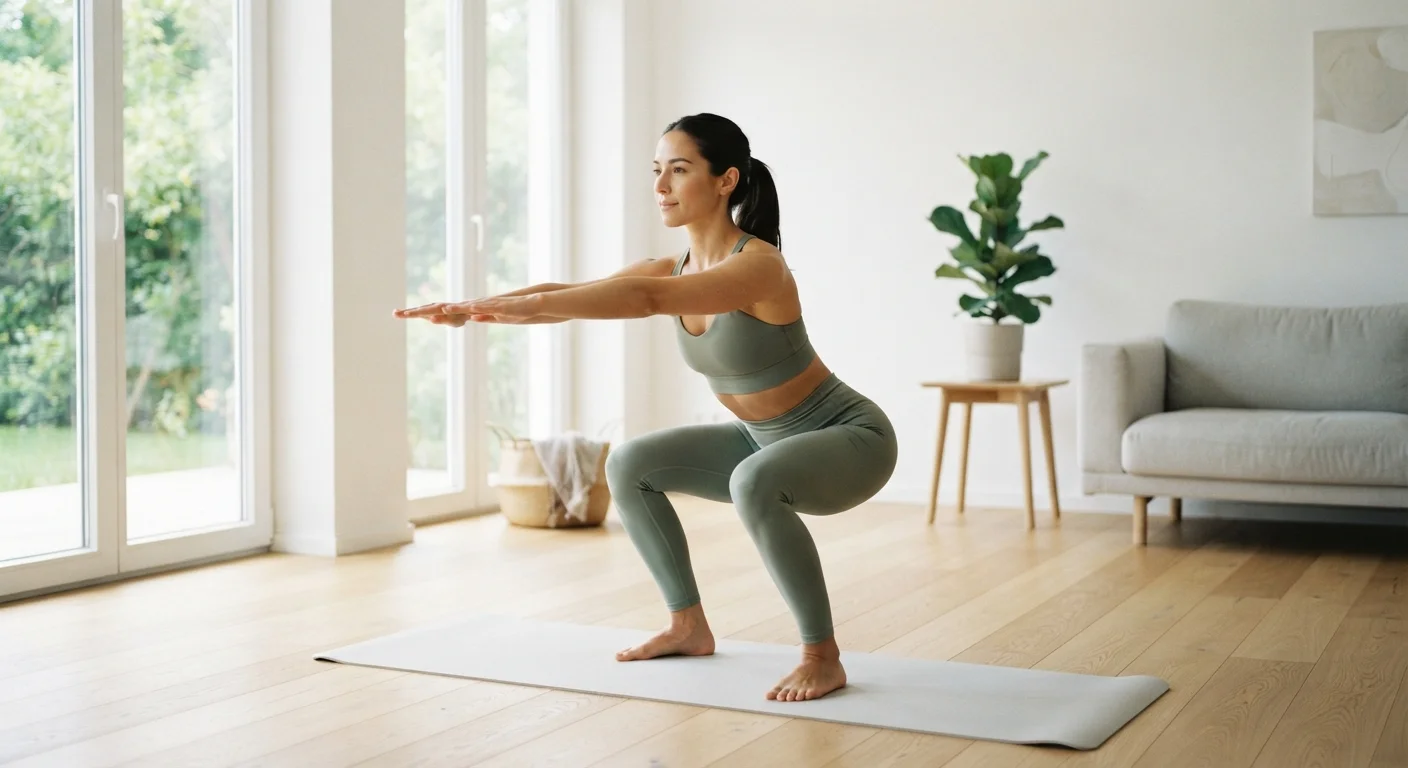
- Squat - Targets quadriceps, glutes, and hamstrings. Stand with feet shoulder-width apart, toes slightly out. Hinge at the hips and knees simultaneously, keeping the chest upright and knees tracking over the toes. Descend until thighs are roughly parallel to the floor, then press through the heels to return upright.
- Reverse Lunge - Targets glutes, quads, and challenges single-leg balance. Step one foot backward, lowering the back knee toward the floor. Keep the front shin as vertical as possible. Return to standing and alternate legs.
- Glute Bridge - Targets glutes and hamstrings with minimal spinal load. Lie on your back, knees bent, feet flat. Press the hips upward until the body forms a straight line from shoulders to knees. Squeeze at the top for a moment before lowering.
- Calf Raise - Isolates the gastrocnemius and soleus. Stand near a wall for balance, rise onto the balls of both feet, then lower slowly. A slow descent increases the challenge.
Repetition (Rep)
One complete cycle of a movement from start position back to start position. Reps are typically grouped into sets.
Set
A defined number of consecutive repetitions performed before a rest period. For example, three sets of ten squats means performing ten reps, resting, then repeating twice more.
Anterior Chain
The muscles running along the front of the body, including the quads, hip flexors, abs, and chest. Many push-up and plank variations primarily load this chain.
Posterior Chain
The muscles along the back of the body - glutes, hamstrings, and spinal erectors. Glute bridges and deadlifts are classic posterior-chain exercises.
Progressive Overload
The practice of gradually increasing the challenge placed on muscles over time - through more reps, slower tempo, or harder variations - to continue promoting adaptation.
Isometric Hold
An exercise where the muscle generates force without changing length. The plank is a well-known isometric hold for the core.
Upper-Body and Core Movements
Upper-body bodyweight work relies heavily on pushing and pulling mechanics. Core exercises range from static holds to dynamic movements that train spinal stability.
- Push-Up - Targets chest, anterior shoulders, and triceps. Begin in a high plank: hands slightly wider than shoulder-width, body a straight line from head to heels. Lower the chest to the floor, then press back up without letting hips sag or pike. A knee-supported variation reduces load for beginners.
- Triceps Dip - Targets the triceps and anterior deltoid. Using a stable chair or bench, place hands behind the hips, fingers forward. Lower the body by bending the elbows to roughly 90 degrees, then press back up. Keep the hips close to the surface edge to reduce shoulder strain.
- Plank (Forearm) - A static hold training the entire anterior core. Forearms on the floor, elbows under shoulders, hips level. Breathe steadily and avoid holding your breath. Duration - not speed - determines the challenge.
- Dead Bug - Trains deep core stability with low spinal risk. Lie on your back, arms extended toward the ceiling, hips and knees at 90 degrees. Slowly lower one arm overhead while extending the opposite leg, keeping the lower back pressed to the floor. Return and alternate.
For a comparison of how these strength-focused movements differ from aerobic exercise in their effects on the body, see our overview of strength training vs. cardio.
Building a Routine Around These Movements
A functional bodyweight session can be assembled using two or three movements from each category above. Alternating lower-body and upper-body exercises limits local fatigue and keeps rest periods short, which adds a cardiovascular element to the session.
Consistency matters far more than intensity, especially at the start. Movement habits that hold up over a lifetime are built on regularity and gradual progression - not on any single heroic workout. Even short sessions scheduled throughout a busy day can accumulate meaningful benefit. Fitting exercise into a packed day explores practical ways to make that happen.
Form Comes Before Volume
When learning any new movement, start with fewer repetitions performed cleanly rather than many repetitions with poor mechanics. Sloppy form under fatigue is a leading cause of minor injuries that interrupt training routines. If a movement causes sharp pain - distinct from normal muscular effort - stop and consult a healthcare professional before continuing.
This article is for general informational purposes and does not constitute medical or personal training advice. Individuals with existing health conditions, injuries, or other concerns should consult a qualified healthcare professional before beginning or modifying an exercise program.