

Key Takeaways
- Group classes offer built-in accountability and social energy that can sustain motivation over time.
- Solo training gives you full control over pace, schedule, and exercise selection.
- Neither format is universally superior - the best choice is the one you'll actually stick with.
- Hybrid approaches combining both formats work well for many people.
- Your personality, fitness goals, and lifestyle constraints are the most reliable guides.
Our Verdict
Group classes and solo training each carry genuine advantages - and the research on exercise adherence consistently points to one truth: consistency beats format. If social energy and scheduled accountability help you show up, group classes earn their place. If flexibility and personal focus matter more, solo training will likely serve you better. Many people find a blend of both keeps things sustainable long-term.
| Best for | Recommended |
|---|---|
| Those who need external accountability to stay consistent | Group Classes |
| Those with unpredictable schedules or specific performance goals | Solo Training |
| Those returning to fitness after a long break | Group Classes |
| Those who find social settings draining or distracting | Solo Training |
What the Research Actually Says About Exercise Environments
Decades of exercise science research suggest that the most effective workout is the one a person consistently performs. A landmark concept in behavioral health - the "intention-behavior gap" - shows that most people intend to exercise more than they do. The environment where you train has a measurable impact on whether that gap closes.
Studies published in journals such as the International Journal of Behavioral Nutrition and Physical Activity have found that social support and group cohesion are significant predictors of exercise adherence, particularly for beginners. At the same time, research on autonomy and self-determination theory shows that people who feel in control of their workout choices tend to sustain activity longer. Both findings are valid - they simply describe different people in different situations.
If you're weighing your options, it helps to also consider how exercise fits your available time. Our guide on fitting exercise into a packed day explores practical approaches when your schedule is already stretched thin.
The Real Advantages of Group Classes
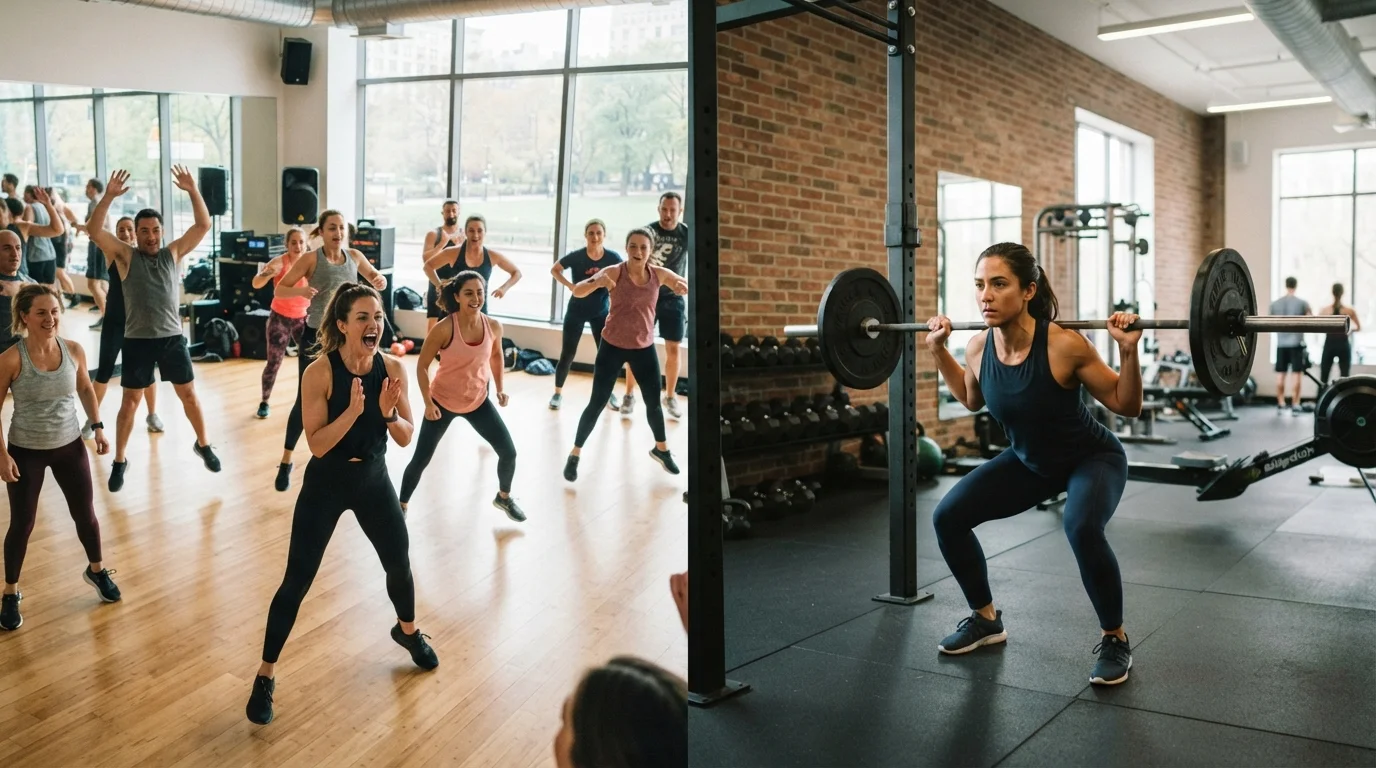
Group fitness formats - whether spin, yoga, HIIT, or dance cardio - deliver several structural benefits that solo workouts rarely replicate on their own.
- Built-in accountability: Booking a class creates a social commitment. Canceling feels different when an instructor or classmates expect you.
- Pacing guidance: Instructors manage intensity cues, reducing the guesswork that trips up many self-directed exercisers.
- The Köhler effect: Research suggests people work harder in group settings than alone, particularly when they perceive themselves as slightly less fit than others nearby.
- Community and belonging: Regular class attendance can build genuine social connection, which itself supports mental wellness.
Group settings tend to work especially well for people who are newer to structured exercise, those who find motivation difficult to sustain independently, or anyone who genuinely enjoys social interaction as part of their routine.
Try a Hybrid Approach Before Deciding
Many people assume it's one or the other, but combining formats often works best. Consider anchoring your week with one or two scheduled group sessions for accountability, then filling remaining days with self-directed movement. This preserves flexibility while keeping a social commitment in place. Reassess after four to six weeks to see which sessions you're looking forward to and which you're dreading.
The Genuine Case for Training Solo
Solo training isn't the fallback for antisocial gym-goers - it's a legitimate and often superior structure for many goals and personalities.
| Group Classes | Solo Training | |
|---|---|---|
| Accountability | High - social commitment | Self-generated only |
| Schedule flexibility | Low - fixed class times | High - train anytime |
| Personalization | Limited by class format | Fully customizable |
| Social connection | Built-in community | Little to none |
| Beginner-friendliness | High - instructor-guided | Moderate - requires initiative |
| Cost | Varies; often higher | Varies; often lower |
| Motivation required | Lower - environment helps | Higher - self-driven |
- Schedule flexibility: You train when it works for your life, not when a class is scheduled.
- Personalized progression: You can advance at your own pace and adjust intensity based on how you actually feel that day.
- Specific goal alignment: If you're working toward a defined performance target - say, building strength in specific movement patterns - solo programming lets you structure sessions precisely. See our overview of what strength training and cardio each do for your body for context on how different goals shape training choices.
- Reduced performance anxiety: For some people, group environments create self-consciousness that actually undermines effort and enjoyment.
Solo training rewards self-awareness and a degree of intrinsic motivation, but it doesn't require either trait to be fully developed from day one - they grow with practice.
Matching Your Personality and Goals to the Right Format
A useful starting point: reflect honestly on what has caused past exercise routines to stall. If skipping was easy when no one knew whether you showed up, group accountability may be the missing piece. If you frequently felt drained, bored, or out of sync in class settings, solo training may simply suit your temperament better.
Consider these practical questions:
- Do you find social energy motivating or depleting during physical effort?
- How predictable is your weekly schedule?
- Do you have a clear sense of what exercises and intensity levels suit your current fitness level?
- Is variety or consistency more important to how you stay engaged?
Neither introversion nor extroversion determines the right answer absolutely - some introverts love the structure of group classes while some extroverts train best alone. What matters is honest self-assessment, not personality labels.
If you're coming back to exercise after time away, our guidance on returning to exercise after a long break can help you choose a starting format that won't overwhelm you in either direction.
This article is for general informational and educational purposes only. It is not a substitute for personalized advice from a qualified fitness professional or healthcare provider. Consult a professional before beginning any new exercise program, particularly if you have existing health conditions.