

Key Takeaways
- Stress is typically tied to an identifiable external cause; anxiety often persists without one.
- Both share physical symptoms like muscle tension, racing heart, and sleep disruption.
- Chronic stress can develop into an anxiety disorder if left unaddressed.
- Recognizing which you're experiencing helps you choose the most effective coping approach.
- Persistent anxiety that interferes with daily life warrants professional evaluation.
Option A
Stress
The external pressure response.
Best for: Identifying when a specific situation or demand is the root cause of your tension.
Option B
Anxiety
The internal, often persistent worry state.
Best for: Recognizing when worry persists beyond a triggering event or lacks a clear external cause.
If your tension disappears once a deadline or conflict is resolved
Stress
Stress is situational - when the trigger goes away, so does the physical and emotional response. Focus on managing the stressor directly.
If worry lingers long after a problem is solved or has no clear trigger
Anxiety
Anxiety can operate independently of any identifiable cause. Persistent worry that disrupts functioning is worth discussing with a mental health professional.
If you're unsure which you're experiencing
Anxiety
When the source is unclear or symptoms feel disproportionate to the situation, it's wise to seek a professional assessment rather than attributing everything to everyday stress.
What Actually Separates Stress from Anxiety
Stress and anxiety are frequently used interchangeably, but they describe distinct mental and physical states. Understanding the difference isn't just academic - it shapes how you respond and whether that response actually helps.
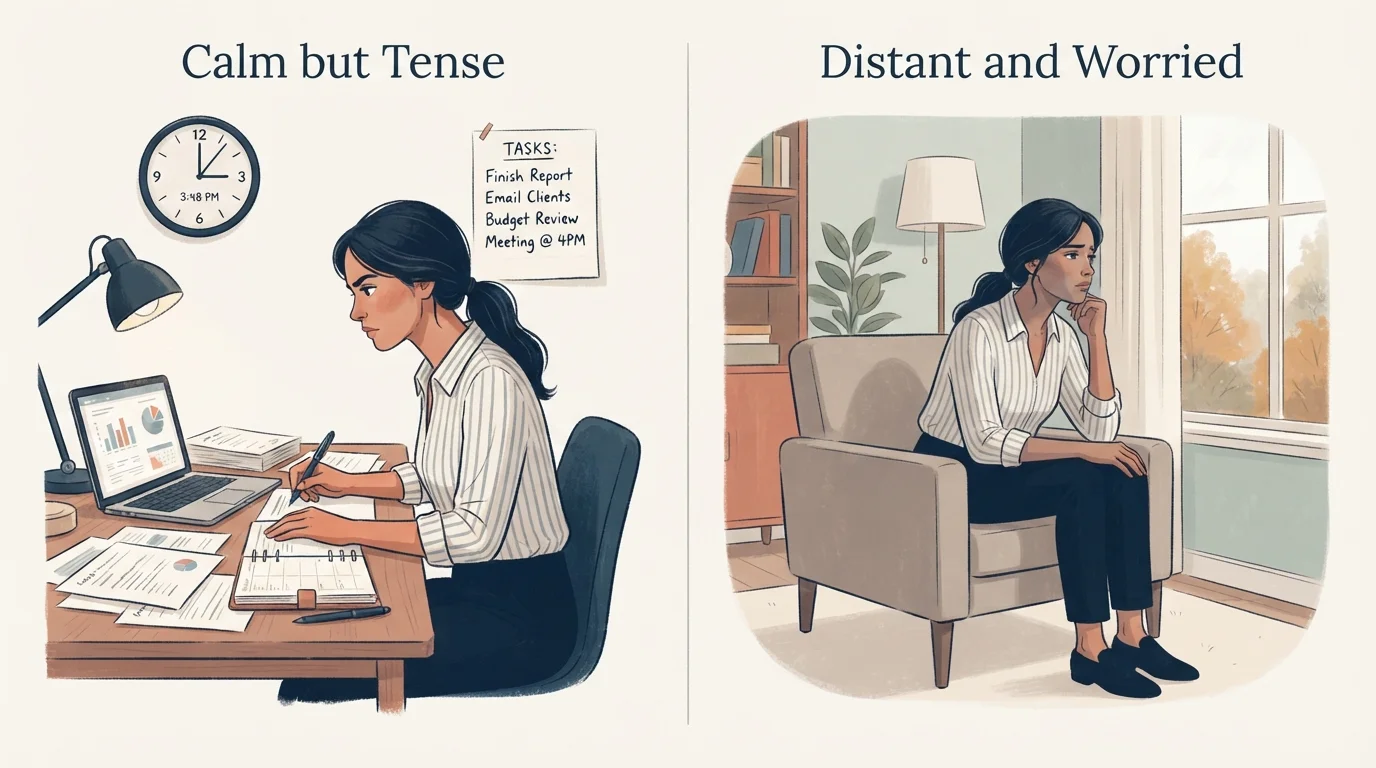
Stress is the body's reaction to an external demand or threat. A looming work deadline, a financial crunch, an argument with a partner - these are stressors. Once the situation resolves, the stress response typically fades with it. It's the body doing exactly what it evolved to do: mobilizing energy and focus to meet a challenge.
Anxiety, by contrast, is characterized by persistent worry or fear that often exists independent of a specific, identifiable trigger. Even when circumstances improve, anxiety can remain - or attach itself to a new concern. Anxiety is an internal state; stress is largely a reaction to something external.
Both involve activation of the body's autonomic nervous system - the so-called fight-or-flight mechanism - which is why they produce overlapping physical sensations. But the origin and duration differ in meaningful ways.
| Criterion | Stress | Anxiety |
|---|---|---|
| Primary cause | External stressor or demand | Internal; often no clear trigger |
| Duration | Resolves when stressor is removed | Can persist without identifiable cause |
| Proportionality | Generally proportionate to situation | Often disproportionate to circumstances |
| Physical symptoms | Tension, fatigue, irritability | Tension, fatigue, restlessness, dread |
| Clinical category | Normal physiological response | Can become a diagnosable disorder |
| Best initial response | Address or reduce the stressor | Therapeutic support; professional evaluation |
Shared Symptoms and Where They Diverge
It's easy to confuse the two because both stress and anxiety can cause muscle tension, sleep problems, irritability, difficulty concentrating, and a racing heart. These are the body's general alarm signals, not unique to either condition.
Where they diverge is in duration and proportionality. Stress tends to be proportionate to a situation and time-limited. Anxiety often feels out of proportion to circumstances - or persists even when no clear threat exists. A person under stress might feel tense before a job interview and fine afterward. A person experiencing anxiety might continue to feel dread for days before and after, or feel it about something far less concrete.
31%
U.S. adults who experience anxiety at some point
According to the National Institute of Mental Health, anxiety disorders are among the most common mental health conditions in the United States.
~1 in 3
People whose chronic stress develops into anxiety
Research published in mental health literature suggests prolonged, unmanaged stress is a recognized risk factor for the development of anxiety disorders.
Anxiety disorders - including generalized anxiety disorder, panic disorder, and social anxiety disorder - are clinical conditions diagnosed by trained mental health professionals. Not all anxiety rises to this level, but repeated or overwhelming anxiety that disrupts your daily life is a signal worth taking seriously. If you find your worry is becoming difficult to carry, our article on signs your stress load has become too heavy can help you gauge when to seek support.
How to Respond to Each
Because stress is situationally driven, practical strategies that address the source tend to work well. Time management, setting boundaries, delegating tasks, and resolving conflicts can directly reduce the stressor - and with it, the stress response.
Anxiety often requires a different approach. Since it isn't always tied to a resolvable external problem, strategies that focus purely on eliminating triggers are less effective. Evidence-based approaches for anxiety include cognitive-behavioral therapy (CBT), mindfulness practices, and in some cases, medication - all of which should be explored with a qualified healthcare provider, not self-prescribed.
Relaxation techniques such as deep breathing, progressive muscle relaxation, and regular aerobic exercise have demonstrated value for both stress and anxiety. They don't eliminate the underlying cause of anxiety, but they can meaningfully reduce its intensity.
When to Talk to a Professional
If anxiety or stress symptoms last more than a few weeks, interfere with work or relationships, or feel unmanageable, it's appropriate to speak with a licensed mental health professional or your primary care provider. You don't need to reach a crisis point to seek help - early support is generally more effective than waiting. Emergency resources such as the 988 Suicide and Crisis Lifeline are also available if you or someone you know needs immediate mental health assistance.
The key point: matching your response to what you're actually experiencing makes a real difference. Treating anxiety as though it's just situational stress - and waiting for circumstances to change - can delay meaningful relief. Similarly, over-pathologizing normal, temporary stress can create unnecessary concern.
This article is for general informational and educational purposes only and is not a substitute for professional medical or mental health advice. If you are concerned about stress, anxiety, or any mental health symptom, please consult a qualified healthcare professional.