

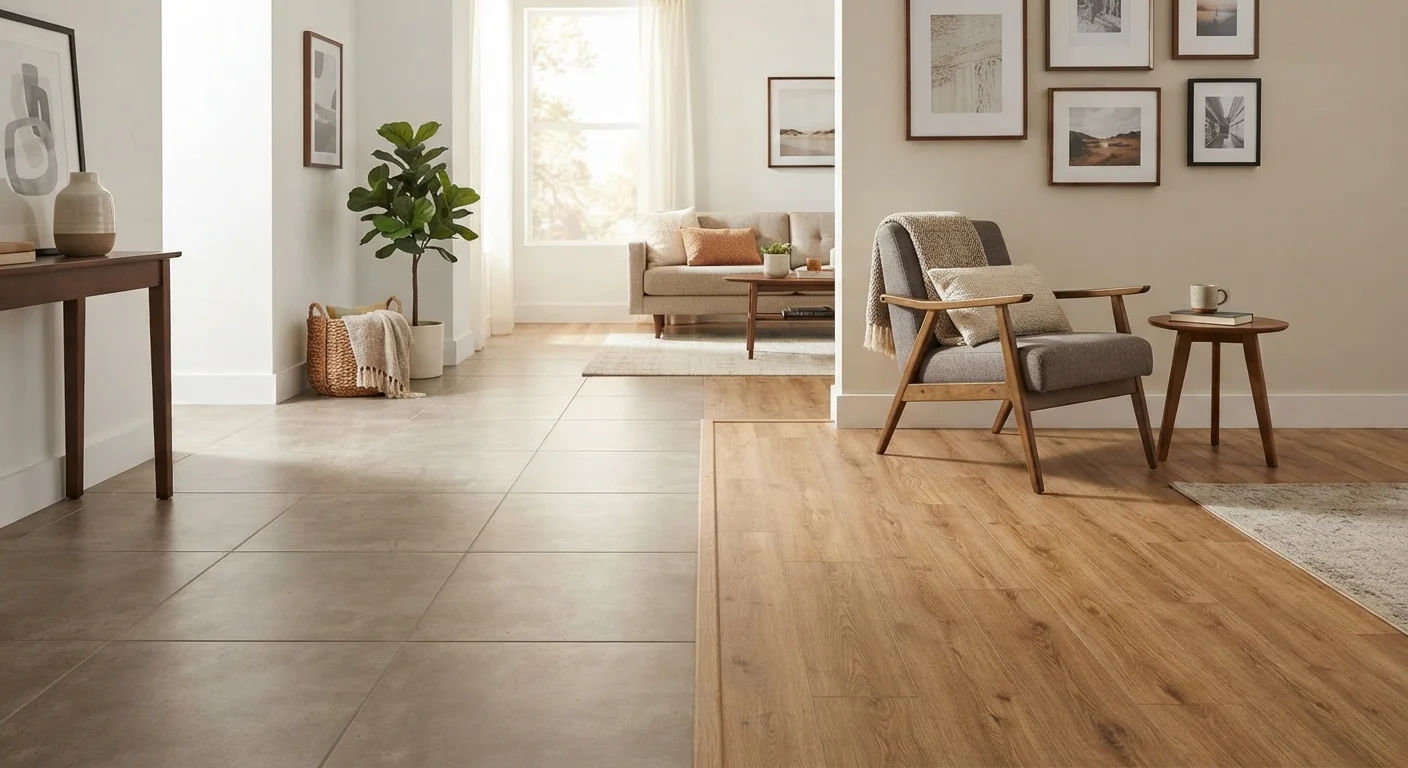
Key Takeaways
- Tile is fully waterproof and nearly indestructible, but cold and hard underfoot - ideal for bathrooms and kitchens.
- LVP installs faster and costs less upfront, making it practical for large living spaces and bedrooms.
- Both handle moisture well, but tile's grout lines require ongoing maintenance to prevent mold.
- LVP can be damaged by prolonged standing water at seams, despite its water-resistant surface.
- Subfloor condition matters for both: tile needs a rigid, level base; LVP needs a flat, smooth surface.
- Neither option is universally superior - the right choice depends heavily on the specific room and how it's used.
Option A
Ceramic or Porcelain Tile
The durable, water-proof classic built to last decades.
Best for: Wet areas, high-traffic zones, and homeowners prioritizing longevity and heat tolerance.
Option B
Luxury Vinyl Plank (LVP)
The comfortable, budget-friendly modern alternative.
Best for: Renters, DIYers, and anyone wanting a warmer underfoot feel with easier installation.
If you're finishing a bathroom or laundry room
Ceramic or Porcelain Tile
Tile is fully waterproof, handles steam and humidity without warping, and holds up to repeated water exposure far better than any vinyl product over the long term.
If you're updating a living room or bedroom on a budget
Luxury Vinyl Plank (LVP)
LVP is warmer, softer underfoot, and significantly easier to install yourself - saving both labor costs and time across larger square footage.
If you have radiant floor heating
Ceramic or Porcelain Tile
Tile conducts and holds heat efficiently, making it the compatible choice. Most LVP products have temperature limits that can compromise the material over time with radiant systems.
If you're a renter or plan to move within a few years
Luxury Vinyl Plank (LVP)
LVP's floating-floor installation is reversible in some cases and far less of a permanent commitment than tile set in mortar.
If you want a kitchen floor that stands up to decades of use
Ceramic or Porcelain Tile
Porcelain tile is scratch-resistant, heat-tolerant, and won't fade under sunlight - all qualities that matter in a busy kitchen over a long time horizon.
Understanding What Each Floor Is Made Of
Before comparing rooms, it helps to understand what these two materials actually are. Ceramic and porcelain tile are fired clay products - dense, rigid, and permanently set into place using mortar and grout. Porcelain is denser and less porous than ceramic, making it even more resistant to water and wear. Both are inorganic, meaning they won't support mold growth on the tile surface itself (grout is a different story).
Luxury Vinyl Plank (LVP) is a multi-layer synthetic product. Its core is typically rigid or semi-rigid PVC, topped with a photographic layer that mimics wood or stone, then sealed with a protective wear layer. Modern LVP products are designed to float over the subfloor rather than being glued or nailed down, which makes installation significantly more accessible for DIYers.
| Criterion | Ceramic / Porcelain Tile | Luxury Vinyl Plank (LVP) |
|---|---|---|
| Water resistance | Fully waterproof surface; grout needs sealing | Water-resistant surface; seams are a vulnerability |
| Durability | Extremely hard; resists scratches and dents | Durable wear layer; can dent under heavy impact |
| Comfort underfoot | Hard and cold | Warmer, slightly cushioned feel |
| DIY installation | Challenging; requires mortar, tile saw, and grout | Moderate; floating click-lock system |
| Typical installed cost | Generally higher, especially with labor | Generally lower overall |
| Radiant heat compatibility | Excellent conductor; fully compatible | Limited; check manufacturer temperature ratings |
| Lifespan | 25-50+ years with proper care | 15-25 years in typical conditions |
| Maintenance | Grout cleaning and periodic sealing required | Simple sweeping and damp mopping |
Bathrooms and Laundry Rooms: Where Tile Has the Clear Edge
Wet rooms are where tile earns its reputation. Porcelain tile is impervious to water when properly installed - shower walls, floors around toilets, and laundry areas all benefit from a material that won't swell, warp, or degrade from repeated moisture exposure. The grout lines are the weak point: they require periodic sealing and cleaning to prevent mold or staining.
LVP is often marketed as waterproof, and the plank surfaces genuinely are. However, water can penetrate the seams between planks and become trapped under the floor - a real concern in rooms where puddles form regularly. In a half-bath with limited water contact, LVP can work well. In a full bathroom or laundry room, tile is the more reliable long-term choice.
Grout Is Not Optional Maintenance
Tile grout is porous and will absorb moisture, soap residue, and mold spores over time if left unsealed. Most tile installers recommend sealing grout lines within 72 hours of installation and resealing every one to three years depending on use. In wet rooms, this step is especially important for preventing black mold from forming in the grout channels.
Kitchens: A Closer Call
Kitchens present moderate moisture, heavy foot traffic, and occasional dropped items. Tile handles all three confidently - it won't scratch from dragged chairs, won't dent from a falling cast iron pan, and stays pristine under spills. The trade-off is comfort: standing on tile for long cooking sessions is noticeably harder on joints, and tile is unforgiving when glassware falls.
LVP offers a warmer, slightly cushioned surface that many cooks prefer during long kitchen sessions. It also installs without the mess of mortar and grout. In kitchens that don't see frequent flooding (most do not), LVP performs reliably. The main risk is the dishwasher or refrigerator: a slow, undetected leak pooling beneath the floor can compromise LVP over time in ways tile would survive.
15-25 years
Typical LVP lifespan in residential use
LVP manufacturers generally rate their products for 15 to 25 years under normal residential conditions, though heavy-use areas may see more wear.
50+ years
Potential lifespan of properly installed porcelain tile
Porcelain tile is among the most durable flooring materials available; when installed correctly and maintained, it routinely outlasts the renovation cycle of the home.
~$3-$7/sq ft
Typical LVP material cost range (general estimate)
Material costs vary by product grade and region; professional installation adds to the total. Always get local quotes before budgeting a project.
Living Rooms and Bedrooms: LVP's Strongest Territory
In rooms with minimal moisture exposure and a priority on comfort, LVP is often the practical winner. Its softer feel underfoot, better acoustic performance (it doesn't amplify the sharp click of footsteps the way tile can), and dramatically easier DIY installation make it well-suited to bedrooms, hallways, and living spaces.
Tile can absolutely work in these rooms - and in warmer climates, its cooling surface is a genuine asset. But the cost of professional tile installation, combined with the cold, hard surface, means many homeowners find LVP a more livable choice for rooms where comfort and cost both matter.
One practical note on subfloors: tile demands a very rigid, flat base. Any flex in the subfloor will eventually crack grout or even tile. LVP is more forgiving of minor imperfections but still requires a smooth, level surface to prevent the planks from shifting or developing hollow spots underfoot.