

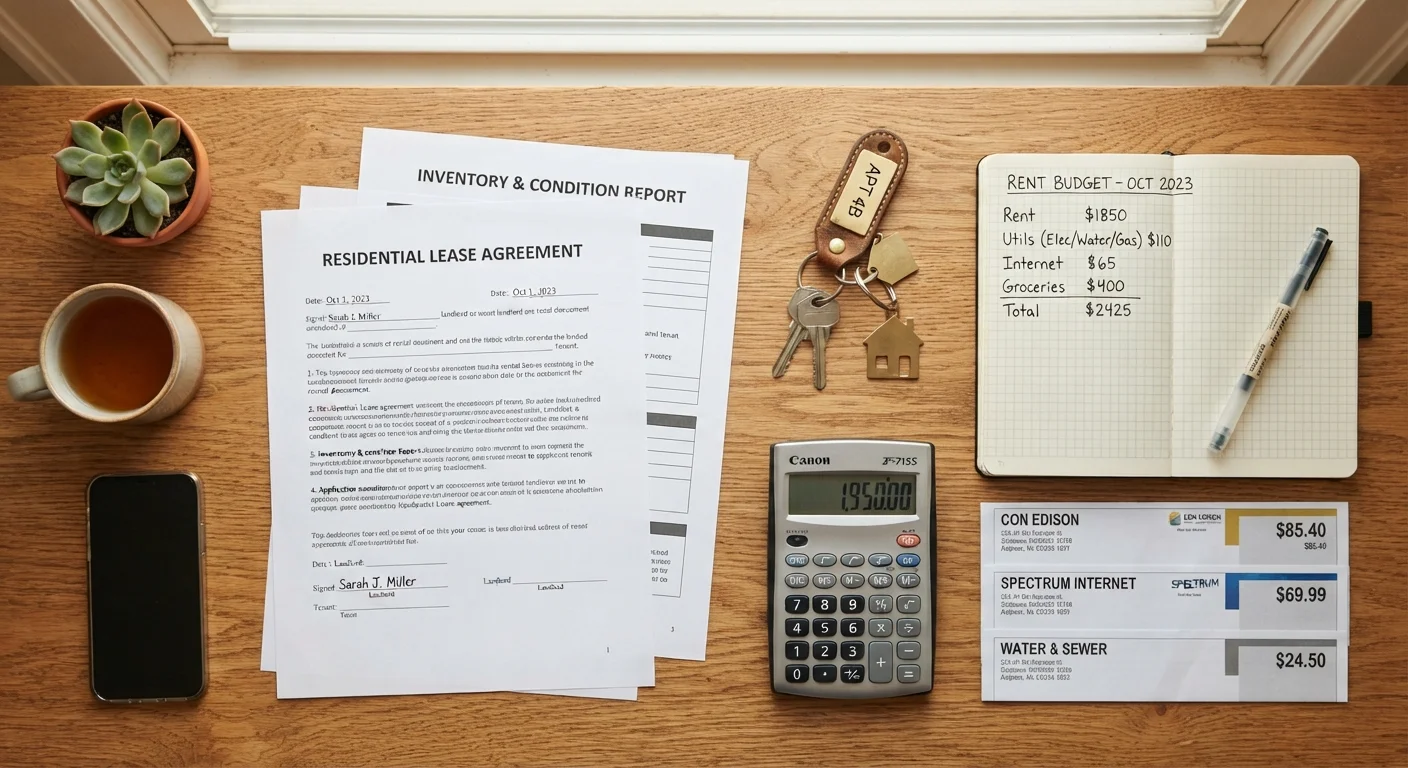
Key Takeaways
- Monthly rent rarely reflects what you'll actually pay - add-on costs can increase your housing spend by hundreds of dollars.
- Move-in costs like security deposits and application fees can easily exceed two months' rent before you unpack a single box.
- Utilities, parking, pet fees, and renters insurance are common recurring charges that belong in your monthly budget.
- Reading the full lease before signing is the most effective way to identify hidden fees.
- Comparing apartments on total cost - not just rent - leads to more accurate financial decisions.
True Cost of Renting
The true cost of renting is the total amount a tenant actually pays to occupy a rental unit, beyond the advertised monthly rent. It includes one-time move-in expenses, recurring monthly charges, and ongoing costs that landlords often don't advertise upfront. Understanding this full picture helps renters budget accurately and avoid financial surprises.
Housing cost burden is typically measured as rent-to-income ratio; the US Department of Housing and Urban Development (HUD) considers households spending more than 30% of gross income on housing to be cost-burdened - a threshold that becomes easier to cross once all rental costs are included.
What the Advertised Rent Number Doesn't Tell You
When you see a listing for a $1,800-per-month apartment, it's natural to assume that's your monthly housing cost. In reality, that figure is typically a floor, not a ceiling. Renters routinely pay 15% to 40% more than the base rent once all associated costs are factored in.
This matters especially for first-time renters. As our guide to renting for the first time explains, understanding the full financial picture before you sign a lease is one of the most important steps in the process. The gaps between advertised rent and actual monthly outlay can catch even experienced renters off guard.
30%
HUD's housing cost-burden threshold
The US Department of Housing and Urban Development considers households spending over 30% of gross income on housing to be cost-burdened - a threshold more renters are crossing as total costs rise.
$4,000-$6,000
Typical move-in cost range
Combining security deposits, first and last month's rent, and application fees, upfront costs for a moderately priced US apartment commonly fall in this range before any moving expenses.
$150-$400+
Monthly add-on costs beyond base rent
Utilities, parking, pet fees, renters insurance, and internet can collectively add this amount to a renter's monthly housing spend, depending on location and unit type.
Move-In Costs: The Upfront Expense Surge
Before you receive your keys, you'll likely owe a substantial lump sum. These one-time costs include:
- Security deposit: Typically equal to one to two months' rent, held by the landlord and returned at move-out if the unit is left in good condition. Rules on deductions and timelines are governed by state law.
- First and last month's rent: Many landlords require both upfront, meaning you could pay three months' worth of rent before moving in a single piece of furniture.
- Application fees: These cover background and credit checks, usually ranging from $25 to $75 per adult applicant. These are almost always non-refundable, even if you're denied.
- Administrative or move-in fees: Some buildings charge separate fees for elevator reservations, building access setups, or administrative processing.
Combined, move-in costs of $4,000 to $6,000 are not unusual for a moderately priced apartment in a mid-sized US city.
Ask for a Full Move-In Cost Estimate in Writing
Before submitting an application, ask the landlord or property manager for an itemized list of all fees due at signing and move-in. This should include the security deposit amount, any administrative charges, and what utilities - if any - are included in the lease. Having this in writing protects you and makes budgeting far more accurate.
Recurring Monthly Costs Beyond the Base Rent
Once you're settled in, a set of recurring charges chips away at your budget each month. These are the costs most renters underestimate when comparing apartments:
- Utilities
- Electricity, gas, water, sewer, and trash can collectively add $100 to $300 or more per month depending on climate, unit size, and what the landlord covers. Always ask for average utility costs for the specific unit before committing.
- Internet and cable
- Budget $50 to $100 per month for broadband. Some buildings include basic internet as an amenity; most don't.
- Parking
- In dense urban areas, a dedicated parking space can run $75 to $300 or more monthly. Even suburban complexes sometimes charge separately for covered or garage parking.
- Pet fees
- Pet-friendly units often charge a non-refundable pet fee ($200 to $500) plus ongoing monthly pet rent ($25 to $75 per animal).
- Renters insurance
- A standard policy costs roughly $15 to $30 per month and covers personal property loss, liability, and temporary displacement if the unit becomes uninhabitable. Many landlords now require proof of coverage as a lease condition.
- Laundry and amenity fees
- In-unit laundry is a premium feature; shared laundry facilities often operate on pay-per-use systems. Some buildings also charge for gym or amenity access.
Utility Costs Vary Widely by Region and Season
A renter in Phoenix will spend considerably more on cooling in summer than one in Seattle; a Minneapolis tenant will face higher heating bills in winter. When evaluating a new apartment, ask the landlord for utility bills from the previous 12 months or request average costs from the utility provider directly. A single month's estimate rarely captures the full annual range.
How to Build a Realistic Rental Budget
Rather than comparing apartments by monthly rent alone, compare them by total monthly cost. A useful approach is to create a side-by-side breakdown for each unit you're seriously considering, listing every known recurring charge alongside the base rent.
It's also worth benchmarking your total housing cost against your income. HUD's 30% threshold offers a baseline, but it's a guideline rather than a rule - your personal financial obligations, savings goals, and local market conditions all matter. If total rental costs consistently exceed 35% of your gross income, you may want to explore different neighborhoods, unit sizes, or roommate arrangements before committing.
The lease itself is your most important document. Read it in full before signing, with particular attention to sections on fees, utilities, renewal terms, and early termination penalties. What's in the lease is what governs your tenancy - verbal assurances from a landlord carry little legal weight.
For broader context on how renting compares financially to owning, see our analysis of the rent vs. buy trade-offs or explore the current US housing market for context on rental pricing trends by region.
This article is for general informational purposes only and does not constitute financial, legal, or housing advice. Rental laws, fee structures, and market conditions vary by state and locality. Consult a qualified professional for guidance specific to your situation.