

Key Takeaways
- Soundbars are compact, simple to set up, and work well in smaller or open-plan rooms.
- Full home theater systems deliver true multi-channel surround sound but require more space and wiring.
- Room size, seating arrangement, and how much you'll notice audio quality all drive the right choice.
- A soundbar with a subwoofer can close some of the gap with entry-level home theater setups.
- Neither option is universally superior - match the system to your actual listening environment.
Our Verdict
Soundbars excel in smaller spaces, simplified setups, and households where visual clutter is a concern. Full home theater systems reward dedicated rooms and listeners who want authentic surround sound immersion. The right choice depends on your room dimensions, tolerance for setup complexity, and how central audio quality is to your everyday viewing.
| Best for | Recommended |
|---|---|
| Apartment dwellers or smaller living rooms | Soundbar |
| Dedicated home theater or media room | Home Theater System |
| Renters or those who move frequently | Soundbar |
| Serious movie and music enthusiasts with a fixed setup | Home Theater System |
What Each System Actually Does
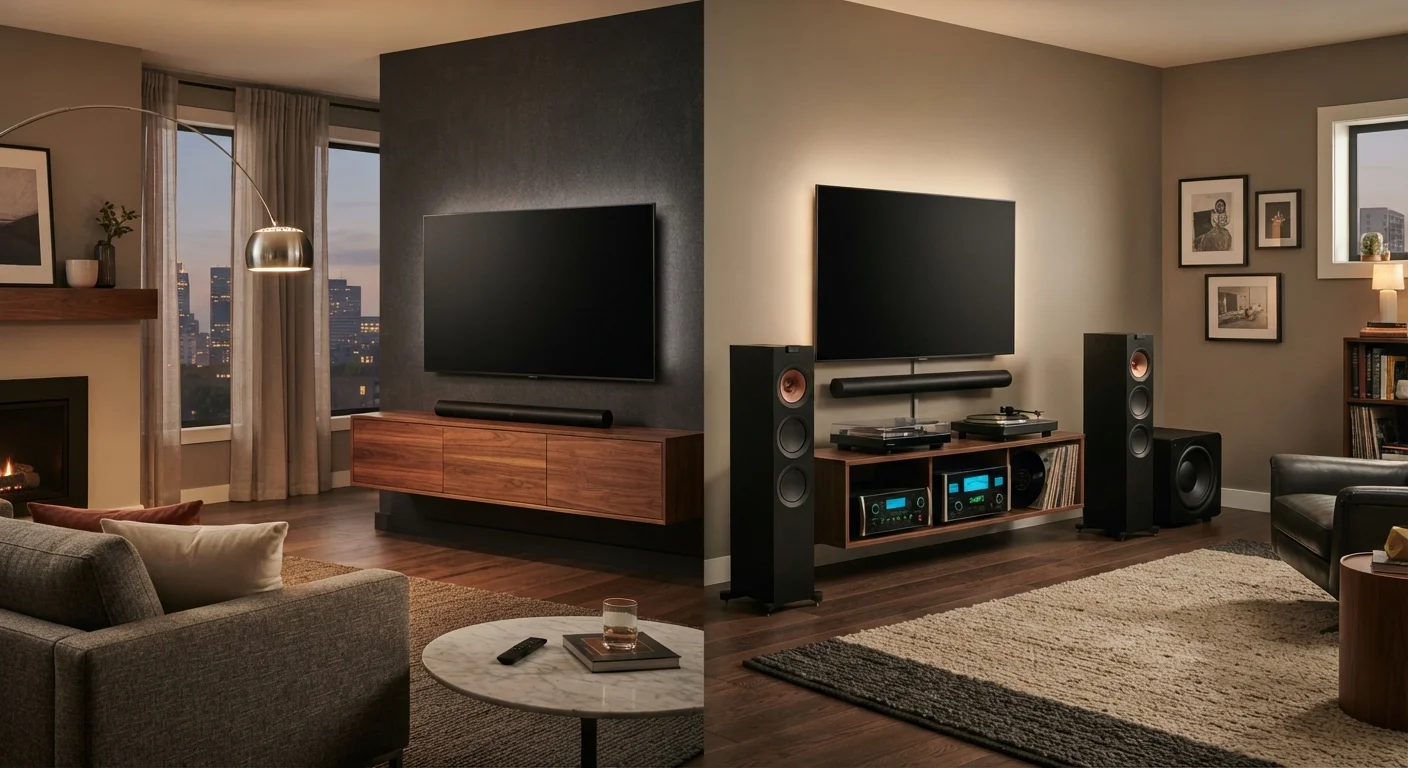
A soundbar is a single elongated speaker enclosure - sometimes paired with a separate wireless subwoofer - that sits in front of or below your TV. It uses internal speaker drivers and digital signal processing (DSP) to simulate width and, on higher-end models, height. The result is noticeably better audio than built-in TV speakers without adding multiple components to your room.
A home theater system (sometimes called a surround sound system) places physically separate speakers around the listener - typically a center channel, front left and right, rear surrounds, and a subwoofer, following the common 5.1 configuration. Each speaker handles its own audio channel, creating directional sound that genuinely comes from different parts of the room. An AV receiver acts as the hub, decoding audio formats and powering all the speakers.
The core difference is physical placement versus simulated placement. Both can deliver satisfying sound; what changes is how faithfully they reproduce the audio engineers' original intent.
Room Size and Layout Matter More Than Most Buyers Expect
Soundbars were designed with real-world living spaces in mind. In a room under roughly 300 square feet, or where seating is close to the TV, a soundbar can fill the space comfortably. Simulated surround effects also work better at closer listening distances, where your ears can be fooled more easily by reflected sound.
Home theater systems genuinely shine in larger, more acoustically defined spaces. Rooms with hard floors, high ceilings, or open floor plans can scatter sound unpredictably - and placing real speakers around the perimeter gives you control over where sound originates, rather than relying on reflections. Dedicated rooms with acoustic treatment get the most out of a full setup.
Test Your Room Before Deciding
Before committing to either system, stand at your typical seating position and clap once sharply. If the sound decays quickly and feels "dead," your room has good absorption and will suit a home theater system well. If you hear a prolonged echo or slap-back, hard surfaces may work against surround placement. A soundbar's front-focused output is often more forgiving in highly reflective rooms.
Renters and those who move often should weigh portability carefully. Soundbars typically require minimal installation, while running speaker wire through walls or managing a six-speaker layout across multiple rooms is a much larger undertaking each time you relocate.
Comparing the Two Approaches
The table below breaks down how soundbars and home theater systems compare across criteria that matter most for typical households.
| Soundbar | Home Theater System | |
|---|---|---|
| Installation effort | Minimal - one or two cables | Moderate to high - multiple speakers and wiring |
| Space required | Small footprint, suits any room | Needs space for speakers at multiple positions |
| Surround sound accuracy | Simulated via DSP | True multi-channel from physical speakers |
| Audio upgrade path | Limited - replace entire unit | Modular - swap individual components |
| Best room size | Small to medium rooms | Medium to large or dedicated rooms |
| Typical complexity | Plug-and-play | Requires calibration and positioning |
| Visual clutter | Very low | Higher - multiple units and cables |
One factor the table can't fully capture: listening habits. If you primarily stream TV shows and casual music, even a mid-range soundbar will feel like a major upgrade over TV speakers. If you regularly watch films with complex soundtracks and want to notice a helicopter pass behind you, dedicated rear speakers make a tangible difference that DSP cannot fully replicate.
Setup Complexity and Long-Term Flexibility
Soundbars typically connect to a TV via a single HDMI ARC (Audio Return Channel) or optical cable. Configuration rarely goes beyond adjusting bass levels and selecting an audio mode. Most users are up and running within fifteen minutes.
Home theater systems involve considerably more steps: routing speaker wire or pairing wireless modules, positioning each speaker to manufacturer specifications, running an automated room calibration (available on many modern receivers), and matching amplifier power to speaker sensitivity ratings. The payoff is a system you can upgrade component by component over time - replace just the front speakers, add a better subwoofer, or swap the receiver - without starting from scratch.
If you're also thinking about the connection between your audio components, our guide to wired vs. wireless audio covers how cable and wireless connections each affect signal quality and reliability, which becomes relevant when choosing between wired speaker runs and wireless surround modules.
Avoid Overbuying for Your Actual Room
A high-channel home theater system (7.1 or Dolby Atmos configurations with ceiling speakers) requires careful room dimensions and seating distances to work as intended. Placing a system designed for a 500-square-foot room into a 150-square-foot space often results in muddied, overwhelming bass and poor stereo imaging. Match the system's channel count and power output to the room - more channels are not automatically better.