

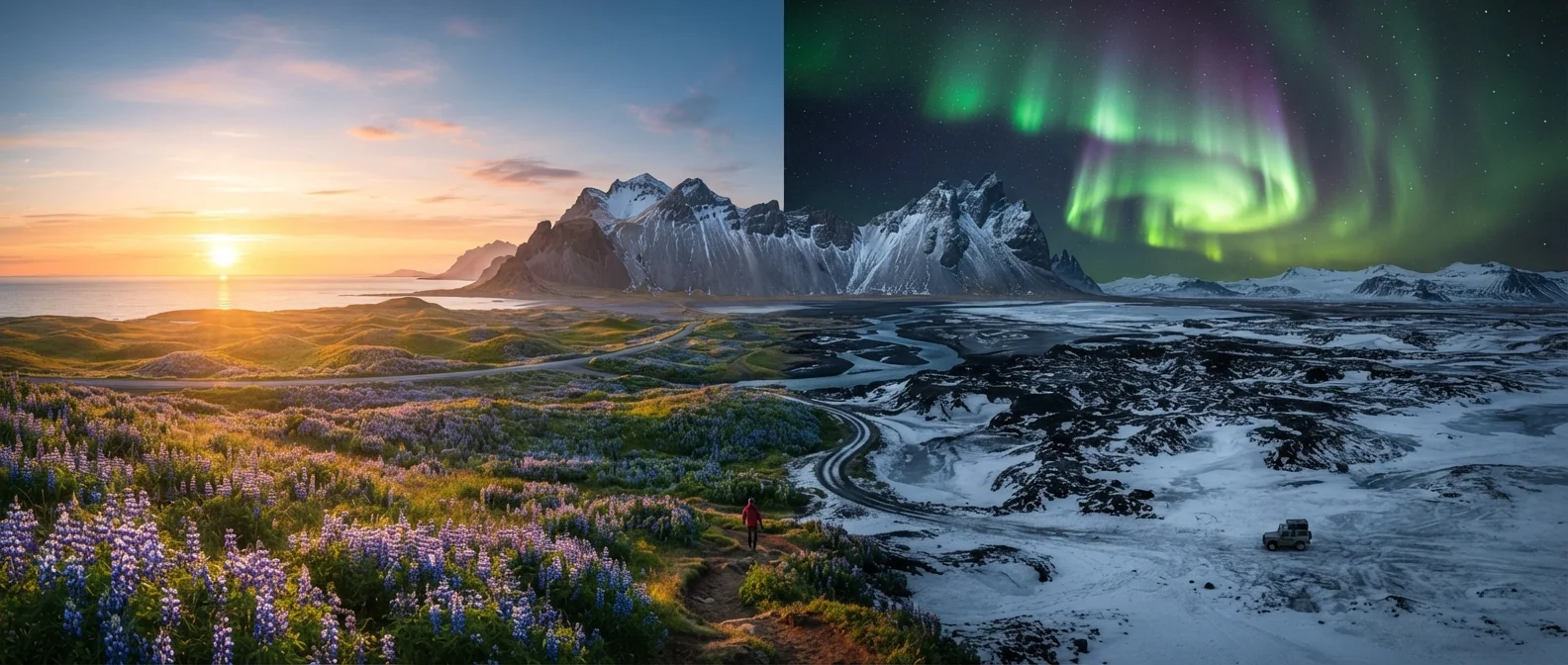
Key Takeaways
- Summer offers near-24-hour daylight, fully open highland roads, and peak crowds at major sites.
- Winter brings the best chances for northern lights but limits driving and closes many attractions.
- Accommodation and flights typically cost more in summer; winter can offer more value in certain categories.
- Ice caves in glaciers are only safely accessible in winter months, roughly November through March.
- Both seasons require flexible itineraries - Icelandic weather changes rapidly regardless of time of year.
- Shoulder seasons (April-May, September-October) can blend the advantages of both with fewer tradeoffs.
Option A
Iceland in Summer
The accessible, action-packed season under endless daylight.
Best for: Hikers, road-trippers, and first-timers who want maximum daylight and open roads.
Option B
Iceland in Winter
The dramatic, atmospheric season built for aurora chasers and solitude seekers.
Best for: Travelers chasing northern lights, ice caves, and a quieter, more raw Iceland.
If you want to drive the entire Ring Road and explore highland interiors
Iceland in Summer
The F-roads (highland tracks) only open when snow clears, typically June through September. Summer also gives you the daylight to cover long driving distances without time pressure.
If seeing the northern lights is your primary goal
Iceland in Winter
Auroras require darkness, which simply doesn't exist in Iceland's summer. Winter nights are long and dark - ideal conditions when skies are clear.
If you prefer smaller crowds and a quieter experience
Iceland in Winter
Tourist volume drops significantly after October. Popular spots like the Golden Circle feel far more manageable outside of peak summer months.
If you're traveling with young children or mobility considerations
Iceland in Summer
Warmer temperatures, icy-road-free driving, and longer operating hours at attractions make summer far easier for families and those with physical limitations.
If experiencing glacier ice caves is on your bucket list
Iceland in Winter
Natural ice caves inside glaciers like Vatnajökull are only considered safe for guided tours during winter when the ice is stable and frozen.
Daylight: The Factor That Changes Everything
Nothing reshapes an Icelandic trip quite like the sun's schedule. In mid-June, Reykjavík experiences roughly 22 hours of daylight - the famous midnight sun means it never truly gets dark. This is exhilarating and disorienting in equal measure. You can hike a trail at 11 p.m. in full light, which stretches what's possible in a single day dramatically.
Winter flips this completely. By December, Reykjavík sees only four to five hours of usable daylight. If you're planning to photograph waterfalls, drive scenic routes, or hike, your window is narrow. That darkness, however, is exactly what opens up the aurora borealis - a phenomenon that draws thousands of visitors specifically for the winter experience. Auroras are unpredictable; a clear, dark sky between September and March gives you a realistic shot, but nothing is guaranteed.
The honest takeaway: summer gives you time, winter gives you atmosphere. Your priorities should drive the choice.
Roads, Access, and Getting Around
Iceland's road network isn't equally available year-round. The F-roads - unpaved highland tracks leading to the interior landscapes like Landmannalaugar and Þórsmörk - are legally off-limits to standard vehicles and physically impassable until snow melts, typically June. Attempting them outside that window risks both your safety and significant fines.
The Ring Road (Route 1) stays open year-round, but winter driving is genuinely challenging. Ice, snow, and sudden whiteouts are real factors. If you plan to rent a car in winter, four-wheel drive and experience with icy roads aren't optional extras - they're practical necessities. Always check road conditions at road.is before setting out, regardless of season.
| Criterion | Iceland in Summer | Iceland in Winter |
|---|---|---|
| Daylight hours | Up to 22+ hours | 4-5 hours (December) |
| Northern lights visibility | Not possible | Best chance (Sept-Mar) |
| Highland F-roads | Open (June-Sept) | Closed |
| Ice cave access | Not available | Available (Nov-Mar) |
| Crowd levels | Peak - very busy | Much quieter |
| Driving difficulty | Generally straightforward | Challenging; ice and snow likely |
| Typical accommodation cost | Higher (peak season) | Lower outside Reykjavík |
| Wildlife highlights | Puffins, Arctic terns | Reindeer more visible |
For travelers who prefer not to drive, summer brings more frequent and varied bus and tour connections. Winter tour options are more limited but focused - think glacier walks, snowmobile trips, and aurora tours by jeep.
Crowds, Costs, and Logistics
Iceland has seen dramatic tourism growth in recent years, and the summer crunch at headline sites - the Blue Lagoon, Seljalandsfoss, the Golden Circle - is real. Parking lots fill early, walking paths get congested, and accommodation in popular areas can book out months in advance. Prices for flights and hotels peak in June, July, and August.
Winter quiets things down considerably, though it's worth noting that Reykjavík remains a popular city-break destination even in December. Accommodation outside the capital is easier to secure, and you'll often share iconic spots with far fewer people. That said, some rural guesthouses and restaurants close in the off-season - always verify operating dates before committing to a specific itinerary.
For a middle path, understanding what shoulder season means for a destination like Iceland can help you find timing that avoids the worst of both - see also our broader look at the tradeoffs of off-peak travel timing.
A Note on Weather Expectations
Iceland's weather is famously unpredictable in every season. Summer can bring rain, wind, and chilly temperatures even in July - packing layers is essential year-round. Winter storms can ground flights and close roads with little notice. Build buffer days into any Iceland itinerary and check local forecasts (vedur.is) regularly. Flexibility isn't optional - it's part of traveling here well.
Unique Experiences You Can Only Get in One Season
Some of Iceland's most memorable experiences are strictly seasonal. In summer: puffin-watching (the birds nest on Icelandic cliffs from May through August), lupine flower fields in full purple bloom, and river rafting in the glacial rivers of the north. The midnight sun itself is an experience worth building a trip around - sitting beside a waterfall at 1 a.m. in warm golden light is something few places on Earth offer.
In winter, the draw is equally compelling but different in character. Natural glacier ice caves - the electric-blue chambers inside Vatnajökull - are only safely accessible from roughly November through March when temperatures keep the ice stable. Reindeer are more visible in east Iceland during winter. And the stark, snow-covered lava fields create a landscape that feels genuinely otherworldly.
Neither season has a monopoly on beauty - they're simply showing you different versions of the same remarkable country.