

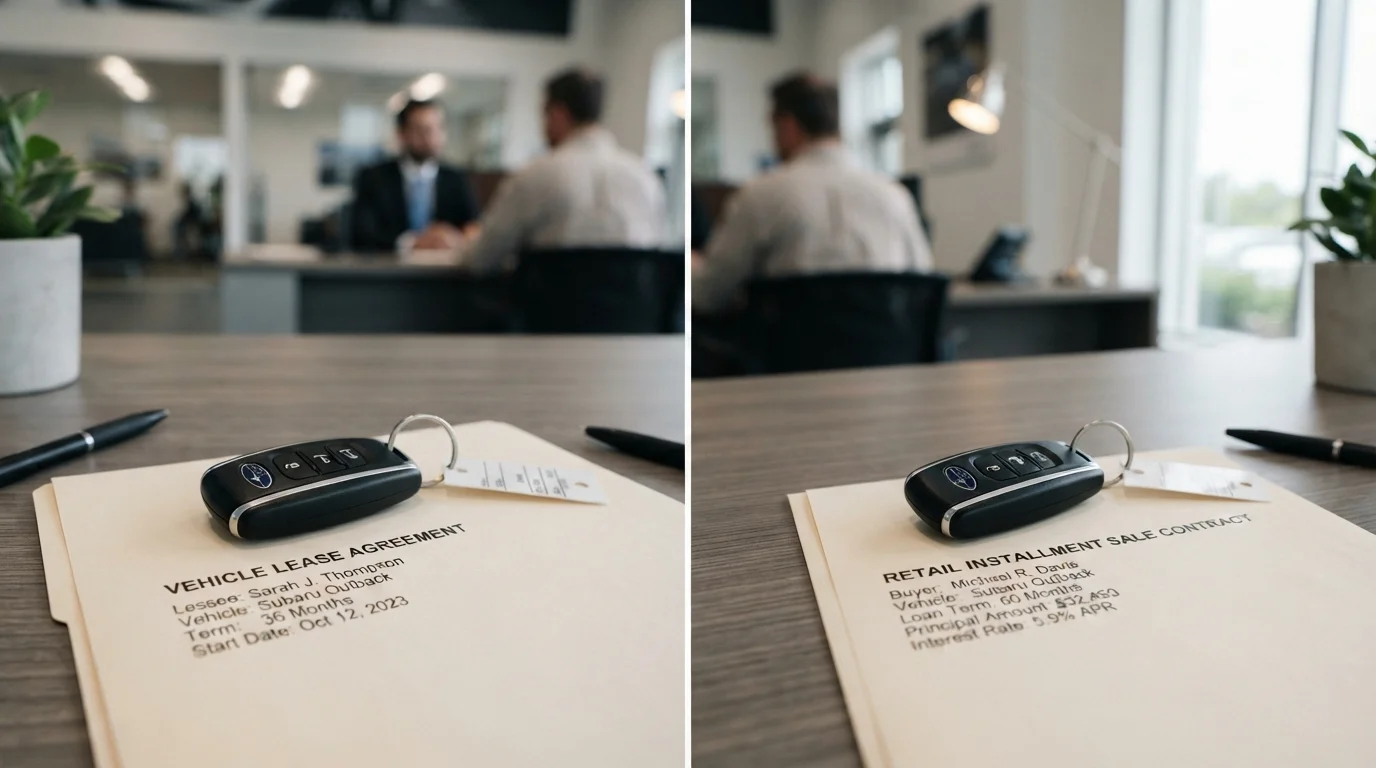
Key Takeaways
- A lease makes you a long-term renter; a loan puts you on a path to full vehicle ownership.
- Leases impose mileage limits and return conditions that can trigger significant end-of-term fees.
- Loan holders can modify, sell, or trade their vehicle at any time once the lien is satisfied.
- Insurance requirements are generally stricter under a lease than a standard financed arrangement.
- Monthly lease payments are typically lower, but total cost over time often favors financing for long-term drivers.
- Early exit from either agreement carries financial consequences, but lease early termination tends to be more costly.
Option A
Car Lease
The structured, lower-upfront access arrangement.
Best for: Drivers who prefer lower monthly payments, want a new vehicle every few years, and drive predictable annual mileage.
Option B
Car Loan (Financing)
The ownership-building, long-term commitment.
Best for: Drivers who want to build equity, drive without mileage restrictions, and plan to keep a vehicle well past the loan payoff date.
If you drive under 12,000-15,000 miles per year and want a newer vehicle every two to three years
Car Lease
Leases are structured around predictable, lower-mileage use and automatically transition you to a new vehicle at term end without the hassle of selling.
If you drive heavily, take road trips frequently, or use your vehicle for work
Car Loan (Financing)
Financing removes mileage anxiety entirely. Once the loan is paid, you own the vehicle outright and face no per-mile penalties.
If you want to customize or modify your vehicle
Car Loan (Financing)
A leased vehicle must be returned in near-original condition. Financing gives you full discretion over modifications once any lien is clear.
If managing monthly cash flow is a primary concern in the near term
Car Lease
Lease payments are generally lower than loan payments on a comparable vehicle because you're only paying for depreciation during the lease term.
If building long-term asset value and reducing recurring vehicle costs matters most
Car Loan (Financing)
After loan payoff, you own a vehicle with no further payment obligations, potentially reducing your transportation costs significantly over time.
What You Actually Own - and What You Don't
The most consequential difference between leasing and financing isn't the monthly payment - it's what you legally control from day one. When you finance a vehicle, the lender holds a lien against the title, but you are the registered owner. As you make payments, you build equity. Once the loan is paid off, the lien is released and the title is yours free and clear. For a plain-language breakdown of what titles and liens mean in practice, see our guide to vehicle registration, titles, and liens.
A lease works differently at its core. The leasing company - typically the automaker's financial arm or a bank - retains ownership throughout the term. You are granted the right to use the vehicle under specific conditions. There is no equity accumulation, no title transfer in progress, and no ownership stake being built. Think of it as a long-term, structured rental with clearly defined rules.
| Criterion | Car Lease | Car Loan (Financing) |
|---|---|---|
| Ownership | Leasing company retains title | Driver is owner; lender holds lien |
| Equity built | None | Yes, grows with each payment |
| Monthly payment | Generally lower | Generally higher |
| Mileage limits | Yes - typically 10,000-15,000/yr | None |
| Customisation allowed | No - must return as received | Yes, at owner's discretion |
| End-of-term options | Return, buy out, or re-lease | Full ownership - keep, sell, or trade |
| Early exit cost | High - significant penalties common | Moderate - pay remaining principal |
| Gap coverage | Usually required by lessor | Optional (lender may suggest) |
Day-to-Day Responsibilities: Maintenance, Insurance, and Restrictions
Leases typically require you to maintain the vehicle according to the manufacturer's schedule and return it in good condition - a standard defined by the leasing company, not just common sense. Excess wear, whether that means a cracked bumper, stained upholstery, or tires worn below a set tread depth, can result in charges at turn-in. Lessees are usually required to carry gap coverage (which pays the difference between the vehicle's market value and the remaining lease balance if it's totaled) and higher liability limits than some financed owners choose to carry.
Financed drivers have more latitude. They can choose their own insurance levels above state-required minimums (though lenders typically require comprehensive and collision coverage while a loan is active), skip gap coverage if they choose to accept the risk, and let normal wear accumulate without a penalty checklist waiting at the end.
Mileage is the other daily constraint that only lease drivers face. Most leases are written for 10,000-15,000 miles per year. Exceeding that cap triggers a per-mile fee - commonly ranging from 10 to 25 cents per mile - that can add up to hundreds or thousands of dollars at turn-in. Financed drivers face no such cap.
Lease Agreements: Read the Fine Print
Lease contracts contain specific definitions for 'excess wear and tear' that vary by leasing company. Before signing, ask for the company's written wear guidelines and understand exactly what condition the vehicle must be in at return. Some contracts also include disposition fees - a flat charge simply for returning the vehicle - that are easy to overlook during negotiation.
End-of-Term: Your Options When the Agreement Closes
When a loan term ends, the outcome is straightforward: you own the vehicle. You can keep driving it, sell it privately, trade it in, or use it as a down payment on a new purchase. Drivers who pay off a vehicle and continue driving it debt-free often find this the most cost-effective long-term outcome.
At lease end, you face a structured decision: return the vehicle, purchase it at a pre-agreed residual value, or (if your contract allows) roll into a new lease. Returning the vehicle means a thorough inspection and potential fees for excess wear or mileage overages. Buying out the lease can make financial sense if the market value of the vehicle has risen above the residual price - but it requires arranging separate financing or paying cash at that point.
Early exit is painful on both paths, but generally more so with a lease. Loan payoff early is usually straightforward - you pay the remaining principal, and the lien is released. Lease early termination typically involves penalties that can equal several months of remaining payments, since the leasing company built its revenue assumptions into the full term. If you're setting out on your ownership journey for the first time, the New Driver's Roadmap to Car Ownership walks through these and other foundational decisions in detail.
~30%
Share of new vehicle transactions structured as leases
Experian's State of the Automotive Finance Market reports have consistently shown leasing representing roughly a quarter to a third of new vehicle transactions in recent years.
10-25¢
Typical per-mile overage fee on a lease
Most standard lease agreements in the US specify a per-mile penalty in this range, which can compound significantly over a multi-year term for high-mileage drivers.