

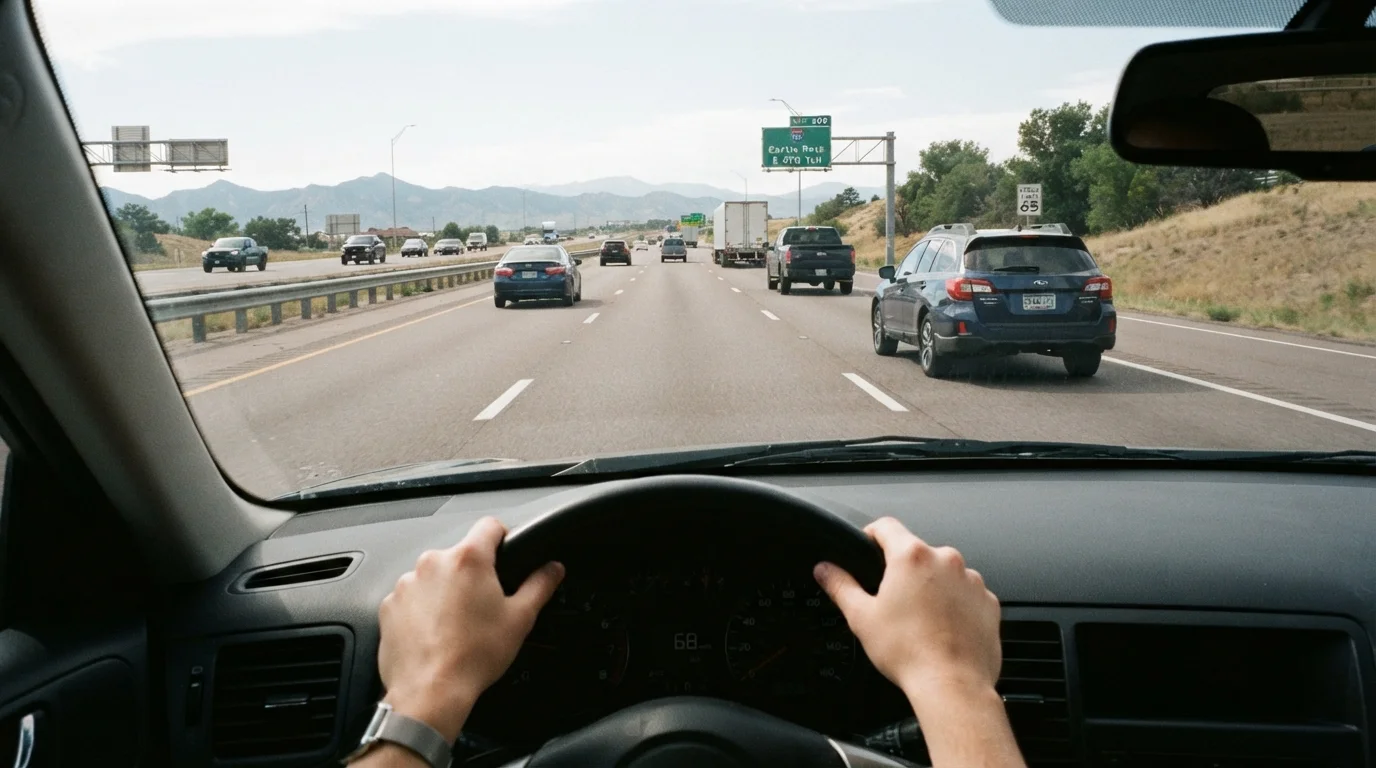
Key Takeaways
- Defensive driving means anticipating hazards rather than just reacting to them after they appear.
- Maintaining a 3-second following distance gives your brain and body time to respond safely.
- Scanning the road 12 seconds ahead is a proven technique for spotting developing hazards early.
- Intersections, highway merges, and adverse weather are where defensive habits matter most.
- Consistent practice - not occasional effort - is what turns these skills into reliable habits.
Start here
What Defensive Driving Actually Means
Next
The Core Principles in Practice
Then
Hazard Perception and the 12-Second Rule
Apply it
Where Defensive Driving Makes the Biggest Difference
Long term
Building the Habit Over Time
What Defensive Driving Actually Means
Most drivers think of themselves as safe - they stop at red lights, use turn signals, and avoid obvious risks. But defensive driving is a different skill set altogether. It's the practice of operating a vehicle in a way that anticipates hazards and preserves your ability to respond, rather than simply reacting to events as they unfold.
The phrase is often used loosely, but at its core, defensive driving rests on one idea: you cannot control other drivers, road conditions, or unexpected events, but you can control your positioning, speed, and attention. By managing those three variables deliberately, you dramatically reduce the scenarios that can escalate into a crash.
This isn't a passive mindset. It requires active, continuous observation - reading traffic patterns, identifying escape routes, and adjusting well before a hazard becomes urgent. For a deeper look at how risk varies across different driver profiles, see how driving risk evolves across life stages.
The Core Principles in Practice
Defensive driving is built on a small set of principles that compound into significantly safer behavior:
- Maintain a safe following distance. The widely recommended baseline is three seconds between you and the vehicle ahead. Pick a fixed object on the roadside; when the car in front passes it, you should reach it no sooner than three seconds later. Wet roads, poor visibility, or a heavy load each warrant adding another second or more.
- Manage your speed to conditions. Posted speed limits reflect ideal conditions. Rain, fog, construction, or heavy pedestrian traffic all call for lower speeds - not as a legal requirement but as a practical margin of safety.
- Eliminate distractions. Cognitive load from a phone conversation - even hands-free - measurably slows reaction time. Defensive drivers treat attention as their most finite resource and protect it accordingly.
- Assume errors from others. Approaching every intersection with the assumption that someone may run the light sounds paranoid; in practice, it simply means slowing slightly and confirming cross-traffic has stopped before proceeding.
Practice the Three-Second Count Today
On your next drive, pick a highway sign, shadow line, or any fixed object on the side of the road. When the vehicle ahead passes it, count: 'one-one-thousand, two-one-thousand, three-one-thousand.' If you reach the object before finishing, ease off the accelerator. This simple exercise builds the habit of distance awareness quickly and requires no special conditions.
Hazard Perception and the 12-Second Rule
One of the most practical tools in defensive driving is the 12-second visual lead: train your eyes to routinely scan the road approximately 12 seconds of travel time ahead. At 30 mph, that's roughly 500 feet; at highway speeds, it's closer to 1,200 feet. Most drivers focus only on the car directly in front of them.
Scanning further ahead lets you spot developing situations - a merging truck, a cyclist entering the shoulder, brake lights rippling backward through traffic - while you still have time and space to respond gradually rather than abruptly.
Pair this with frequent mirror checks. A common recommendation is to glance at your mirrors every five to eight seconds, ensuring you always have an updated mental map of the vehicles around you. This matters especially at night, when depth perception and reaction time are reduced. Our guide on night driving blind spots covers the specific ways low-light conditions change the challenge.
Where Defensive Driving Makes the Biggest Difference
Certain driving environments are where defensive habits deliver the clearest benefit:
- Intersections
- More crashes occur at intersections than any other road segment. Cover your brake as you approach, confirm all lanes have cleared, and don't accelerate the instant the light turns green.
- Highway merges
- Adjust your speed early to create a gap rather than forcing a late merge. Be equally alert to vehicles merging into your lane unexpectedly.
- Following an aggressive driver
- Increase your following distance and, if possible, change lanes to create separation. Engagement rarely improves the situation. Evidence-informed strategies for managing aggressive drivers can help you respond calmly.
- Adverse weather
- Rain, ice, and fog each alter how your vehicle behaves. Understanding what your vehicle's safety systems can and cannot do in these conditions matters - see what traction control and ABS actually do for a plain-English breakdown.
Complacency Is the Quiet Risk
Research consistently shows that experienced drivers are not automatically safer drivers - familiarity with a route can actually reduce alertness. Driving a commute you've completed hundreds of times doesn't eliminate the possibility of a pedestrian stepping unexpectedly into the road or a vehicle running a stop sign. Apply defensive habits on familiar roads just as deliberately as on unfamiliar ones.
Building the Habit Over Time
The gap between knowing defensive driving principles and actually applying them under pressure is closed through repetition. Like any motor skill, these behaviors need to become automatic - which means practicing them deliberately on every drive, not just when conditions seem demanding.
A few practical approaches:
- Narrate your hazard observations aloud on routine drives. This sounds unusual but forces conscious engagement with what you're seeing.
- After a close call - even a minor one - take a moment to identify what you could have positioned differently, not to assign blame but to extract a lesson.
- Consider a structured defensive driving course. Many state DMVs maintain lists of approved programs, and the skills reinforced in a classroom or simulator setting transfer directly to the road.
Good vehicle condition also plays a supporting role. Tires, brakes, and visibility systems need to be functional for defensive technique to be effective. Our car maintenance hub covers the routine checks that keep your vehicle ready to respond when you need it to.
This article is for general informational purposes only. Always follow the traffic laws and safety regulations applicable in your state or jurisdiction.