

Key Takeaways
- Diversification reduces the damage a single bad investment can do to your overall portfolio.
- Different asset types - stocks, bonds, real estate - tend to respond differently to market conditions.
- Geographic and sector diversification adds additional layers of risk management.
- Diversification does not eliminate risk; it manages it by spreading exposure.
- Over-diversification can dilute potential gains, so balance is important.
Diversification
Diversification is the practice of spreading investments across different asset types, industries, or geographic regions so that a loss in one area does not devastate the whole portfolio. The core idea is that different investments often respond differently to the same economic conditions. When some holdings fall in value, others may hold steady or rise, smoothing out the overall impact.
In portfolio theory, diversification reduces unsystematic risk - the risk tied to a specific company or sector - while systematic risk, which affects the broader market, cannot be fully eliminated through diversification alone.
Why Putting Everything in One Place Is Risky
Imagine putting all of your savings into shares of a single company. If that company thrives, your investment grows - but if it stumbles due to a product recall, a management scandal, or an industry downturn, your entire financial stake takes the hit. This is what investors call concentration risk: the danger of overexposure to a single investment or sector.
Diversification is the deliberate counter to this problem. By holding a mix of investments - across different industries, asset classes, and sometimes countries - you reduce how much any single failure can hurt you. It doesn't require advanced knowledge or large sums to apply the principle; it requires a shift in how you think about building a portfolio.
Before diving further, it helps to have a solid grasp of foundational terms. Our investing glossary covers the vocabulary you're most likely to encounter as you learn more.
~20-30
Stocks needed to reduce most unsystematic risk
Academic research in portfolio theory, including work associated with modern portfolio theory, has long suggested that holding roughly 20-30 uncorrelated stocks significantly reduces company-specific risk.
40%+
International share of global stock market
Non-US markets represent a significant portion of global equity, meaning a US-only portfolio misses a large share of the investable world, according to broad market index data.
How Diversification Actually Works
The logic behind diversification rests on a simple observation: not all investments move in the same direction at the same time. Stocks and bonds, for example, have historically had a somewhat inverse relationship - when stocks fall sharply, bonds sometimes hold value or even rise as investors seek safer ground. This tendency is called negative correlation, and it is the engine that makes diversification useful.
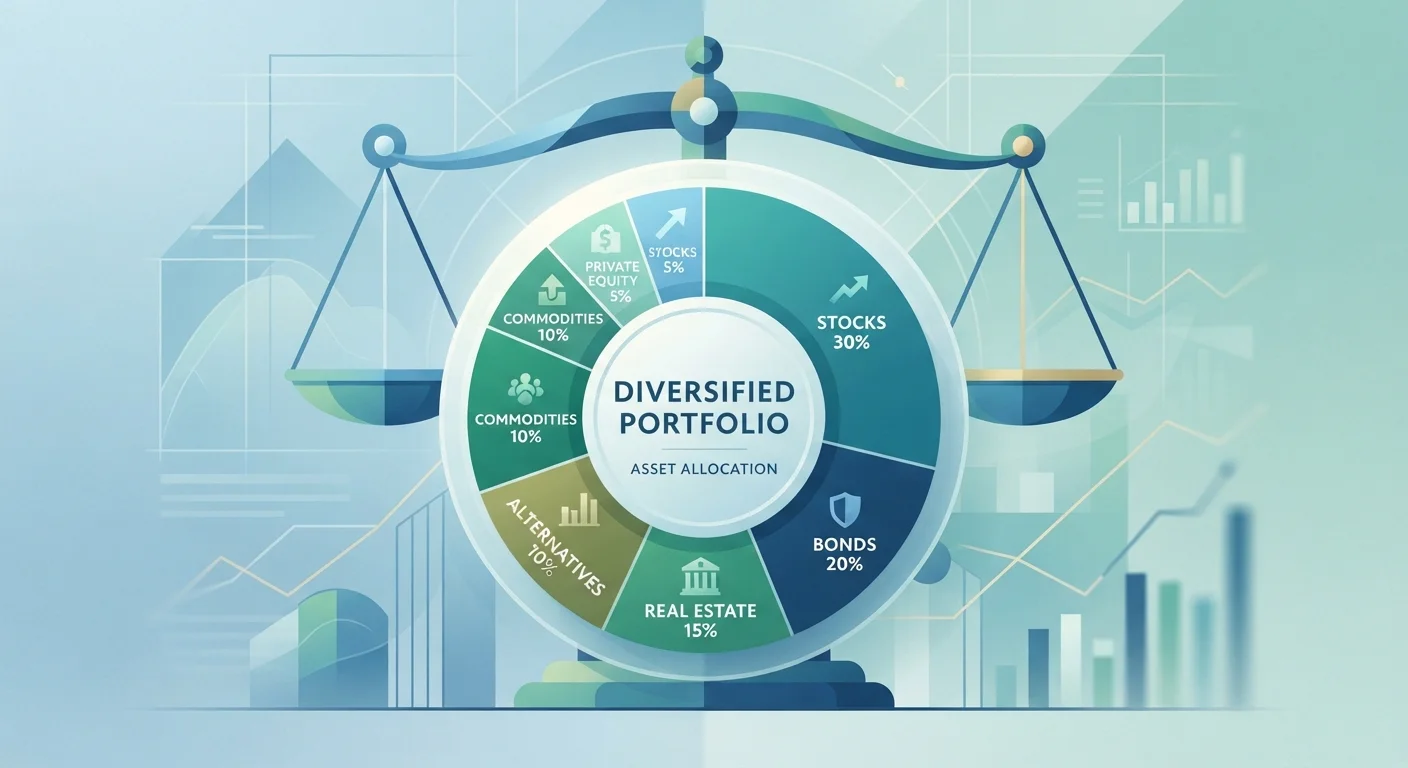
Spreading across asset classes - stocks, bonds, real estate investment trusts, cash equivalents - is a foundational layer of diversification. Within stocks alone, further diversification is possible: across sectors (technology, healthcare, consumer goods), company sizes (large-cap, small-cap), and geographies (domestic, international). Each layer reduces a different kind of concentrated exposure.
For a broader picture of how stocks and bonds each behave independently, see our side-by-side breakdown of stocks vs. bonds.
The Limits of Diversification
Diversification is a powerful tool, but it has clear boundaries. It can reduce unsystematic risk - the kind tied to a specific company or industry - but it cannot eliminate systematic risk, the risk that comes from broad economic forces affecting nearly all markets at once. A severe global recession or a financial crisis can drag down a well-diversified portfolio alongside everything else.
There is also such a thing as too much diversification. Owning dozens of nearly identical holdings in the same sector, or spreading so thinly that every strong performer is diluted, can undermine the purpose. Some investors call this "diworsification" - a portfolio that looks diverse on paper but delivers mediocre outcomes because it is too unfocused.
Pairing diversification with a consistent investment habit - like regularly contributing a fixed amount - can reinforce its benefits over time. Our explainer on dollar-cost averaging describes one such approach and its trade-offs.
Start Simple, Then Layer
If you're new to investing, you don't need to build a complex portfolio from day one. Starting with broad, diversified index funds - which hold hundreds of securities in one vehicle - gives you built-in diversification while you learn more. As your knowledge grows, you can consider adding additional layers. For foundational concepts to review first, see our pre-investing checklist.
This article is for general informational purposes only and does not constitute personalised financial, investment, or tax advice. Consider consulting a qualified financial professional before making decisions about your own investments.