

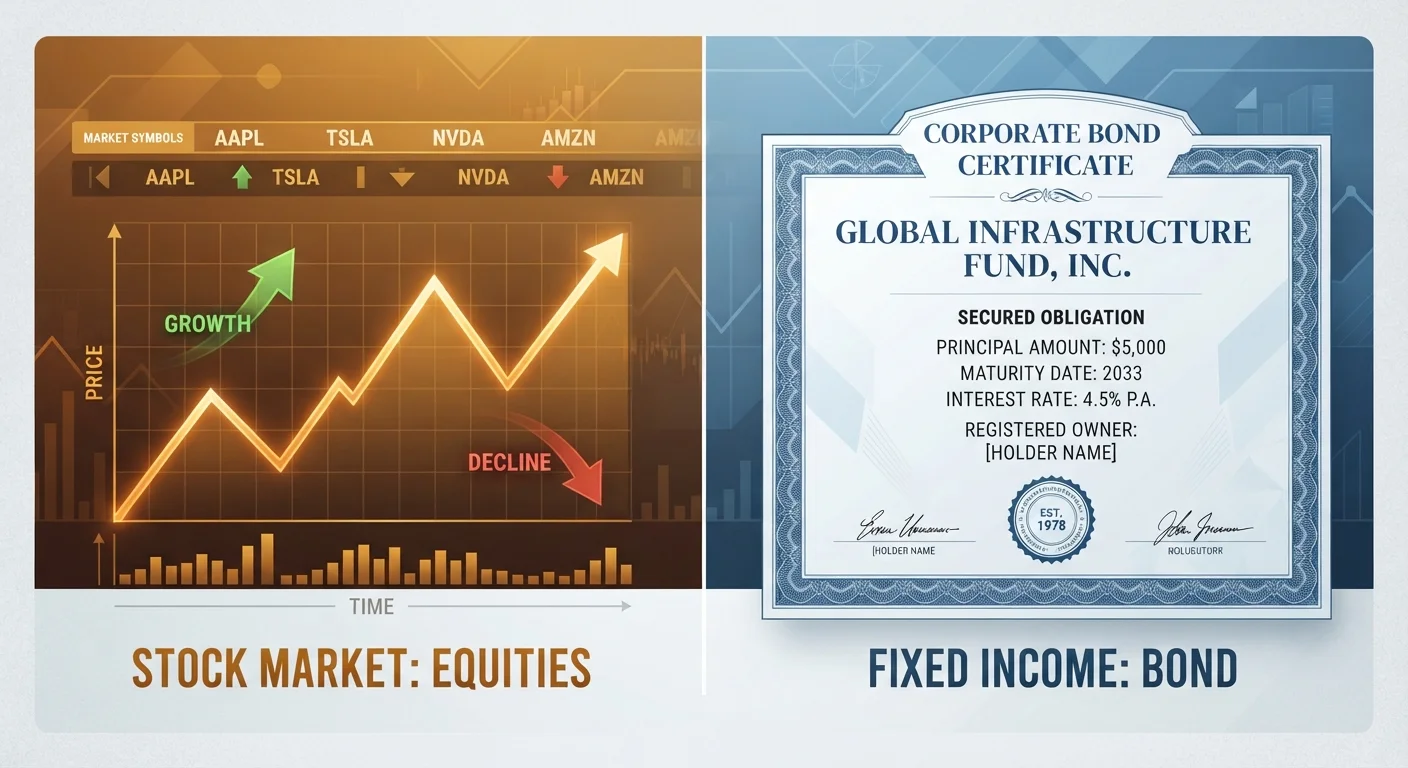
Key Takeaways
- Stocks represent partial ownership in a company; bonds represent a loan to an issuer.
- Stocks offer higher long-term growth potential but carry greater short-term price volatility.
- Bonds provide predictable interest payments but typically grow less than stocks over time.
- Both assets carry risk - bond holders can lose money if an issuer defaults or rates rise.
- Most diversified portfolios hold a mix of both to balance growth and stability.
Option A
Stocks
Ownership stakes in companies with growth potential and higher risk.
Best for: Investors seeking long-term capital growth who can tolerate market swings.
Option B
Bonds
Loans to issuers that pay predictable interest over a fixed term.
Best for: Investors prioritizing income stability and capital preservation over growth.
If you have a long time horizon and can tolerate market volatility
Stocks
Stocks have historically produced stronger long-term returns, making them well-suited for investors who won't need the money for many years and can ride out downturns.
If you need reliable income or are approaching a financial goal
Bonds
Bonds deliver scheduled interest payments and return principal at maturity, making them more predictable for near-term needs or income-focused strategies.
If you want to balance growth with reduced overall portfolio swings
A mix of both
Stocks and bonds have often moved in different directions during market stress, so combining them can smooth overall portfolio volatility without abandoning growth entirely.
What You Actually Own With Each
The single clearest distinction between stocks and bonds is what you hold when you buy them.
A stock - also called an equity or share - makes you a part-owner of the company that issued it. If the company grows, your shares may appreciate in value. If it earns a profit and chooses to distribute some of it, you may receive dividends. But if the company struggles, the share price can fall - and stockholders are last in line if a company goes bankrupt.
A bond is a debt instrument. When you buy one, you are effectively lending money to the issuer - which could be a corporation, the federal government, or a municipality. In exchange, the issuer typically agrees to pay you a fixed interest rate (called the coupon) at regular intervals and return your original loan (the principal) on a set maturity date. Bondholders rank ahead of stockholders in bankruptcy proceedings, which is one reason bonds are generally considered less risky than stocks.
For a broader look at how these two instruments fit into a complete portfolio alongside funds, see our guide to the building blocks of a portfolio.
| Criterion | Stocks | Bonds |
|---|---|---|
| What you hold | Partial ownership in a company | A loan to an issuer |
| Primary return source | Price appreciation + dividends | Fixed interest (coupon) payments |
| Return predictability | Variable - not guaranteed | More predictable if held to maturity |
| Typical risk level | Higher short-term volatility | Lower volatility; default and rate risk |
| Bankruptcy priority | Last in line | Ahead of stockholders |
| Income type | Dividends (optional, not guaranteed) | Coupon payments (scheduled) |
| Term | No fixed end date | Fixed maturity date |
How Returns and Risks Differ
With stocks, return comes from two sources: price appreciation (the share becomes worth more than you paid) and dividends (optional income distributions). Neither is guaranteed. Stock prices can rise dramatically or fall sharply within short periods, and companies can cut or eliminate dividends at any time.
With bonds, the primary return is the interest income you receive while holding the bond. If you hold to maturity, you also get your principal back - assuming the issuer doesn't default. That predictability is the core appeal of bonds for many investors.
That said, bonds are not risk-free. Two key risks apply:
- Default risk: If the issuer cannot meet its obligations, you may not receive full interest or principal. Credit ratings - issued by agencies like Moody's or S&P - attempt to signal this risk level, though ratings are not guarantees.
- Interest rate risk: When interest rates rise, the prices of existing bonds typically fall, because newer bonds pay more. If you sell before maturity, you could receive less than you paid.
Understanding both types of risk is essential before adding either asset class to a portfolio. Our glossary of essential investing terms defines terms like yield, coupon, and credit rating in plain language.
~10%
US stocks long-run average annual return
The broad US stock market has historically averaged roughly 10% annually before inflation, though individual years vary widely and past performance does not predict future results.
4-5%
Typical yield range for investment-grade bonds
Investment-grade corporate and government bond yields fluctuate with prevailing interest rates; the figures above reflect general ranges and are not guarantees of future income.
60/40
Classic stock-to-bond portfolio split
A 60% stock, 40% bond allocation is a widely cited starting framework for balanced investors, though the appropriate mix varies by individual circumstances.
How Stocks and Bonds Work Together
Most financial educators describe stocks and bonds as complementary rather than competing. Historically, they have not always moved in the same direction at the same time - when stock markets fall sharply, investors sometimes shift toward bonds, which can cushion portfolio losses. This relationship is not guaranteed to hold in every market environment, but it is the conceptual basis for mixing the two.
The proportion of each you hold depends heavily on factors like your time horizon (how long before you need the money), your risk tolerance (how comfortable you are with value fluctuations), and your financial goals. A younger investor saving for retirement decades away is often described as having room for more stock exposure. Someone closer to needing funds may lean more toward bonds for stability.
This blending of asset types is a central idea behind diversification - the practice of not concentrating your portfolio in a single place. For a plain-language explanation of how that works, see our article on spreading risk across a portfolio.
Bonds Are Not the Same as Savings Accounts
A common misconception is that bonds behave like bank deposits - safe and stable at all times. In reality, bond prices fluctuate in the secondary market, and selling before maturity can result in a gain or a loss depending on interest rate movements. If you need certainty about getting your exact dollars back, a bond held to maturity differs meaningfully from one traded before it matures.
This article is for general informational and educational purposes only. It does not constitute personalized financial, investment, tax, or legal advice. Please consult a qualified financial professional before making any investment decisions.