

Key Takeaways
- Minimum payments are designed to keep accounts current, not to pay off debt efficiently.
- Interest compounds on your remaining balance each month, meaning most early payments cover interest rather than principal.
- A $3,000 balance at 20% APR paid at the minimum could take over a decade to clear.
- Paying even a modest fixed amount above the minimum can dramatically cut total interest paid.
- Understanding how minimums are calculated helps you make more informed repayment decisions.
Minimum Payment
A minimum payment is the smallest amount a credit card issuer requires you to pay each billing cycle to keep your account in good standing. It is typically calculated as either a flat dollar amount or a small percentage of your outstanding balance - whichever is greater. Paying only this amount keeps you current on the account but leaves the bulk of your balance accruing interest month after month.
Most card issuers set minimum payments at roughly 1-3% of the statement balance, or a fixed floor (often $25-$35). Because the minimum shrinks as your balance shrinks, the repayment schedule extends disproportionately long.
How Minimum Payments Are Structured
Credit card issuers set minimum payments to keep accounts technically current - but the structure is not designed with fast repayment in mind. A typical formula requires you to pay either a flat dollar floor (often around $25-$35) or a small percentage of your balance (commonly 1-3%), whichever is higher. Some issuers also fold in the current billing period's interest charges.
The critical mechanic: as your balance falls, so does your minimum payment. This sounds like good news, but it means you're sending progressively smaller amounts toward a balance that's still accumulating interest every single day. The repayment timeline stretches out not because you're falling behind, but because the system is calibrated to move slowly.
Your Statement Must Show Repayment Projections
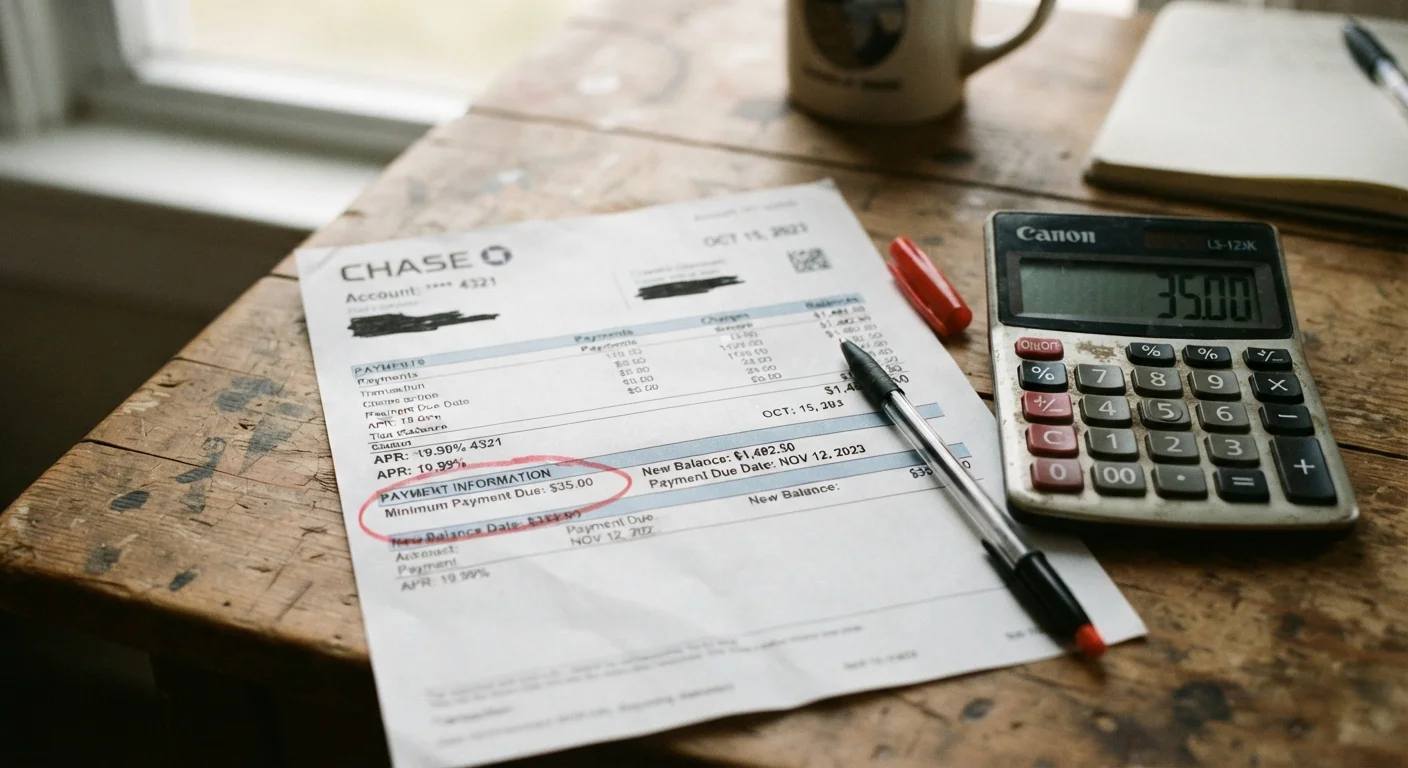
Under federal law, credit card statements in the US are required to include a minimum payment warning - a calculation showing how long it will take to pay off your balance if you make only minimum payments each month, and the total interest you'll pay. This disclosure appears on every billing statement. If you haven't looked at it closely, it's a useful starting point for understanding your own situation.
What the Math Actually Looks Like
Consider a concrete illustration. A $3,000 credit card balance at 20% APR, paid only at the minimum each month, could take well over 10 years to fully repay - and you might end up paying more than $3,000 in interest alone on top of the original balance. The exact figures depend on the issuer's minimum formula, but this range is consistent with standard amortization math.
Contrast that with a fixed payment of $100 per month on the same balance and rate. In that scenario, the balance would be gone in roughly three and a half years, and total interest paid would be a fraction of the minimum-only path. The difference isn't about paying a huge amount extra - it's about paying a consistent, fixed amount that doesn't shrink with the balance.
10+ years
Estimated payoff timeline on $3,000 at 20% APR (minimum payments only)
Based on standard amortization math using a 2% minimum payment formula; exact results vary by issuer terms.
~3.5 years
Estimated payoff timeline on the same balance at a fixed $100/month
Illustrative calculation showing how a fixed payment dramatically shortens repayment compared to a shrinking minimum.
1-3%
Typical minimum payment as a percentage of balance
Most major US credit card issuers calculate minimums within this range, subject to a fixed dollar floor.
Why Interest Works Against You Early On
When you carry a revolving balance, interest accrues daily based on your average daily balance and the card's annual percentage rate (APR). On a high-rate card, a large portion of each minimum payment is consumed by that month's interest charge before even a dollar touches the principal you originally borrowed.
Early in a minimum-payment repayment schedule, the math can feel almost stationary - your balance barely moves. This is because you're essentially paying to tread water. Understanding this dynamic is central to grasping why carrying a credit card balance has a true long-term cost that goes far beyond the purchase price of anything you charged.
Practical Approaches to Breaking the Cycle
The most direct lever is paying more than the minimum - and making that extra amount fixed rather than flexible. Choosing a set monthly payment you can sustain, rather than the variable minimum, keeps repayment on a predictable trajectory.
Beyond that, two structured strategies - the debt avalanche and debt snowball - offer frameworks for tackling multiple balances. Our guide to the debt avalanche and debt snowball walks through how each works and what situations each may suit. If you're managing several cards, it's also worth being aware of habits that commonly derail debt repayment progress, such as treating windfalls as spending money rather than applying them to balances.
For those weighing broader options, debt consolidation can sometimes reduce the interest rate you're paying - but it comes with its own trade-offs worth understanding before acting.
Commit to a Fixed Monthly Payment Amount
Instead of paying whatever the minimum happens to be each month, pick a fixed dollar amount you can consistently afford and stick to it. Even $50-$100 above the minimum makes a meaningful difference over time. Setting up an automatic payment for this fixed amount removes the temptation to pay less during tighter months.
This article is for general informational and educational purposes only and does not constitute personalized financial advice. Consult a qualified financial professional for guidance tailored to your specific situation.