

Key Takeaways
- Debt consolidation combines multiple debts into a single loan or payment, often with one interest rate.
- Lower monthly payments may come at the cost of a longer repayment timeline and more total interest paid.
- Qualification depends on creditworthiness, and not everyone will be approved for a lower rate.
- Consolidation does not eliminate debt - spending habits must also change for lasting improvement.
- Comparing consolidation to alternatives like debt avalanche or debt management plans helps you choose wisely.
Simplifies multiple payments into one
Managing a single monthly payment reduces administrative complexity and lowers the chance of missing a due date, which can protect your credit score.
May reduce overall interest rate
If you qualify for a rate lower than your existing debts - especially high-rate credit cards - consolidation can reduce what you pay in interest over the life of the debt.
Provides a fixed repayment end date
Unlike revolving credit balances, consolidation loans have defined terms, giving you a clear timeline and making long-term budgeting more predictable.
Can improve monthly cash flow
A lower monthly payment can free up room in a tight budget, though this benefit should be weighed against any extension of the repayment period.
May cost more in total interest over time
Stretching repayment over a longer term - even at a lower rate - can result in paying more total interest than if you'd aggressively paid down existing debts.
Qualification depends on credit health
Borrowers with lower credit scores may not qualify for a rate that is meaningfully better than their existing debts, reducing or eliminating the financial benefit.
Does not address root spending habits
Consolidation reorganizes debt but does not fix the underlying behaviors that caused it; without behavioral change, new debt often accumulates on the cleared accounts.
Some forms carry fees or collateral risk
Origination fees, balance transfer fees, or using home equity as collateral can add costs or introduce risks - such as potential loss of the asset - that unsecured debt does not carry.
Our Verdict
Debt consolidation can be a genuinely useful tool when it lowers your interest rate, simplifies repayment, and fits within a realistic budget. However, it works best as part of a broader financial reset - not as a standalone fix. Readers who qualify for a meaningfully lower rate and have addressed the habits that created the debt are best positioned to benefit.
Best for borrowers carrying multiple high-interest debts who qualify for a lower rate and are committed to changing the spending patterns that led to the debt.
What Debt Consolidation Actually Means
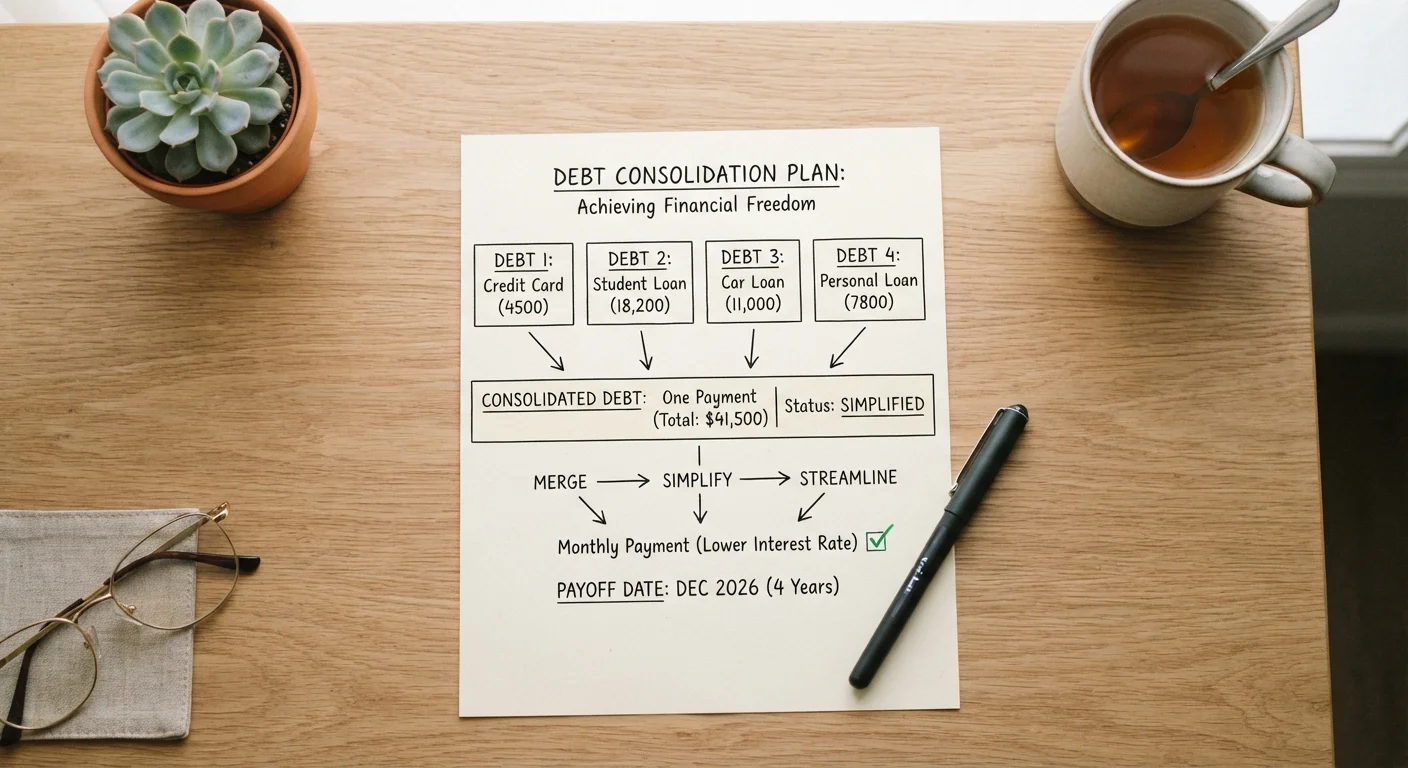
Debt consolidation is the process of combining several existing debts - typically credit card balances, medical bills, or personal loans - into a single new loan or repayment arrangement. Instead of tracking multiple due dates, interest rates, and minimum payments, you make one monthly payment to one lender.
The most common forms include personal consolidation loans, balance transfer credit cards, and home equity loans. Each works differently in terms of rates, eligibility, and risk. This article focuses on the general trade-offs that apply across consolidation approaches, rather than recommending any specific product.
Understanding what consolidation does - and doesn't - do is the starting point for deciding whether it fits your situation. For a deeper look at how consolidation loans compare to another common option, see Debt Management Plans vs. Debt Consolidation Loans.
Consolidation Is Not the Same as Debt Settlement
Debt consolidation and debt settlement are often confused but are fundamentally different. Consolidation combines debts into a new loan you repay in full. Debt settlement involves negotiating to pay less than the full balance owed, which typically has significant negative consequences for your credit and may carry tax implications. Always clarify which option is being discussed when speaking with a financial service provider.
The Genuine Advantages
When consolidation works as intended, it offers several meaningful benefits worth understanding clearly.
Simplifies multiple payments into one
Managing a single monthly payment reduces administrative complexity and lowers the chance of missing a due date, which can protect your credit score.
May reduce overall interest rate
If you qualify for a rate lower than your existing debts - especially high-rate credit cards - consolidation can reduce what you pay in interest over the life of the debt.
Provides a fixed repayment end date
Unlike revolving credit balances, consolidation loans have defined terms, giving you a clear timeline and making long-term budgeting more predictable.
Can improve monthly cash flow
A lower monthly payment can free up room in a tight budget, though this benefit should be weighed against any extension of the repayment period.
Simplified finances and a potentially lower interest rate are the two most cited reasons borrowers pursue consolidation. A single payment is easier to manage, reducing the risk of a missed due date. And if the new loan carries a lower rate than your existing debts - particularly high-rate credit cards - you may pay less interest over time.
Fixed repayment terms also bring predictability. Unlike a revolving credit card balance that can stretch indefinitely, a consolidation loan has a defined end date, which can be motivating and easier to plan around.
The Real Limitations
Consolidation is not a solution for every debt situation, and the limitations are just as important to understand as the benefits.
May cost more in total interest over time
Stretching repayment over a longer term - even at a lower rate - can result in paying more total interest than if you'd aggressively paid down existing debts.
Qualification depends on credit health
Borrowers with lower credit scores may not qualify for a rate that is meaningfully better than their existing debts, reducing or eliminating the financial benefit.
Does not address root spending habits
Consolidation reorganizes debt but does not fix the underlying behaviors that caused it; without behavioral change, new debt often accumulates on the cleared accounts.
Some forms carry fees or collateral risk
Origination fees, balance transfer fees, or using home equity as collateral can add costs or introduce risks - such as potential loss of the asset - that unsecured debt does not carry.
One of the most overlooked risks is that consolidation can extend your repayment timeline. A lower monthly payment might feel like relief, but if it comes with more months of payments, you could end up paying more total interest - even at a lower rate. Always calculate the full cost of repayment, not just the monthly figure.
There is also the underlying cause problem. Consolidation reorganizes debt; it does not address why the debt accumulated. Without changes to spending or budgeting habits, many borrowers find themselves accumulating new balances on the credit cards they just paid off. For a broader look at common misconceptions around debt payoff, see Common Misconceptions About Paying Off Debt.
20%+
Typical credit card APR in the US
Federal Reserve data has shown average credit card interest rates frequently exceeding 20%, making the rate comparison central to any consolidation decision.
~1 in 3
Borrowers who re-accumulate debt after consolidation
Research from consumer finance studies has suggested a significant share of consolidators carry new balances within a few years, underscoring the behavioral component of debt management.
How Consolidation Compares to Other Approaches
Consolidation is one strategy among several. The debt avalanche and debt snowball methods offer alternatives that don't require a new loan or credit approval - they restructure how you prioritize payments across existing debts. For some people, those methods may be more effective or more accessible.
The right approach depends on your interest rates, credit profile, income stability, and personal motivation style. A good annual financial review can help clarify which path makes sense for your current position. The Annual Savings and Debt Health Checkup is a practical starting point for that kind of structured review.
If you're unsure which strategy fits your situation, a nonprofit credit counselor or a licensed financial professional can help you evaluate your options without selling you a product. This article is for general educational purposes and is not a substitute for personalized financial advice.
This article provides general financial education only and does not constitute personalized financial, tax, or legal advice. Consult a qualified financial professional before making decisions about your debt or finances.