

Key Takeaways
- A DMP is administered by a nonprofit credit counseling agency; a consolidation loan comes from a bank, credit union, or online lender.
- DMPs typically require closing enrolled credit accounts, which may temporarily affect your credit score.
- Consolidation loans require a credit check - applicants with poor credit may not qualify for a rate that actually saves money.
- Both approaches work best for unsecured debt like credit cards; neither eliminates what you owe.
- Consulting a nonprofit credit counselor before choosing either path can clarify which option fits your specific situation.
Option A
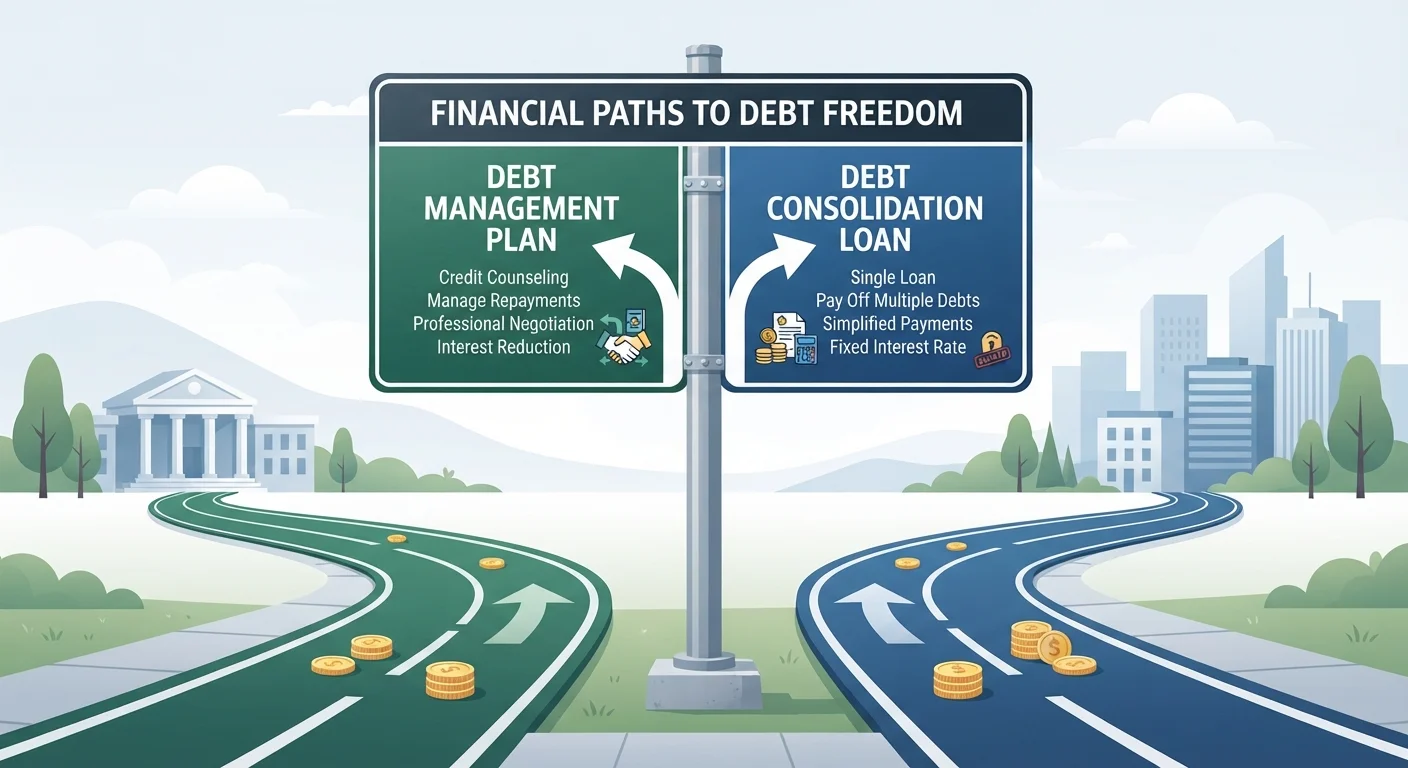
Debt Management Plan (DMP)
A counselor-guided repayment program through a nonprofit agency.
Best for: People with steady income who need structured guidance, reduced interest rates, and accountability without taking on new credit.
Option B
Debt Consolidation Loan
A single new loan used to pay off multiple existing debts.
Best for: Borrowers with solid credit who can qualify for a lower interest rate and prefer managing one monthly payment independently.
If your credit score is low and you're struggling to keep up with multiple payments
Debt Management Plan (DMP)
DMPs don't require good credit to enroll, and counselors negotiate directly with creditors to lower interest rates on your behalf.
If you have strong credit and want full control over your repayment
Debt Consolidation Loan
Qualified borrowers can often secure a lower APR than their current cards carry, reducing total interest without a third-party program.
If you want professional oversight and a structured payoff timeline
Debt Management Plan (DMP)
A DMP assigns a fixed monthly payment and timeline - typically three to five years - with a counselor monitoring progress throughout.
If you need to preserve access to credit during repayment
Debt Consolidation Loan
Unlike a DMP, a consolidation loan does not require you to close existing credit accounts as a condition of the program.
How Each Approach Works
Both a Debt Management Plan (DMP) and a Debt Consolidation Loan aim to simplify repayment and reduce the cost of carrying debt - but they operate through fundamentally different mechanisms.
A DMP is coordinated by a nonprofit credit counseling agency. After reviewing your income, expenses, and debts, a counselor contacts your creditors to negotiate reduced interest rates or waived fees. You make one monthly payment to the agency, which distributes funds to each creditor on your behalf. Most DMPs run for three to five years, and you typically agree to stop using - and sometimes close - the enrolled accounts during that period.
A Debt Consolidation Loan, by contrast, is a new loan you take out from a bank, credit union, or online lender. The proceeds pay off your existing debts, leaving you with a single loan at (ideally) a lower interest rate. You then repay the lender directly, with no agency involved. This approach requires a credit application and approval - meaning your credit history matters significantly. To learn more about how revolving balances accumulate cost over time, see The True Cost of Carrying Credit Card Debt.
| Criterion | Debt Management Plan | Debt Consolidation Loan |
|---|---|---|
| Administered by | Nonprofit credit counseling agency | Bank, credit union, or lender |
| Credit check required | No | Yes |
| Interest rate reduction | Negotiated by counselor | Depends on credit qualification |
| Account access during repayment | Enrolled accounts typically closed | Existing accounts remain open |
| Typical repayment timeline | 3-5 years | Varies by loan term |
| Monthly payments | One payment to agency | One payment to lender |
| Ongoing fees | Modest monthly agency fee | Possible origination fee; no ongoing fee |
| Debt types covered | Primarily unsecured debt | Primarily unsecured debt |
Key Trade-Offs to Weigh
Neither option is universally superior - the right fit depends on your credit profile, financial habits, and goals.
~$1,000
Average monthly DMP payment reported by participants
According to the National Foundation for Credit Counseling (NFCC), many DMP participants consolidate multiple card payments into a single manageable monthly amount.
3-5 years
Typical DMP completion timeline
Most nonprofit credit counseling agencies structure DMPs to reach full repayment within this window, assuming consistent on-time payments.
620-670+
Credit score often needed for competitive loan rates
Lenders generally reserve the lowest personal loan APRs for borrowers with good to excellent credit, making score a critical factor in consolidation decisions.
Credit Impact
Enrolling in a DMP may cause a temporary dip in your credit score because creditors may note the account as enrolled in a plan, and you'll likely be required to close enrolled accounts. However, consistently making on-time payments through a DMP can improve your score over time. A consolidation loan triggers a hard credit inquiry upfront, but keeping accounts open and reducing utilization can be a net positive if you manage the new loan responsibly.
Cost and Fees
DMPs charged through reputable nonprofit agencies carry modest setup and monthly fees - typically well below what a for-profit debt settlement company might charge. Consolidation loans carry origination fees in some cases, and the total interest paid depends heavily on the loan rate you qualify for. If your credit score doesn't support a meaningfully lower rate, consolidation may not save you money. For a deeper look at these nuances, Debt Consolidation: A Balanced Look at the Trade-Offs walks through the full picture.
Behavioral Factors
A DMP provides external accountability - the agency handles creditor communication and tracks your payments. A consolidation loan places full responsibility on you. If overspending contributed to the debt in the first place, a loan alone doesn't address those habits. It's worth reviewing Common Misconceptions About Paying Off Debt to avoid assumptions that can derail either approach.
Which Path Fits Your Situation?
A few practical questions can help clarify which direction makes sense:
- What is your credit score? If it's below roughly 670, qualifying for a consolidation loan at a genuinely lower rate may be difficult.
- How many creditors are involved? A DMP can manage multiple accounts simultaneously; a consolidation loan also combines them, but requires sufficient loan proceeds to cover the total.
- Do you want professional support? If navigating creditor communications feels overwhelming, a DMP's counselor relationship provides structure that a loan does not.
- Can you handle the monthly payment? Both approaches require consistent payments. If cash flow is tight, confirm any new payment is genuinely sustainable.
Self-directed repayment strategies - like the avalanche or snowball methods - are another option worth understanding before committing to either program. The Debt Avalanche and Debt Snowball, Explained covers how those work. And if you're balancing debt repayment with saving goals, Saving While in Debt: What to Prioritize and When offers useful framing on sequencing priorities.
Watch Out for For-Profit Debt Settlement Companies
Debt settlement is a separate - and riskier - category from both DMPs and consolidation loans. Settlement companies typically instruct consumers to stop paying creditors, which can cause significant credit damage and potential legal action. Nonprofit credit counseling agencies (look for NFCC-affiliated organizations) operate differently and are subject to stricter standards. If you're exploring a DMP, verify the agency's nonprofit status and accreditation before enrolling.
This article is for general informational and educational purposes only and does not constitute personalized financial or legal advice. Consult a qualified financial professional to evaluate options based on your individual circumstances.