

Key Takeaways
- Tackling one room at a time prevents overwhelm and delivers visible progress quickly.
- The kitchen and bedroom closet typically offer the highest return for decluttering effort.
- A consistent 'one in, one out' habit prevents clutter from returning after a big purge.
- Labeling storage and assigning fixed homes to items are the two most effective long-term strategies.
- Permits and professional help are rarely needed for organizing - but safety hazards uncovered during decluttering should be addressed by a qualified professional.
Why a Room-by-Room Approach Works
Decluttering an entire home in one sweep sounds efficient in theory, but it often leads to half-finished piles and decision fatigue. A room-by-room method keeps your focus narrow and your wins visible. When you finish one space, you have immediate proof that progress is real - and that momentum carries you forward.
This approach also respects how different rooms function. The criteria for keeping a spatula are not the same as for keeping a sweater. Working room by room lets you apply context-specific thinking rather than forcing every item through a single filter.
If you're curious how this strategy compares to sorting by category across the whole house, see our comparison of decluttering methods to find the approach that fits your household best.
25%
Of homeowners who can't park in their garage due to clutter
According to U.S. Department of Energy research on home storage habits, roughly one in four two-car garages is too full to hold a single vehicle.
40%
Of housework eliminated by reducing clutter
Research cited by the National Soap and Detergent Association suggested that clutter is a primary driver of extra cleaning time in American homes.
Before You Start: Set Yourself Up for Success
Good preparation shortens the actual work. Before touching a single drawer, gather your supplies: sturdy bags or boxes labeled Keep, Donate, Trash, and Relocate (for items that belong in a different room). Set a realistic time block - 45 to 90 minutes per session is a sustainable range for most people.
It also helps to ask yourself a few clarifying questions about each space before diving in: What is this room supposed to do? What's making it hard to use right now? Our pre-reorganization checklist walks through exactly those questions so you don't redo the same work months later.
Work One Zone at a Time
Don't try to declutter an entire room in a single pass if it feels overwhelming. Break each room into zones - for example, treat the pantry, lower cabinets, and upper cabinets as three separate sessions. Finishing a zone completely is more satisfying and effective than leaving several zones half-done.
Kitchen and Dining Area
The kitchen rewards ruthless editing. Start with cabinets and drawers, pulling everything out so you can see duplicates clearly. Most households own far more spatulas, mugs, and take-out containers than they use. A useful rule: if it takes more than ten seconds to locate something you reach for daily, the system needs adjustment.
- Expired food: Check the pantry and refrigerator door shelves. Discard anything past its date.
- Duplicate tools: Keep one or two of each; donate the rest.
- Mismatched containers: Lids without bottoms and bottoms without lids go in the trash.
- Countertop appliances: If you haven't used it in six months and it takes up prime counter space, store it or let it go.
Dining areas often collect mail and charging cables by default. Assigning a dedicated spot elsewhere for those items - even just a small basket near the front door - removes the clutter magnet entirely.
Don't reorganize before you declutter. Buying storage bins before deciding what stays is one of the most common organizing mistakes - you'll likely buy the wrong sizes for the wrong things.
Organizing clutter just makes it neater clutter. Determining what stays first ensures your storage solutions actually match what you own.
Set a visible timer when decluttering emotionally difficult areas like closets. Working in defined 20-minute sprints keeps decision fatigue manageable and prevents sessions from dragging into exhaustion.
Decision fatigue is real: the quality of our choices deteriorates after sustained effort. Short, focused sessions consistently outperform marathon purges.
Bedrooms and Closets
The bedroom closet is one of the most emotionally charged spaces in any home. Clothing decluttering is slower than it looks because each item carries a story. Give yourself permission to move at a measured pace here.
Pull everything from the closet and sort into categories: currently worn, seasonal, sentimental, and unused. Items in the 'unused' pile that still have tags on them are prime donation candidates - they were never integrated into your wardrobe and likely won't be.
- Store seasonal items in labeled bins on high shelves or under the bed.
- Face all hangers the same direction; after a season, anything still reversed hasn't been worn.
- Fold bulky items like sweaters rather than hanging them - hanging stretches knits over time.
For the rest of the bedroom, address nightstands, dressers, and under-bed storage separately. Each surface should have a defined purpose, not serve as a general landing zone.
Sentimental Items Deserve Their Own Session
Mixing sentimental items into a general declutter session slows everything down and raises emotional stakes unnecessarily. Set sentimental objects aside in a dedicated box and schedule a separate, unhurried time to go through them. This prevents guilt-driven decisions made in the middle of an otherwise productive session.
Living Room and Common Areas
Living rooms accumulate items from every member of the household, which makes them tricky. Start with flat surfaces: coffee tables, side tables, and entertainment units. Remove everything, clean the surface, then only return what genuinely belongs there.
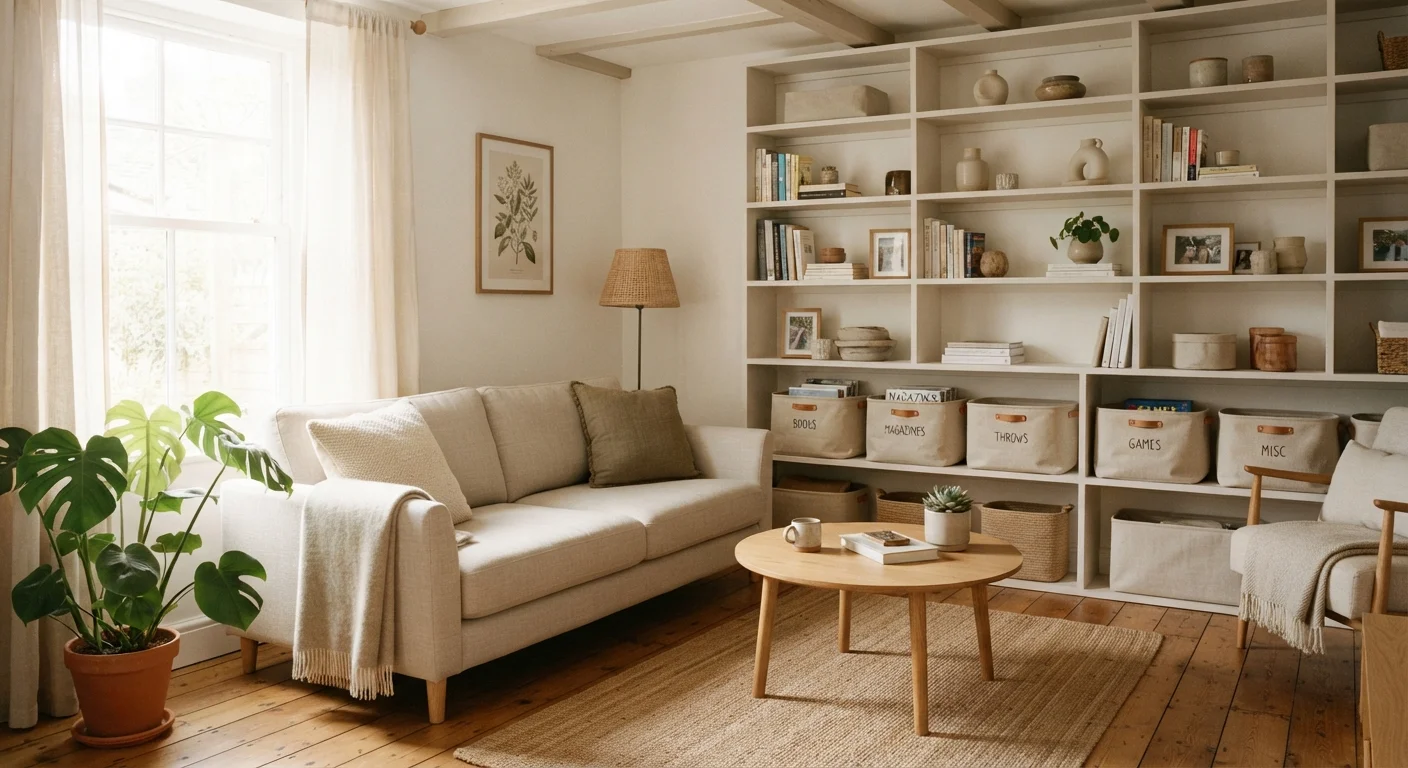
Books, media, and décor deserve honest evaluation. Keep what you love and use; release what's there by habit. For shared items like board games or remote controls, create a consistent home and communicate it to everyone in the household - consistency is what makes a system hold.
If your living space doubles as a workspace or hobby area, consider whether storage for those functions is adequate. Small apartments especially benefit from dual-purpose furniture with hidden storage. Our small apartment storage guide offers practical strategies for compact spaces.
Bathrooms
Bathrooms are usually the quickest room to declutter - and the most satisfying. Most bathroom clutter is expired, empty, or simply forgotten.
- Pull everything from under the sink and inside the medicine cabinet.
- Discard expired medications (follow local pharmacy take-back guidelines), empty bottles, and products you've stopped using.
- Group what remains by function: daily use, occasional use, first aid.
- Return only daily-use items to prime spots; store the rest further back or in a separate container.
Keep countertops to a minimum. Three to five items maximum keeps cleaning fast and the space feeling calm.
Medication Disposal Requires Care
Do not flush medications down the drain or toss them in household trash unless the label specifically directs it. Many pharmacies and local health departments offer free medication take-back programs. Improper disposal can contaminate water supplies and poses a safety risk if medications are accessible to children or pets.
Garage, Basement, and Storage Spaces
These spaces tend to be the final destination for items that 'might be useful someday.' That someday rarely comes. Approach the garage or basement in zones - tools, sports equipment, seasonal décor, hardware - rather than trying to tackle the whole space at once.
Safety matters here. If you uncover items like old paint cans, solvents, or unknown chemicals during your sort, do not mix or dispose of them in regular trash. Contact your local municipality for hazardous waste disposal guidelines. Similarly, if decluttering reveals structural concerns - water damage, pest evidence, or faulty wiring - address those with a qualified professional before continuing.
- Label every bin and shelf clearly; unlabeled storage becomes a black hole.
- Keep frequently used items at eye level and reachable; rarely used items go high or deep.
- Donate working tools and sporting goods to community organizations or tool libraries.
Keeping It Clear: Maintenance Habits That Stick
A decluttered home only stays that way with simple ongoing habits. The most effective ones are low-effort and built into routines you already have.
- One in, one out: When something new enters the home, something comparable leaves.
- Weekly reset: A 15-minute weekly pass through common areas prevents buildup from becoming a project.
- Seasonal review: Every few months, reassess one room. Pair this with seasonal home tasks using our seasonal maintenance schedule to build both habits together.
The goal isn't a perfectly sparse home - it's a home where everything has a place and finding what you need is effortless. Small, consistent habits sustain that far more reliably than periodic overhauls.
“A place for everything, and everything in its place. The real goal of organization isn't aesthetic - it's to reduce the daily friction of finding and returning things.”
— Samuel Smiles, 19th-century author, often credited with popularizing this organizational principle