

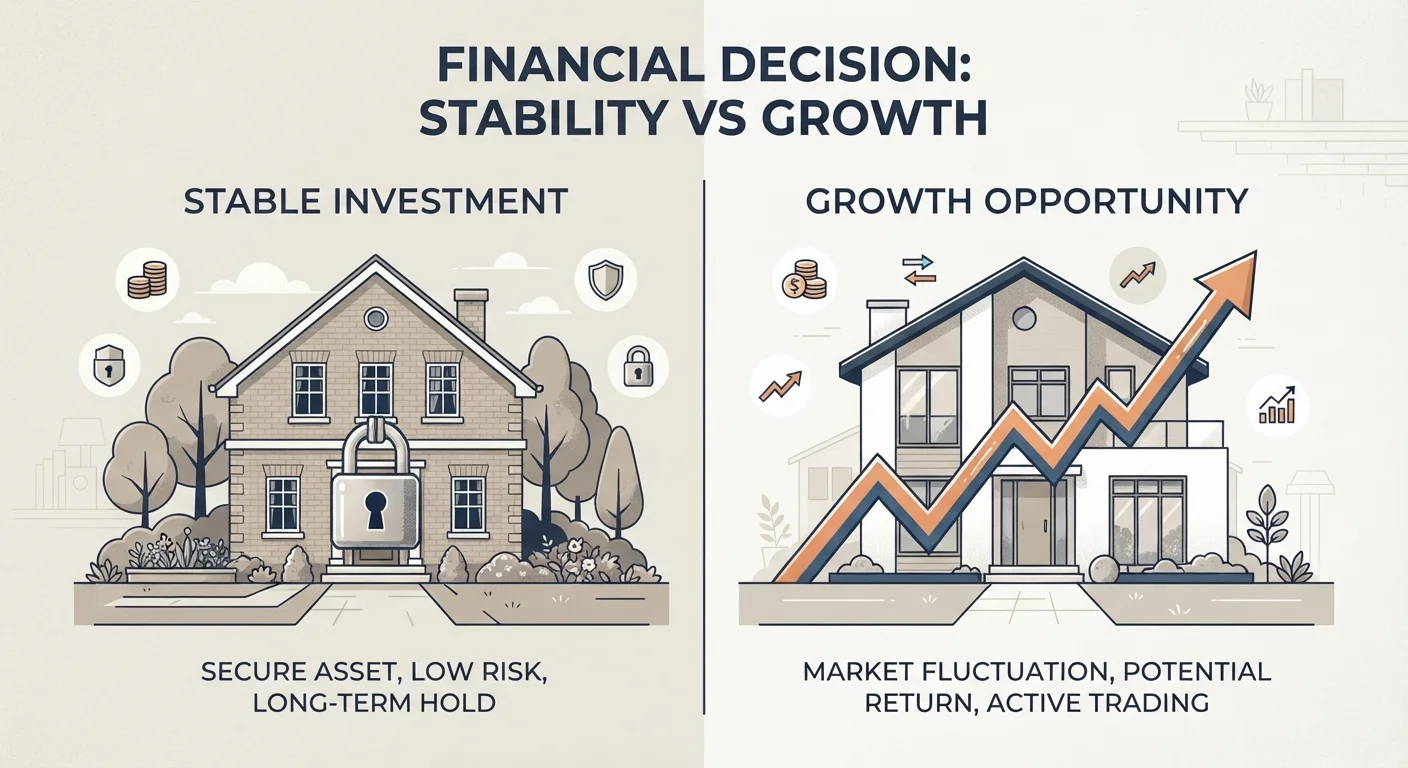
Key Takeaways
- Fixed-rate mortgages lock in your interest rate for the entire loan term, keeping payments stable.
- ARMs offer a lower introductory rate that adjusts periodically after an initial fixed period.
- Fixed rates suit long-term homeowners; ARMs may benefit those with shorter planning horizons.
- ARM rate adjustments are governed by caps, limiting how much rates can rise per period or over the loan life.
- The right choice depends on your timeline, risk tolerance, and current rate environment.
Option A
Fixed-Rate Mortgage
The predictable, long-term stability choice.
Best for: Buyers who plan to stay in a home for many years and want consistent monthly payments regardless of market movements.
Option B
Adjustable-Rate Mortgage (ARM)
The flexible, potentially lower-cost alternative.
Best for: Buyers who expect to sell or refinance within a few years and can tolerate some payment variability in exchange for a lower initial rate.
If you plan to own the home for 10 or more years
Fixed-Rate Mortgage
Long-term owners benefit most from payment certainty, and the predictability outweighs any short-term savings from a lower ARM rate.
If you expect to sell or refinance within 5-7 years
Adjustable-Rate Mortgage (ARM)
A 5/1 or 7/1 ARM lets you benefit from a lower initial rate during the period you actually own the home, before any adjustments take effect.
If market interest rates are historically low
Fixed-Rate Mortgage
Locking in a low fixed rate prevents you from being exposed to future rate increases, preserving affordability over the long run.
If your income is variable or you prioritize lower early payments
Adjustable-Rate Mortgage (ARM)
The lower initial rate reduces early monthly obligations, which may help cash flow during the first years of ownership - though future adjustments carry real risk.
How Each Mortgage Type Is Structured
A fixed-rate mortgage carries an interest rate that never changes over the life of the loan. Whether your term is 15 or 30 years, the rate agreed upon at closing is the rate you'll pay on your final payment. Principal and interest portions shift slightly over time as amortization works, but the total monthly payment stays constant.
An adjustable-rate mortgage (ARM) is structured in two phases. The first is a fixed-rate introductory period - commonly 3, 5, 7, or 10 years - during which the rate stays stable. After that, the rate adjusts at regular intervals (typically annually) based on a benchmark index, such as the Secured Overnight Financing Rate (SOFR), plus a lender-set margin. A 5/1 ARM, for example, holds its rate fixed for five years, then adjusts once per year thereafter.
| Criterion | Fixed-Rate Mortgage | Adjustable-Rate Mortgage (ARM) |
|---|---|---|
| Interest Rate | Locked for full loan term | Fixed initially, then adjusts periodically |
| Initial Monthly Payment | Typically higher than ARM | Often lower during introductory period |
| Payment Predictability | Fully predictable | Variable after fixed period ends |
| Common Terms | 15-year, 30-year | 3/1, 5/1, 7/1, 10/1 |
| Rate Change Risk | None | Moderate to high, governed by caps |
| Best Horizon | 10+ years in the home | 3-7 years before selling or refinancing |
| Complexity | Simple to understand and budget | Requires understanding index, margin, and caps |
Understanding how rates affect overall housing costs is foundational. Mortgage rates reshape affordability in ways beyond monthly payments - worth understanding before committing to either structure.
How Monthly Payments Behave Over Time
With a fixed-rate mortgage, your principal and interest payment is set at closing and will not change. This makes long-range budgeting straightforward - useful when evaluating whether homeownership fits your financial picture compared to renting. For context, the financial trade-offs between renting and buying often hinge on exactly this kind of payment certainty.
ARM payments can be lower early on - sometimes meaningfully so - because lenders typically offer a discounted introductory rate. However, once the adjustment period begins, payments can rise or fall depending on benchmark index movements. Most ARMs include rate caps to limit exposure:
- Periodic cap: limits how much the rate can change in a single adjustment period.
- Lifetime cap: sets an absolute ceiling on how high the rate can ever go above the initial rate.
2%
Typical ARM periodic rate cap per adjustment
Most conventional ARMs limit each annual rate adjustment to 2 percentage points, per standard industry structures cited by the Consumer Financial Protection Bureau.
5%
Common ARM lifetime rate cap above initial rate
A 5% lifetime cap means an ARM starting at 6% could rise no higher than 11% over the full loan term under typical cap structures.
30 years
Most common fixed-rate mortgage term in the US
The 30-year fixed-rate mortgage remains the dominant product in the US home lending market, offering the lowest fixed monthly payment across standard terms.
Even with caps in place, an ARM that adjusts upward significantly can increase monthly payments by hundreds of dollars. Borrowers should model worst-case scenarios - not just the initial payment - before selecting this structure.
Which Structure Fits Your Situation
The decision ultimately comes down to three variables: how long you plan to stay, your comfort with payment uncertainty, and where rates currently sit relative to historical norms.
Fixed-rate mortgages reward patience and longevity. If the rate environment is favorable at closing, you insulate yourself from future market volatility for the entire loan term. They're also the easier product to understand - straightforward math, no index tracking required.
ARMs can be a rational choice when a buyer has a defined, shorter horizon - relocating for work, upsizing as family needs grow, or purchasing an investment property with a planned exit. The savings during the fixed introductory window can be real, provided the borrower doesn't remain in the loan long enough for adjustment risk to materialize.
Refinancing Can Change Your Structure Later
Choosing an ARM today doesn't lock you into that structure permanently. Many borrowers refinance into a fixed-rate product before their adjustment period begins, particularly if rates remain stable or decline. However, refinancing carries its own costs - including closing costs and qualification requirements - so it should not be assumed as a guaranteed exit strategy. Always evaluate an ARM based on its terms as-is, not solely on a refinancing assumption.
It's also worth noting that stability preferences apply beyond mortgages. The same tension between locked-in terms and flexible structures appears in lease decisions - comparing month-to-month and fixed-term leases illustrates the same core trade-off in a rental context.
This article is for general informational and educational purposes only and does not constitute financial or legal advice. Consult a licensed mortgage professional or financial adviser regarding your specific circumstances.