

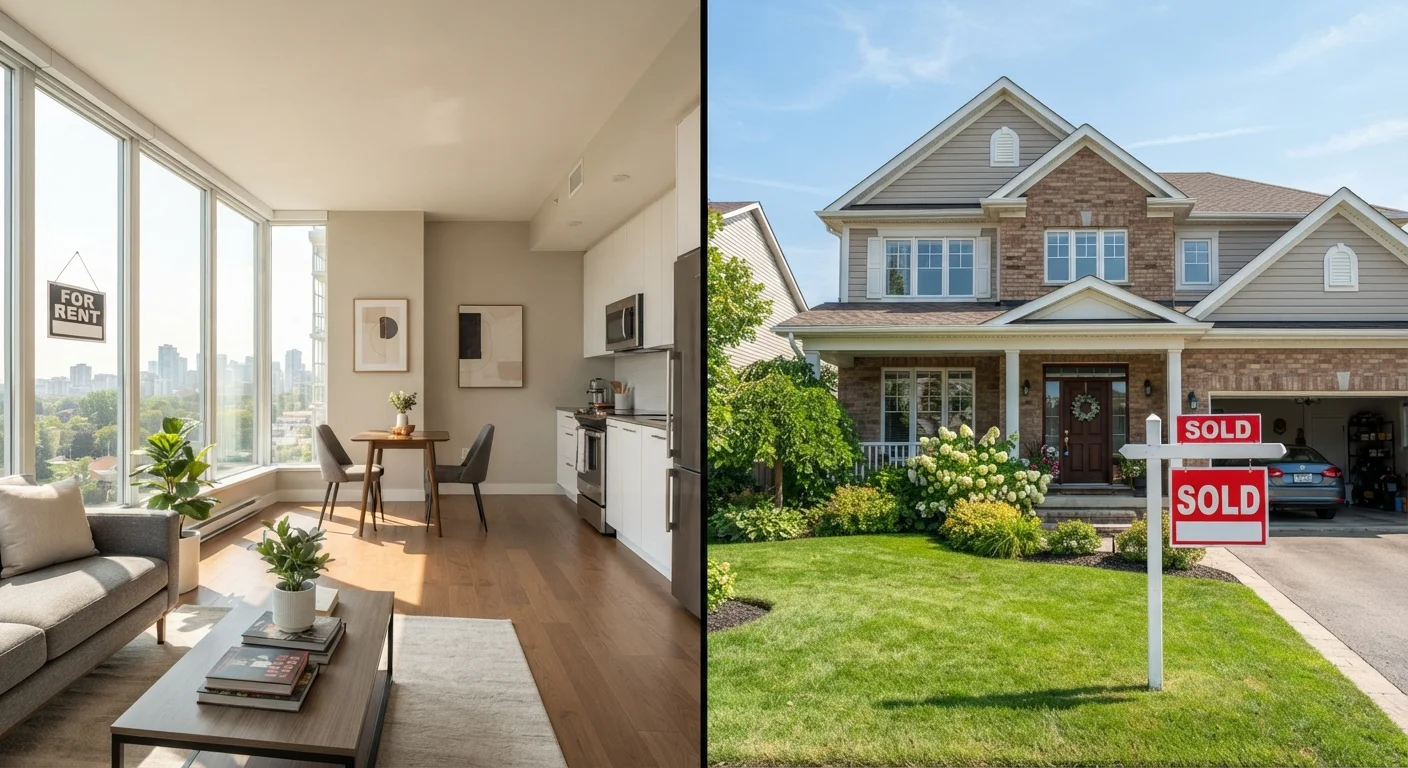
Key Takeaways
- Buying builds equity over time but requires significant upfront capital and ongoing maintenance costs.
- Renting offers flexibility and predictable short-term costs but provides no ownership stake.
- The financial advantage of buying depends heavily on how long you stay in the home.
- Lifestyle factors - career stability, family plans, mobility needs - often matter as much as the numbers.
- Neither option is universally superior; the right choice depends on individual financial and life circumstances.
Our Verdict
Both renting and buying serve legitimate financial and lifestyle goals depending on your situation. Buying tends to reward those with long time horizons, stable incomes, and strong savings; renting suits those who need flexibility, are in higher-cost markets, or aren't yet financially positioned to own. There is no universal right answer - the better choice is the one that aligns with your current finances and life trajectory.
| Best for | Recommended |
|---|---|
| Those with stable income, long-term location plans, and sufficient savings | Buying |
| Those who need mobility, are early in their careers, or are in high-cost markets | Renting |
| Those focused on building long-term wealth through equity appreciation | Buying |
| Those who want to avoid maintenance responsibilities and large capital commitments | Renting |
The Core Financial Trade-Off
At its simplest, renting means paying for housing without accumulating ownership, while buying means directing payments partly toward an asset you control. But the comparison is rarely that clean. When you buy, you take on a mortgage, property taxes, homeowner's insurance, and ongoing maintenance - costs that can add 1-3% of a home's value per year beyond the mortgage payment itself. See our full breakdown of homeownership costs for context on what lenders and buyers often undercount.
Renters, meanwhile, face their own hidden costs beyond monthly rent. Application fees, renters insurance, and parking can meaningfully raise the real price of renting. The true cost of renting an apartment article examines these line items in detail.
The central financial question is how long you plan to stay. Buying involves substantial transaction costs - typically 2-5% of the purchase price in closing costs, plus agent commissions if you sell. Those costs only make sense if you occupy the home long enough for equity growth to offset them. Many housing economists suggest a minimum five-to-seven year horizon before buying is likely to outperform renting financially, though this varies significantly by local market conditions.
| Renting | Buying | |
|---|---|---|
| Upfront costs | First/last month, security deposit | Down payment, closing costs (2-5%) |
| Monthly cost predictability | Fixed during lease term | Fixed (mortgage) plus variable maintenance |
| Equity building | None | Yes, over time |
| Flexibility to relocate | High - lease end or break clause | Low - selling is slow and costly |
| Exposure to market risk | None (no asset stake) | Yes - values can rise or fall |
| Maintenance responsibility | Landlord handles most repairs | Owner bears all costs |
| Customization freedom | Limited by lease terms | Full control of the property |
| Long-term cost trend | Rent can increase over time | Fixed mortgage; equity grows |
Equity, Wealth Building, and Market Risk
One of homeownership's most cited advantages is equity accumulation - as you pay down your mortgage and the property appreciates, your net worth grows. Historically, US home values have trended upward over long periods, though appreciation is uneven across markets and time frames, and past trends do not guarantee future performance.
However, homeownership also concentrates risk. A homeowner's wealth can become heavily tied to a single illiquid asset in a single location. Market downturns, neighborhood changes, or local economic shifts can erode value. Renters, by contrast, are not exposed to property-level depreciation risk - though they also don't benefit from appreciation.
5-7 years
Typical break-even horizon for buying
Housing economists generally estimate buyers need to stay at least five to seven years for ownership costs to be offset by equity gains, though this varies by market.
2-5%
Typical closing cost range for buyers
The Consumer Financial Protection Bureau notes that closing costs generally range from 2% to 5% of the loan amount, representing a significant upfront commitment.
1-3%
Annual maintenance cost as share of home value
A commonly cited rule of thumb among housing professionals is that homeowners should budget 1-3% of their home's value annually for maintenance and repairs.
Market conditions also reshape the calculus. During periods of elevated home prices, the monthly cost of owning can significantly exceed the cost of renting a comparable unit, sometimes for years. In those environments, renters who invest the difference in diversified assets may build comparable or greater wealth - though this requires financial discipline that not all households maintain in practice.
Lifestyle Flexibility vs. Stability
Financial calculations aside, the rent-vs.-buy decision is deeply personal. Renting typically offers greater mobility - lease terms are finite, and relocation doesn't require selling a property. This matters for people in early career stages, those with uncertain employment geography, or anyone anticipating significant life changes in the near term.
Ownership, on the other hand, offers stability and control. Homeowners aren't subject to rent increases or landlord decisions to sell the property. They can renovate, keep pets freely, and make the space their own. For families seeking long-term roots in a community - school districts, neighborhood ties, predictable housing costs - ownership often provides a foundation that renting cannot easily replicate.
Run Your Own Numbers Before Deciding
General rules of thumb are useful starting points, but the rent-vs.-buy calculation shifts significantly based on your local market, current interest rates, and how long you plan to stay. Use a reputable rent-vs.-buy calculator (many are available from nonprofit housing organizations and government-affiliated sites) to model scenarios specific to your income, savings, and target location. No single national average can substitute for your own math.
Lease structure also affects the flexibility equation. Month-to-month versus fixed-term leases carry different cost and commitment profiles even within renting - a nuance worth understanding before signing. And for first-time renters navigating the process from scratch, the ground-up overview of renting covers each stage clearly.
Mortgage Structure and Long-Term Costs
For buyers, the type of mortgage chosen shapes the financial picture over time. A fixed-rate mortgage locks in the interest rate for the life of the loan, making monthly principal and interest payments predictable. An adjustable-rate mortgage (ARM) starts with a lower rate that can change periodically, introducing payment uncertainty. Understanding these structures is foundational before committing to a purchase - our comparison of fixed and adjustable-rate mortgages explains how each behaves over time.
Beyond the mortgage itself, buyers should account for property tax trajectories, HOA fees where applicable, insurance costs, and the possibility of major repairs - roof, HVAC, plumbing - that can run into the tens of thousands of dollars. These costs don't appear in the sticker price of a home but are real components of ownership's total expense. Renting transfers most of these maintenance obligations to a landlord, which has genuine economic value even if it doesn't appear on a balance sheet.
This article provides general financial and housing information for educational purposes only. It does not constitute personalized financial, investment, or legal advice. Readers should consult a qualified financial adviser, mortgage professional, or attorney when making decisions about their own housing situation.