

Key Takeaways
- Remote work has redistributed housing demand away from dense city cores toward suburbs and smaller metros.
- Urban markets tend to offer stronger rental demand and walkability, while suburbs compete on space and affordability.
- Infrastructure investment, school quality, and commute access shape suburban desirability in ways city markets don't experience equally.
- Neither market type is uniformly stronger - local economic conditions matter more than the urban-suburban label alone.
- Buyers and sellers benefit from tracking market-specific indicators rather than applying national housing trends broadly.
Our Verdict
Urban and suburban housing markets are driven by fundamentally different demand forces, and neither consistently outperforms the other across all conditions. Urban areas tend to support rental density and walkable amenities, while suburbs attract buyers seeking space, school access, and relative value. The right market to engage with depends on individual priorities, local economic health, and current inventory conditions rather than a blanket urban-versus-suburban judgment.
| Best for | Recommended |
|---|---|
| Buyers prioritizing walkability, transit access, and rental investment potential | Urban markets |
| Families seeking larger homes, school district quality, and more land | Suburban markets |
| Remote workers with flexibility to relocate away from city cores | Suburban or exurban markets |
| Investors tracking long-term population and employment growth trends | Depends on metro-level data |
Why Urban and Suburban Markets Move Differently
Housing markets are often discussed at the national level, but price trends, inventory, and buyer competition vary dramatically between urban cores and their surrounding suburbs. Understanding what drives home prices in each geography requires looking beyond interest rates to structural factors like employment density, zoning constraints, and migration patterns.
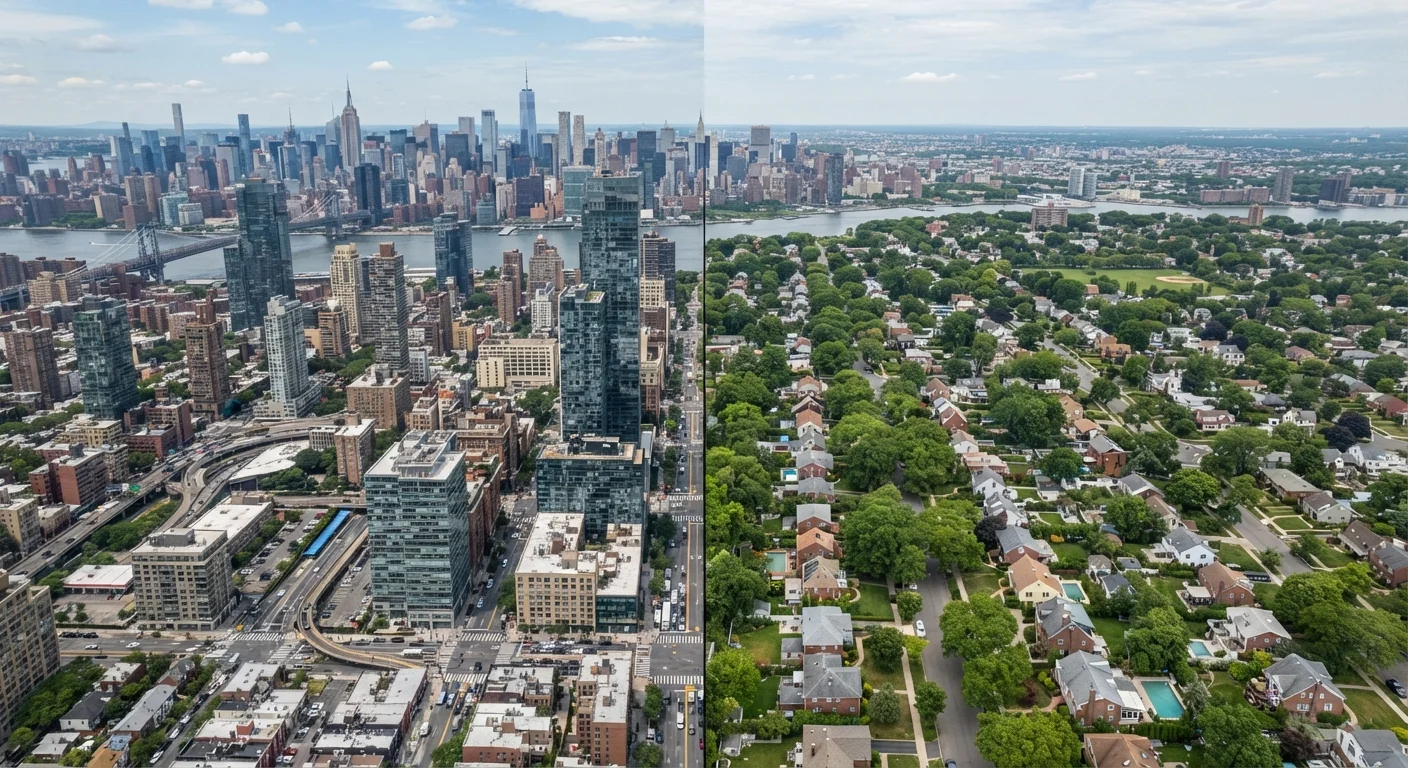
Urban markets - defined broadly as dense, walkable city centers - are heavily influenced by job proximity, transit infrastructure, and the concentration of renters. Suburban markets, by contrast, are shaped more by school district reputation, lot size expectations, and the availability of new construction. These aren't just preferences; they translate into meaningfully different supply and demand dynamics.
The COVID-19 pandemic accelerated a divergence that had been building for years. As remote and hybrid work reduced the necessity of daily commutes, many households reassessed whether urban density justified its premium. Suburban and exurban areas absorbed much of that outflow, pushing prices and competition higher in markets that had previously been more stable.
| Urban Markets | Suburban Markets | |
|---|---|---|
| Primary demand driver | Employment density and transit access | School quality and space affordability |
| Renter share | Typically higher | Typically lower |
| New construction role | Limited by zoning and land scarcity | More prevalent; shapes supply meaningfully |
| Remote work impact | Reduced demand pressure in some cores | Increased competition from relocated workers |
| Price per square foot | Generally higher | Generally lower relative to urban |
| Market volatility | Tied closely to major employer activity | More influenced by migration and rate sensitivity |
| Infrastructure sensitivity | Transit investment drives premiums | Road, broadband, and school investment drives growth |
Key Demand Drivers in Urban Housing Markets
Urban housing demand is closely tied to employment clusters. When major employers concentrate in a city center, workers compete for nearby housing - driving up both rents and purchase prices. This is why tech hubs, financial districts, and healthcare campuses tend to anchor urban price growth even when broader national trends soften.
Rental demand also plays a larger structural role in cities. A higher share of urban residents rent rather than own, meaning landlord investment activity influences overall market conditions more than in suburban areas. High renter concentrations can sustain demand even when ownership affordability declines.
Walkability and transit access represent genuine pricing premiums in urban environments. Properties near transit corridors or in highly walkable neighborhoods consistently command higher prices - a relationship that reflects both convenience and the relative scarcity of such locations. Zoning restrictions in many cities limit new density, compounding supply constraints and keeping prices elevated.
Evaluate Transit Access Before Assuming Urban Premiums
Not all urban neighborhoods command a walkability or transit premium equally. Before assuming a city address justifies a higher price, check the property's actual Walk Score and proximity to active transit lines. Urban micro-locations vary widely, and a city ZIP code alone doesn't guarantee the demand characteristics associated with truly walkable, transit-rich neighborhoods.
Key Demand Drivers in Suburban Housing Markets
Suburban demand is driven by a distinct set of household priorities. School district quality consistently ranks among the strongest predictors of suburban home values - buyers with children often treat attendance zones as a non-negotiable filter before evaluating any other property attribute.
Space and affordability relative to urban alternatives are also central. Suburbs typically offer larger floor plans and lot sizes at lower per-square-foot costs, which becomes especially compelling when urban prices rise sharply. This relative value proposition tends to intensify during rate-sensitive periods when buyers' purchasing power is squeezed.
Infrastructure investment - road networks, broadband access, and commercial development - increasingly determines which suburban communities attract sustained demand. Fast-growing suburbs often benefit from retail and office development that follows residential growth, creating self-reinforcing demand cycles. Understanding how housing inventory shapes local markets is especially relevant in suburbs where new construction plays a larger role in supply.
How Migration and Remote Work Are Reshaping Demand Patterns
Internal migration flows have become one of the most significant forces reshaping urban-suburban demand balances. Data from the US Census Bureau and various academic studies indicate that many large coastal metros experienced net population outflows during the early 2020s, while Sun Belt suburbs and mid-sized metros absorbed significant in-migration.
Remote work expanded the feasible commute radius for a large segment of the workforce. A buyer willing to commute two or three days per week can realistically consider communities 40-60 miles from a city center that would have been impractical for daily commuters. This shift extended competitive pressure well into exurban areas previously insulated from urban price dynamics.
That said, the picture isn't static. Return-to-office mandates from major employers have renewed urban housing demand in some metros, partially reversing earlier suburban momentum. The durability of remote work arrangements - and therefore the durability of suburban demand premiums - remains uncertain. Buyers and sellers alike benefit from tracking key market indicators at the local level rather than relying on national narratives.
~24%
US workers fully remote post-pandemic
Pew Research Center surveys conducted in the early 2020s estimated roughly one in four workers performed their jobs entirely remotely at various points, reshaping commute-radius housing decisions.
Top 10
Large US cities with net out-migration
US Census Bureau data from 2020-2022 showed several major metros including New York and San Francisco recording net domestic out-migration, redistributing housing demand to suburban and Sun Belt markets.
15-25%
Walkability premium on urban home values
Research from real estate economists has generally found that high walkability scores are associated with meaningful price premiums in dense urban neighborhoods compared to car-dependent equivalents.
What This Means for Buyers, Sellers, and Market Observers
The urban-suburban distinction is a useful frame, but it can obscure wide variation within each category. A suburb adjacent to a thriving employment hub may be more competitive than a city neighborhood experiencing population decline. Whether conditions favor buyers or sellers depends far more on local supply-demand balance than on whether a market is technically urban or suburban.
For buyers, the practical implication is to evaluate each target market on its own fundamentals: months of supply, days on market, price-to-income ratios, and recent migration trends. For sellers, understanding what type of buyer is active in their specific submarket - urban professional, relocating family, investor - informs pricing and presentation strategy more than broad geographic labels.
Market observers tracking broader housing trends should treat urban and suburban data separately rather than aggregating them. Composite metro-level figures often mask divergent micro-market dynamics that matter most to people making real property decisions.
National Trends Can Mislead Local Decisions
Headlines about national housing market conditions frequently obscure significant variation between individual metros, neighborhoods, and property types. A market described as cooling nationally may still be highly competitive in specific suburban corridors, and vice versa. Always consult local inventory data, days-on-market figures, and a qualified real estate professional before making decisions based on broad market summaries.