

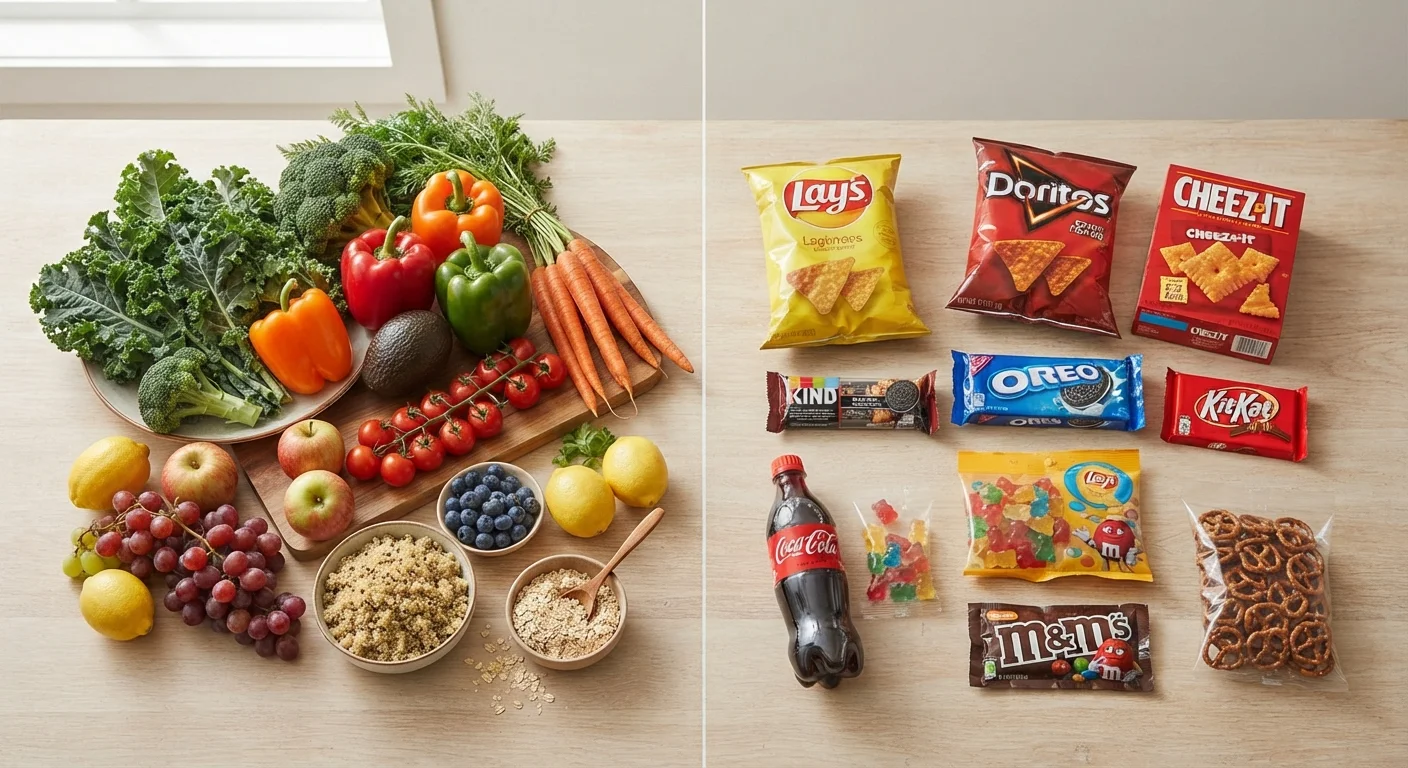
Key Takeaways
- Processing exists on a spectrum - canned beans and packaged cookies are not nutritionally equivalent.
- Whole foods generally retain more fiber, vitamins, and minerals than heavily processed alternatives.
- Ultra-processed foods are consistently linked to poorer health outcomes in population research.
- Many minimally processed foods - frozen vegetables, plain yogurt - are nutritionally sound choices.
- Reading nutrition labels helps you distinguish between processing levels at the grocery store.
Option A
Whole Foods
Minimally altered, nutrient-dense foods close to their natural state.
Best for: People seeking to maximize fiber, micronutrients, and satiety without added ingredients.
Option B
Processed Foods
A broad category ranging from lightly modified staples to heavily engineered products.
Best for: Convenient, affordable nutrition when chosen thoughtfully - not all processing degrades food quality.
If you want to maximize nutrient density in every meal
Whole Foods
Whole foods deliver fiber, phytonutrients, and micronutrients with minimal interference from added sugars, sodium, or industrial additives.
If convenience and food budget are primary concerns
Processed Foods
Minimally processed options like canned legumes, frozen vegetables, and plain oats offer strong nutritional value at lower cost and prep time.
If you're trying to reduce added sugars and sodium intake
Whole Foods
Whole and minimally processed foods naturally contain little to no added salt or sugar, making portion control and label-reading far simpler.
If you want a realistic, sustainable everyday diet
Processed Foods
A balanced approach that includes minimally processed staples alongside whole foods is practical, affordable, and supported by dietary evidence.
What Do These Terms Actually Mean?
The words "whole" and "processed" get used loosely in nutrition conversations, which creates more confusion than clarity. A working definition helps: whole foods are foods consumed close to their natural state - an apple, a handful of oats, a piece of fish. Processed foods are any foods that have been altered from their original form, even if minimally.
That second definition covers an enormous range. Pasteurized milk, washed and bagged spinach, and roasted nuts are all technically processed - yet so are cheese puffs and fast-food chicken nuggets. Treating them as a single category is one of the most persistent oversimplifications in popular nutrition. Public health researchers increasingly use classification systems like NOVA, which sorts foods into four groups based on the extent and purpose of processing, from unprocessed whole foods to ultra-processed formulations.
The NOVA Classification System
NOVA, developed by researchers at the University of São Paulo, categorizes foods into four groups based on the extent of industrial processing rather than nutrient content alone. It distinguishes minimally processed foods from "ultra-processed" products engineered for palatability and shelf life. While NOVA is widely used in public health research, it is a research tool rather than an official dietary guideline. Some nutritionists debate its boundaries, but it provides a useful framework for understanding why not all processed foods carry the same health implications.
Understanding where a food falls on that spectrum is more useful than a binary "good vs. bad" framing, and it's a skill you can develop without any specialized training.
The Spectrum: From Minimally Processed to Ultra-Processed
Think of food processing as a dial rather than a switch. At one end sit unprocessed or minimally processed foods: fresh produce, eggs, plain legumes, unseasoned meat. These retain essentially all of their original nutritional structure - fiber intact, vitamins undiminished, no ingredients added.
In the middle are processed culinary ingredients and moderately processed foods: olive oil, flour, canned tomatoes (often with just salt), frozen vegetables, plain yogurt, and hard cheeses. These have been transformed but still function nutritionally in ways close to their source ingredients. Frozen vegetables, for instance, are typically flash-frozen at peak ripeness and can match - or exceed - fresh produce in certain vitamins.
At the far end sit ultra-processed foods (UPF): packaged snacks, sweetened beverages, instant noodles, and many breakfast cereals. These products are typically assembled from refined ingredients plus additives - emulsifiers, flavor enhancers, colorants - that have no whole-food equivalent. Large-scale epidemiological studies, including a 2019 analysis published in JAMA Internal Medicine, have associated high UPF consumption with increased all-cause mortality, though researchers note these associations do not prove direct causation.
| Criterion | Whole / Minimally Processed | Ultra-Processed |
|---|---|---|
| Fiber content | High - naturally intact | Often low - removed in refining |
| Added sugars | None | Frequently high |
| Sodium | Naturally low | Often elevated for flavor/preservation |
| Ingredient list length | One to a few recognizable items | Long, includes additives and emulsifiers |
| Micronutrient retention | Generally high | Reduced; sometimes fortified artificially |
| Satiety per calorie | Typically higher due to fiber and protein | Often lower - easier to overconsume |
| Cost and convenience | Variable; some are very affordable | Often convenient but not always cheaper |
Why Fiber and Nutrient Density Matter
One of the most consistent nutritional differences between whole and ultra-processed foods is fiber. Refining grains removes the bran and germ - the parts richest in fiber, B vitamins, and minerals - leaving mostly starch. The U.S. Dietary Guidelines recommend 25-38 grams of fiber per day depending on age and sex, yet most Americans fall significantly short of that target, largely due to reliance on refined grain products.
Fiber supports gut microbiome diversity, slows glucose absorption, and promotes satiety. Whole grains, legumes, vegetables, and fruits supply it naturally. You can explore how fiber, sugar, and starch interact in more detail - but the core point is that processing often strips fiber out and adds sugar in, shifting a food's metabolic effect substantially.
Micronutrient retention follows a similar pattern. Some processing - like cooking - can actually increase bioavailability of certain nutrients (lycopene in tomatoes, for example). But heavy refining, extended shelf-stability treatments, and high-heat manufacturing generally reduce vitamin content relative to minimally processed equivalents.
Making Practical Sense of It at the Store
Navigating a grocery store doesn't require memorizing a classification system. A few practical signals help: shorter ingredient lists usually indicate less processing; the presence of added sugars, hydrogenated oils, or unfamiliar additives signals a more heavily processed product. Learning to read a nutrition label fluently is one of the most empowering skills in everyday nutrition - see our guide to reading nutrition labels for a row-by-row walkthrough.
Budget is a real constraint. The assumption that eating well requires expensive whole foods is a barrier worth examining. Plain oats, dried lentils, frozen spinach, and canned sardines are all minimally processed, nutritionally rich, and affordable. Our article on eating well on a budget addresses this directly with evidence-informed strategies.
The goal isn't eliminating all processed food - that's neither realistic nor necessary. It's shifting the balance toward foods that retain more of what the body needs, without excessive additives or refined ingredients.
This article is for general informational and educational purposes only and does not constitute medical or dietary advice. Consult a registered dietitian or qualified healthcare professional for guidance tailored to your individual health needs.