

Key Takeaways
- Open shelving improves item visibility but requires regular tidying to avoid looking cluttered.
- Closed cabinets conceal disorder and reduce dust accumulation on stored items.
- Your household's tidying habits matter more than aesthetics when choosing a storage style.
- Many homes benefit from a mixed approach, using open shelves for frequently used items and cabinets for everything else.
- Neither option is universally superior - the right choice depends on space, lifestyle, and maintenance tolerance.
Option A
Open Shelving
The visible, accessible display approach.
Best for: Households that stay consistently tidy and want everyday items within quick, easy reach.
Option B
Closed Cabinets
The contained, clutter-concealing classic.
Best for: Households that prioritize a clean visual appearance and need to store varied or mismatched items out of sight.
If you want quick access to everyday items without hunting through doors
Open Shelving
Open shelves put everything at a glance, reducing the friction of daily routines in kitchens, offices, or living areas.
If you struggle to maintain consistent tidiness or have young children
Closed Cabinets
Cabinets hide visual noise instantly, making spaces feel calm even when organization inside is imperfect.
If dust and cleaning effort are a concern
Closed Cabinets
Enclosed storage shields items from airborne grease, dust, and moisture - especially valuable in kitchens and bathrooms.
If you want to display curated collections or decorative pieces
Open Shelving
Open shelves invite intentional display, turning functional storage into a design element that reflects personal style.
If you're organizing a utility or storage-heavy space like a garage or basement
Closed Cabinets
Utility spaces benefit from the containment and protection that cabinet doors provide for tools, supplies, and seasonal items.
How Each Approach Handles Visibility and Access
The most immediate difference between open shelving and closed cabinets is what you see - and how quickly you can reach what you need.
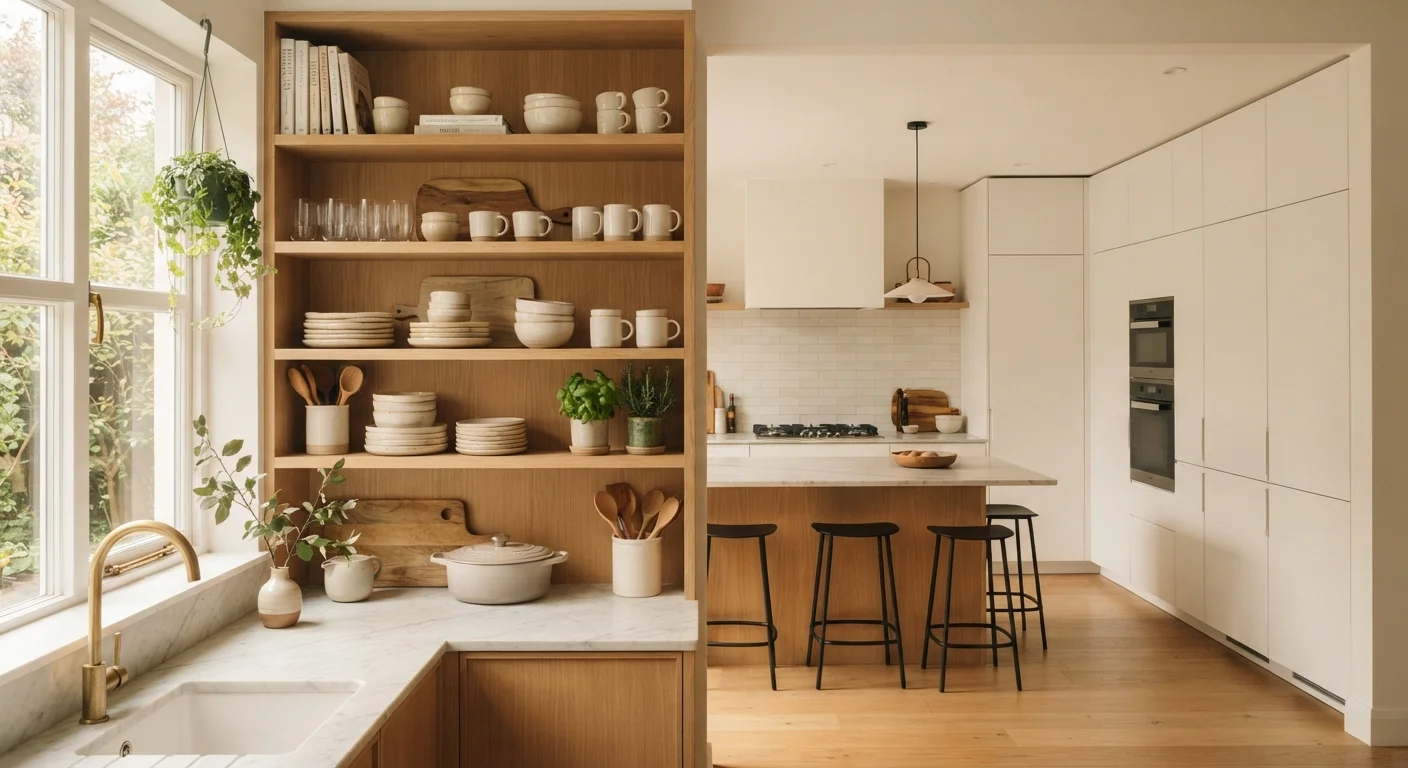
Open shelving puts every item on display. That visibility has a real practical upside: you can spot what you need without opening a door, which speeds up routines in high-traffic spaces like kitchens and home offices. The trade-off is that the shelf itself becomes a performance. Every cup, book, or container is visible to anyone in the room, so disorder reads instantly as mess.
Closed cabinets operate on a different logic. The door creates a visual boundary that separates the room's appearance from what's happening inside the storage. A cabinet can contain a loosely organized jumble and still look orderly from the outside. That buffer reduces daily maintenance pressure - but it also means you're relying on memory or labeling to know what's where.
For households that do a lot of cooking, open shelving for frequently used items (everyday dishes, spices, cooking oils) can make genuine sense. For a kitchen organization starting point, it's worth mapping which items you reach for daily versus weekly before deciding which storage type fits each zone.
| Criterion | Open Shelving | Closed Cabinets |
|---|---|---|
| Item visibility | Everything visible at a glance | Items hidden behind doors |
| Access speed | Immediate, no doors to open | Slightly slower; requires opening |
| Dust accumulation | Higher - items exposed to air | Lower - doors limit particles |
| Visual clutter impact | High - disorder shows instantly | Low - mess is concealed |
| Tidying maintenance | Frequent, ongoing | Less frequent, more forgiving |
| Decorative potential | Strong - doubles as display | Limited to cabinet exteriors |
| Best storage candidates | Attractive, frequently used items | Utilitarian or mismatched items |
Maintenance, Dust, and the Real Cost of Each Style
Maintenance is where many open-shelving enthusiasts find themselves reconsidering. Exposed surfaces collect dust, grease residue in kitchens, and ambient moisture in bathrooms. Items stored on open shelves require periodic wiping - both the shelf and the objects on it. The more items you display, the more surface area you're committing to clean.
Closed cabinets are not maintenance-free, but the cleaning burden is more contained. Cabinet interiors tend to stay cleaner longer since doors limit airborne particles. The exterior surfaces - doors, handles, and frames - are easier to wipe down quickly than rows of individual objects.
62%
Americans who say clutter causes stress
A survey by the American Psychological Association found that a majority of adults report that a disorganized home contributes to feelings of stress and anxiety.
3x
More surface area to clean on open shelves
Home organization experts commonly note that open shelving can require up to three times more wiping surface per storage unit compared to equivalent closed cabinetry.
The question of maintenance connects directly to habit and household routine. If you cook often and wipe counters daily, extending that habit to open shelves may feel natural. If cleaning happens in bursts rather than continuously, closed cabinets will serve you better between sessions.
It's also worth considering what you're storing. Glassware, decorative ceramics, and books are lower-maintenance on open shelves than pantry staples, cleaning supplies, or anything that gets replaced irregularly. Mismatched or utilitarian items tend to look better behind a door.
Clutter Control and Visual Calm
One of the most underestimated organizational factors is visual noise - the cognitive load created by seeing too many objects at once. Open shelving amplifies visual complexity; closed cabinets reduce it.
Research in environmental psychology broadly supports the idea that cluttered visual fields increase perceived stress, though the degree varies by individual. For households where visual calm is a priority - or where family members find clutter distracting - closed cabinets offer a meaningful advantage that has nothing to do with how organized you actually are inside them.
That said, open shelving can contribute to calm when used intentionally. A shelf displaying a small number of carefully chosen, visually cohesive items (uniform containers, a single color family, items of similar height) can feel ordered rather than chaotic. The minimalist approach to home organization applies here: fewer items on display are easier to maintain and easier to look at.
If reducing clutter overall is your current challenge, the storage type matters less than the total quantity of items you own. See how different approaches compare in our guide to decluttering methods.
Renting or Planning a Renovation?
If you rent your home, open shelving is often easier to add without permanent modification - freestanding shelving units require no installation and can move with you. Renters considering wall-mounted options should check their lease terms first. If you're planning a renovation with built-in cabinetry, consult a licensed contractor or cabinet installer to ensure structural requirements and any applicable building codes are met.
Finding the Right Mix for Your Home
Few homes benefit from committing entirely to one approach. A hybrid strategy - open shelving for a defined subset of items, cabinets for everything else - tends to outperform either extreme in most real-world households.
A practical starting point: identify the items you access every single day and consider whether they're worth keeping visible and reachable. Then ask honestly how much tidying effort you're willing to sustain. That intersection usually points to the right ratio.
In kitchens, open shelves work well for everyday dishes and a few decorative pieces; cabinets handle the pantry staples, appliances, and cleaning supplies. In living areas, open shelves suit books and curated objects; closed storage handles remotes, cords, and miscellaneous items. Utility spaces like garages and basements almost always favor closed storage - see our guide to organizing utility spaces for room-specific strategies.
Whatever combination you choose, the organizing principle stays the same: match the storage type to the item's use frequency, visual appeal, and your realistic maintenance habits - not to what looks appealing in a photo.