

Key Takeaways
- Systems built around how kids actually behave are far more sustainable than perfection-focused setups.
- Age-appropriate storage lets children participate in tidying, reducing the burden on parents.
- Reducing the total number of items in rotation makes any organizational system easier to maintain.
- Consistent reset routines - not constant tidying - are the backbone of a calmer family home.
- Flexibility matters: organization with kids means adjusting systems as children grow and habits shift.
Why Standard Organization Advice Often Fails Families
Most home organization advice is written with adults in mind - and it shows. Neat rows of matching containers, precisely folded items, and surfaces kept clear all look wonderful in photos. In a home with children, though, those systems often collapse within days. That's not a failure of effort; it's a mismatch between the system and reality.
Organizing a home with kids requires a different starting point: design for the people who actually live there, at their actual developmental stages. Before rethinking any storage setup, it's worth understanding why decluttering should come before reorganizing - the same principle applies here, perhaps even more urgently when toys and gear accumulate fast.
The approaches below aren't about achieving showroom-ready results. They're about building systems that hold up under daily use and don't require constant adult intervention to maintain.
Match storage height and accessibility to the child's age
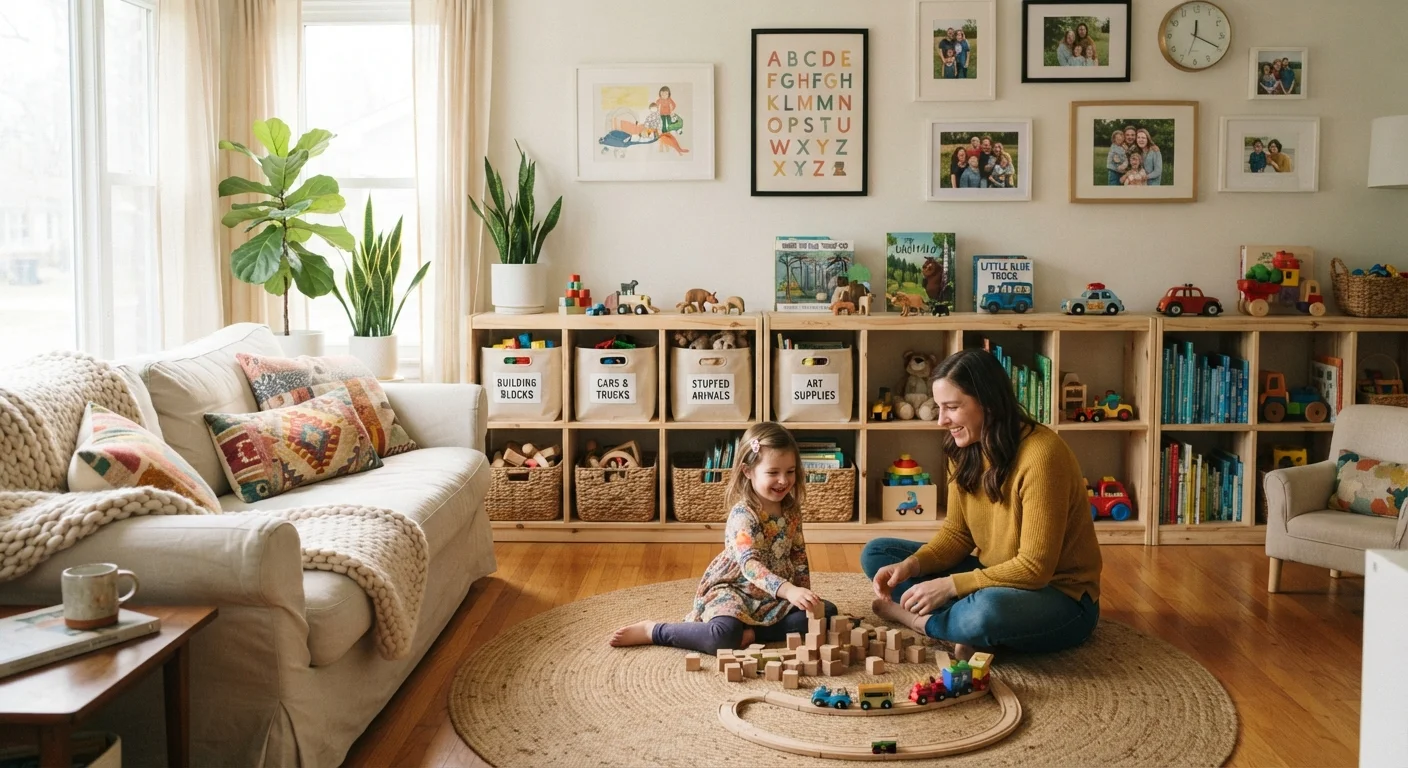
One of the most practical changes families can make is repositioning storage so children can actually reach it. Hooks at shoulder height, low shelving, and open bins placed near the floor allow younger children to put things away without adult help. When kids can complete the full loop - take out, use, return - they're far more likely to do so.
As children grow, storage can move up or become more complex. Adjustable shelving units are useful precisely because they can evolve. The goal is always independence: the fewer barriers between a child and putting something away, the more often it will happen.
When kids can reach their own storage, they're far more likely to use it.
Limit what's in active rotation at any given time
Having fewer items out doesn't mean eliminating things - it means rotating them. Many families find that keeping a portion of toys, books, or craft supplies stored away and cycling them periodically reduces clutter without reducing enjoyment. Children often engage more deeply with a smaller set of things than when overwhelmed by too many options.
This approach also makes tidying dramatically faster. When a playroom has 20 items rather than 80, a five-minute cleanup is actually achievable. A minimalist approach has real trade-offs, but thoughtful rotation isn't minimalism - it's practical curation.
Rotating toys in and out keeps spaces manageable and children more engaged.
Use visual cues and simple labeling systems
Text-only labels work well for older children and adults, but younger kids respond better to picture labels or color coding. A bin with a photo of blocks on the front communicates exactly where blocks go, even before a child can read. This small investment in labeling does a lot of the organizational work passively.
Color coding can extend across zones - blue bins for art supplies, green for outdoor gear - so that even a young child can sort by color alone. Keep the system consistent and simple enough that guests, grandparents, and babysitters can also follow it without a tutorial.
Picture labels and color coding let children sort independently, well before they can read.
Build a daily reset routine rather than continuous tidying
Trying to keep a home tidy throughout the day with active children is exhausting and largely futile. A more sustainable model is a predictable daily reset - a short window, often before dinner or at bedtime, when everyone participates in returning things to their designated spots. This contains the mess to defined periods rather than turning tidying into a constant task.
For younger children, making this routine consistent and even playful - a cleanup song, a timer, a shared checklist - builds the habit without friction. The key is that the routine happens every day, not only when things feel out of control.
A brief daily reset routine is more sustainable than trying to maintain order all day.
Design dedicated zones for different activities
When everything has a general place but no specific home, clutter accumulates quickly. Defining clear zones - a reading corner, an art table, a homework station - gives each type of activity its own footprint and makes cleanup more intuitive. Children learn to associate a space with a behavior, which reduces the spread of items across the whole house.
Zones don't require separate rooms. Even in a small home, a low shelf designated for art supplies or a basket near the door for backpacks and shoes creates enough structure to prevent sprawl. Before establishing zones, it's worth asking a few clarifying questions about what each space actually needs to serve.
Clear activity zones make cleanup intuitive and help contain mess to defined areas.
Involve children in maintaining the system they helped design
Systems imposed on children without their input tend to get ignored. When kids have a say - even simple choices like which bin color goes where, or how to arrange their bookshelf - they feel ownership over the space and are more invested in keeping it orderly. This participation doesn't need to be elaborate; small decisions create meaningful buy-in.
For older children, this can extend to participating in periodic decluttering decisions about their own belongings - deciding what to pass on, store, or keep in rotation. These are practical life skills, and practicing them at home builds habits that carry forward.
Children who help design their storage systems are more likely to maintain them.
Making It Stick Over Time
Even the most thoughtfully designed system needs occasional reassessment. Children's needs shift as they grow, and a setup that worked for a five-year-old may frustrate an eight-year-old - or become too babyish for them to take seriously. Scheduling a brief seasonal review of storage, labeling, and routines helps you stay ahead of these transitions rather than reacting after chaos has set in.
Schedule a seasonal system review
Set a recurring reminder - perhaps at the start of each season - to walk through your home's organizational systems with your kids. Ask what's working, what feels frustrating, and what's changed since the last review. A 20-minute conversation can prevent months of accumulated disorder and helps children feel heard as the family home evolves around their needs.
It also helps to manage expectations - both your own and your children's. Families who find this balance most sustainable tend to focus on correcting common misconceptions about what organized homes actually look like and aim for functional and calm rather than picture-perfect. And if whole zones of your home - the garage, a basement storage area - have become overflow for outgrown gear, a targeted approach to tackling those avoided spaces can free up significant breathing room throughout the rest of the house.