

Key Takeaways
- Clutter creates a persistent low-level cognitive load that drains mental energy even when you're not actively looking at it.
- Disorganized spaces are linked to elevated cortisol levels, particularly in home environments where people expect to relax.
- Clutter signals unfinished tasks to the brain, keeping your mind in a state of low-grade alertness.
- Emotional attachment to objects - not laziness - is one of the primary reasons clutter accumulates.
- Small, consistent organizational habits are more effective than infrequent overhauls for long-term calm.
Clutter Overwhelm
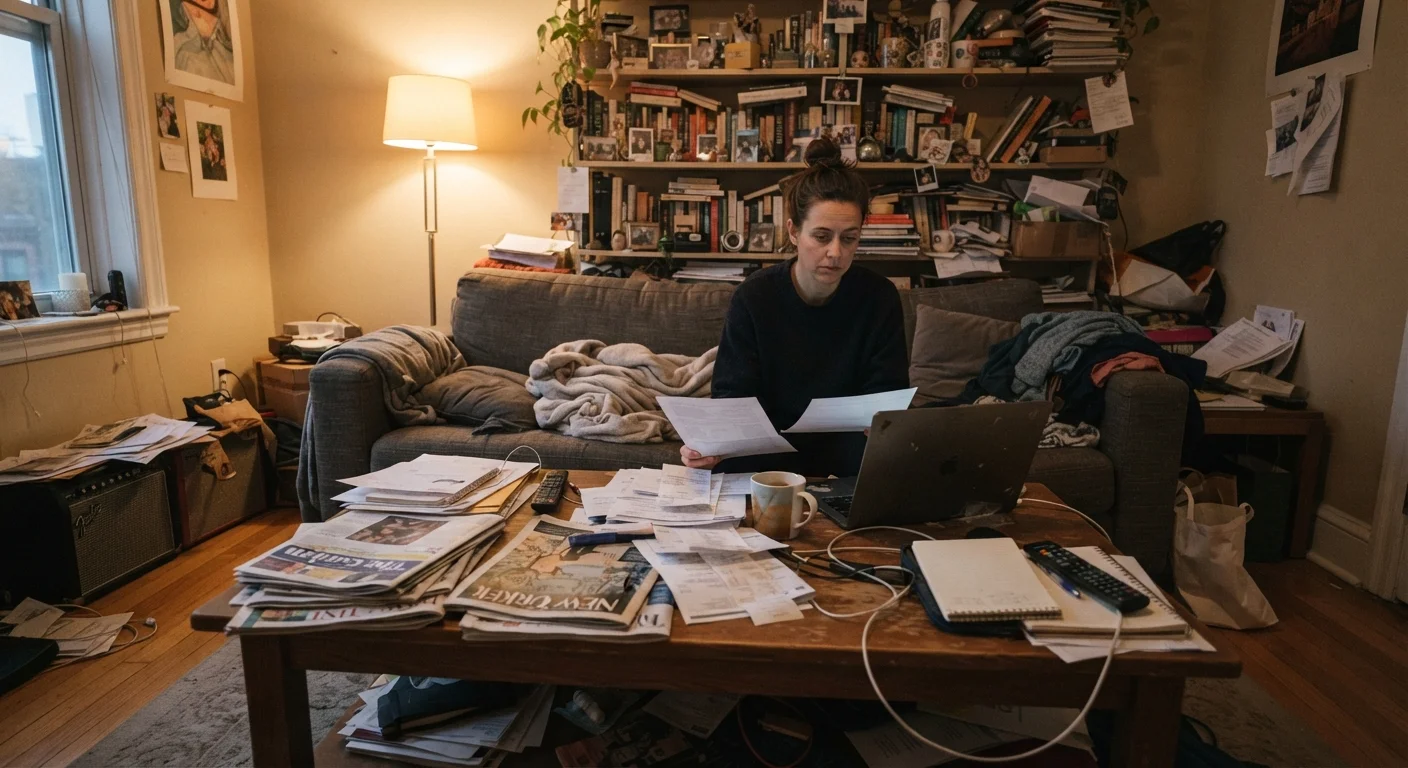
Clutter overwhelm is the cognitive and emotional stress response triggered by disorganized or visually chaotic environments. It's not simply about having too many objects - it's about what those objects demand from your brain. When your surroundings are cluttered, your mind must continuously process competing visual signals, which depletes mental energy and elevates stress.
Researchers describe this as "attentional residue" - the brain's inability to fully disengage from irrelevant stimuli in the visual field, which taxes working memory and executive function.
Why Your Brain Treats Clutter as a Threat
Your brain is a pattern-recognition machine constantly scanning your environment for signals that require action. Clutter floods that system. Every stray object - an unopened envelope, a pile of laundry, a tangle of cables - registers as an unresolved cue. The brain logs each one as a potential task, and that list never fully empties when you're surrounded by disorder.
This is why cluttered spaces feel exhausting even when you aren't doing anything strenuous. You're not resting; you're managing a quiet, continuous stream of mental alerts. Neuroscientists refer to this as cognitive load - the total amount of information your working memory must hold at any given moment. A visually complex environment raises that load whether you're aware of it or not.
“Clutter is not just a physical phenomenon. It is an external representation of internal states - and the relationship between the two runs in both directions.”
— Sherrie Bourg Carter, Psychologist and author writing on stress and environment
The result is a kind of slow drain on mental resources. Decision-making becomes harder. Focus feels slippery. And because the home is typically where people expect to recharge, clutter creates a particularly frustrating contradiction: the place meant to restore you is instead depleting you.
The Emotional Weight of Accumulated Stuff
Clutter isn't always the product of carelessness. More often, it reflects emotional complexity. Objects carry meaning - they're tied to memories, relationships, aspirations, and identity. A box of inherited items in the corner isn't just taking up space; it may represent grief, obligation, or unresolved decisions that feel too heavy to face on a Tuesday afternoon.
Separate the Object from the Decision
When you feel paralyzed about whether to keep something, ask yourself: 'Am I keeping this object, or am I avoiding a decision?' Naming the real obstacle - a complicated emotion, a fear of regret - often makes it easier to address directly rather than continuing to carry it as physical clutter. Give yourself a defined window (ten minutes, one shelf) to make small decisions rather than open-ended sorting sessions.
Psychologists sometimes use the term avoidance coping to describe this pattern. When a decision or emotion feels overwhelming, postponing it is the brain's way of protecting itself - but physical objects become the stand-ins for those deferred choices. The pile on the kitchen counter isn't just clutter; it's a tangible record of everything you haven't quite dealt with yet.
Understanding this dynamic matters because it reframes the problem. Clutter isn't a character flaw. It's often a symptom of a pace of life that outpaces our capacity to process it. That's a more useful starting point than shame.
For a deeper look at how chronic stress accumulates and what that looks like in daily life, see Signs Your Stress Load Has Become Too Heavy to Carry Alone.
What the Research Suggests About Clutter and Stress
Several studies have explored the relationship between home environments and stress hormones. A notable study published in Personality and Social Psychology Bulletin found that women who described their homes using words associated with clutter or unfinished projects had higher levels of cortisol - a primary stress hormone - throughout the day compared to those who described their spaces as restful or restorative.
54%
Americans overwhelmed by their clutter
A survey by the National Association of Professional Organizers found that the majority of Americans feel their homes have too much clutter, and many report not knowing what to do about it.
40%
Increase in perceived home stress from clutter
Research published in Personality and Social Psychology Bulletin found elevated cortisol throughout the day in participants who described their homes as cluttered compared to those describing restful environments.
1 hour
Average time lost daily searching for misplaced items
Various organizational research sources have estimated that disorganized households cost residents meaningful time weekly tracking down misplaced objects, adding to frustration and inefficiency.
While this research doesn't establish a simple cause-and-effect relationship, it does suggest that the way we perceive our environment has measurable physiological effects. Feeling like your home is unfinished or chaotic may sustain a stress response that wouldn't otherwise persist into your evening hours.
It's worth noting that clutter's impact varies by person. Some individuals function comfortably in environments that others find distressing. Factors like ADHD, anxiety sensitivity, and life circumstances all shape how much disorder a person can absorb before it begins to interfere with well-being.
Moving From Understanding to Action
Knowing why clutter feels overwhelming is genuinely useful - it removes the self-blame and replaces it with a more productive framework. The goal isn't a perfectly styled interior. It's creating enough visual calm that your home can do what it's supposed to do: support rest, connection, and focus.
That starts with reduction before reorganization. Buying more storage containers for an overfull space doesn't resolve the underlying load - it often just relocates it. If you're tempted to rearrange before you edit, learn why decluttering must come before organizing for a clearer path forward.
For hands-on guidance, the room-by-room decluttering walkthrough breaks the process into manageable sections so the project never feels monolithic. And once you've cleared the excess, organizational habits that actually stick can help you maintain the calm without relying on willpower alone.