

| VoLTE requirement | Both device and carrier must support it |
| Wi-Fi Calling charges | Usually counts as standard plan minutes |
| APN settings needed | Mainly when switching carriers or using an MVNO |
| eSIM support | Available on most flagship phones since 2018 |
| Roaming indicator | "R" or triangle icon in the status bar |
| HD Voice indicator | HD icon displayed during an active VoLTE call |
Why These Terms Matter
Flip through your phone's Settings app or squint at a carrier plan description, and you'll run into abbreviations like VoLTE, Wi-Fi Calling, and APN - terms that rarely come with explanations. They aren't just marketing language. Each one controls how your phone makes calls, delivers data, and connects to the network. Understanding them helps you troubleshoot dropped calls, figure out why a feature isn't working, or simply know what you're paying for.
This guide defines the most common terms in plain language. No engineering background required. For a broader look at spec-sheet jargon across all your devices, see our tech spec glossary.
| VoLTE requirement | Both device and carrier must support it |
| Wi-Fi Calling charges | Usually counts as standard plan minutes |
| APN settings needed | Mainly when switching carriers or using an MVNO |
| eSIM support | Available on most flagship phones since 2018 |
| Roaming indicator | "R" or triangle icon in the status bar |
| HD Voice indicator | HD icon displayed during an active VoLTE call |
Mobile Data, Calling, and Network Basics
Mobile Data is the cellular connection your phone uses to access the internet when you're not on Wi-Fi. It runs over your carrier's radio network - the same infrastructure that carries your voice calls. Data is measured in megabytes (MB) and gigabytes (GB), and most plans cap or slow it after a threshold.
VoLTE (Voice over LTE) routes phone calls as data packets over a 4G LTE or 5G network instead of the older circuit-switched voice network. The practical benefit is noticeably clearer audio, faster call connection times, and the ability to browse the internet while talking - something older networks couldn't do simultaneously. VoLTE requires both your phone and your carrier to support it. If your device shows an HD icon during a call, VoLTE is active.
Wi-Fi Calling lets your phone route calls and texts over a Wi-Fi connection rather than a cellular signal. It's especially useful in buildings with poor cell reception but a reliable Wi-Fi network. Most modern smartphones support it, though you may need to enable it in Settings and confirm your carrier has it activated on your account. Calls made over Wi-Fi typically count against your regular plan minutes, not as separate charges.
VoLTE
Voice over LTE - a technology that carries phone calls as data over a 4G or 5G network. It produces clearer audio than older voice networks and allows simultaneous calling and data use.
Wi-Fi Calling
A feature that routes calls and SMS messages over a Wi-Fi connection instead of a cellular signal. Useful in low-coverage areas with available Wi-Fi.
APN
Access Point Name - a configuration setting that directs your phone to the correct gateway on your carrier's network for mobile data. Incorrect APN settings can prevent data from working.
eSIM
An embedded SIM card built into the phone's hardware. It can be programmed digitally with a carrier plan, eliminating the need for a physical SIM card.
Roaming
When your phone connects to a partner carrier's network outside your home carrier's coverage area. It may incur extra charges depending on your plan.
LTE
Long-Term Evolution - the 4G wireless standard used for mobile data and VoLTE calls. Most carriers worldwide use LTE as the baseline network layer.
Mobile Data
Internet access delivered over a cellular network, measured in megabytes or gigabytes. Used when a Wi-Fi connection is unavailable or disabled.
HD Voice
A label indicating that a call is using a wideband audio codec, typically enabled by VoLTE. It produces noticeably fuller, clearer sound than standard calls.
For a deeper look at how 5G changes the picture for mobile data and VoLTE, our guide on what 5G actually does covers real-world performance honestly.
Settings Terms You'll Encounter
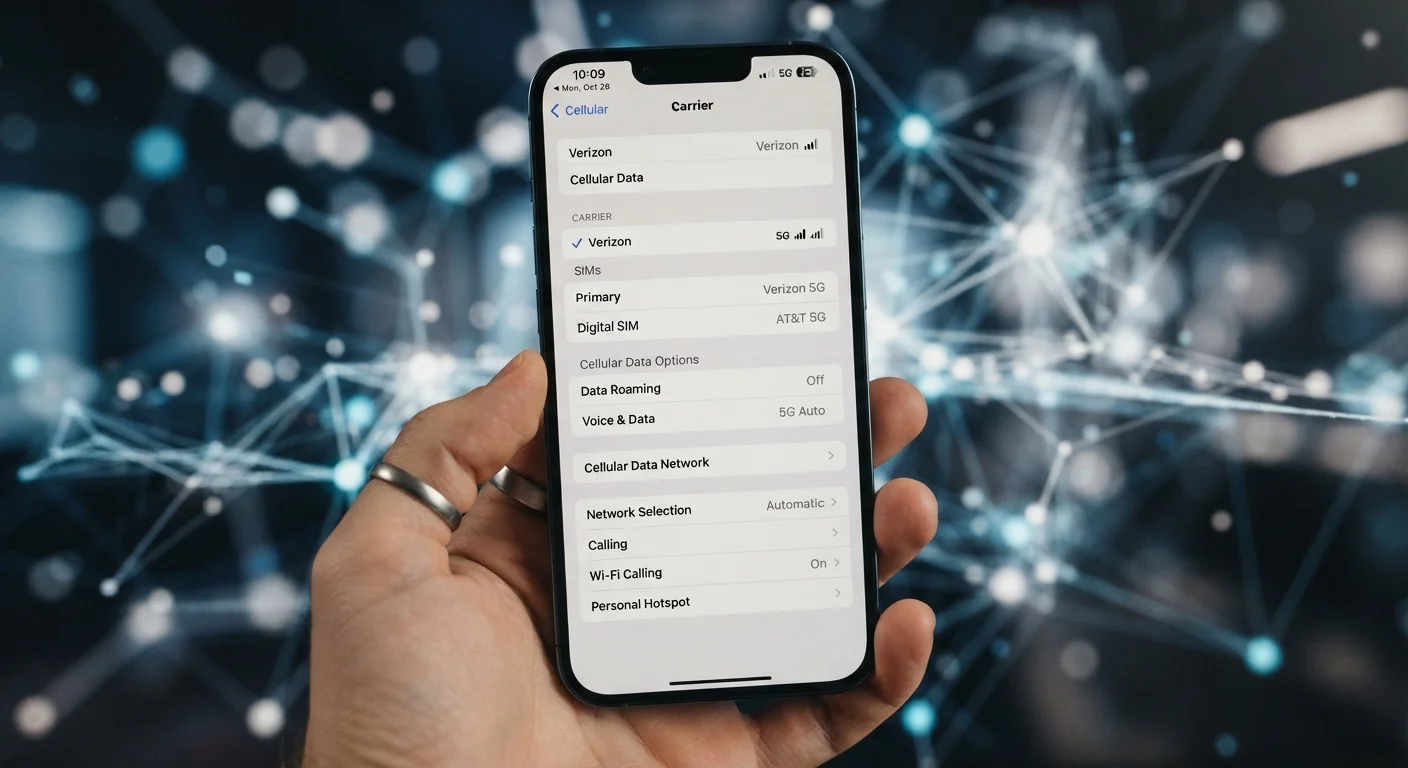
APN (Access Point Name) is a configuration setting that tells your phone how to connect to your carrier's data network. Most carriers push these settings automatically, but if you switch to a new carrier or a budget MVNO, you may need to enter APN details manually. Incorrect APN settings are a common reason mobile data stops working after a SIM swap. Your carrier's support page will list the exact values to enter.
Roaming means your phone is connecting to a partner network outside your carrier's own coverage area - typically when you travel internationally or into a rural area your carrier doesn't directly serve. Data and call roaming can trigger additional charges unless your plan includes it. Many phones show a "R" icon in the status bar when roaming is active.
eSIM (Embedded SIM) is a digital SIM built into modern phones that can be programmed with a carrier plan without inserting a physical card. It allows you to store multiple carrier profiles and switch between them in software - useful for travelers or anyone who wants to keep a secondary number. Understanding whether your phone supports eSIM affects your options when switching carriers. Our article on unlocked vs. carrier-locked phones explains how this intersects with device compatibility.
If you use a budget carrier, many of these settings work identically to major networks because MVNOs lease the same infrastructure. Our guide on how MVNOs work clarifies what you do and don't give up.
2-in-1
VoLTE enables simultaneous calls and data
Unlike older 3G networks, LTE-based voice calls don't interrupt your active data session.
Multiple
Carrier profiles storable on one eSIM
Modern eSIM-capable phones can hold more than one carrier profile, switchable without a physical SIM swap.