

Key Takeaways
- A documented service history can meaningfully support resale value and buyer confidence.
- Maintenance logs help substantiate warranty claims and resolve disputes with service providers.
- Tracking both mileage and dates gives you the most complete picture of your vehicle's health.
- Digital apps and simple spreadsheets work just as well as traditional paper logbooks.
- Every service entry - however minor - contributes to a cumulative safety and reliability record.
Why a Maintenance Log Is More Than an Organizational Tool
Most drivers think of a maintenance log as a convenience - a way to remember when the oil was last changed. In practice, it functions as a legal and financial document that can affect resale negotiations, warranty reimbursements, and even insurance outcomes.
When you go to sell a vehicle, a potential buyer has no way to verify the condition of what they can't see: the timing belt, transmission fluid, brake pads. A written record with dates, mileage, and receipts bridges that trust gap in a way that verbal assurances cannot. Vehicles with verifiable service histories consistently attract more serious buyers and smoother transactions.
For warranty purposes, manufacturers typically require proof of adherence to recommended service intervals before honoring a claim. If a covered component fails and you can't demonstrate that the vehicle received the required maintenance, the claim may be denied - regardless of whether the missed service caused the failure. The log is your evidence.
See our guide to scheduled maintenance intervals to understand what intervals apply to your vehicle and why they exist.
What to Record in Every Entry
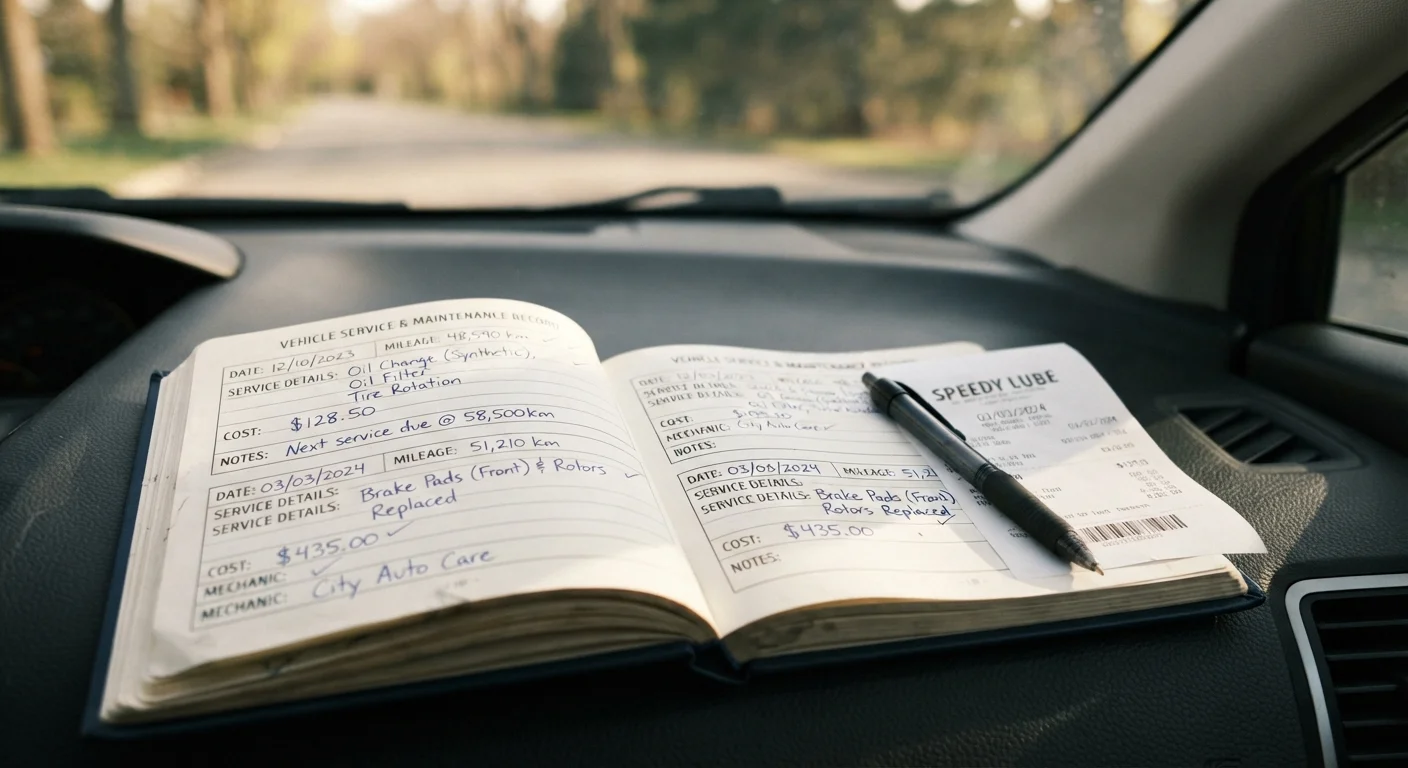
A useful log entry captures six things: the date, the odometer reading, the specific service performed, the parts or fluids used (including brand and specification if relevant), the name and location of the shop or technician, and the total cost. That last detail isn't just for your budget - cost spikes can signal repeat failures worth flagging for a mechanic later.
Don't limit entries to major services. Oil changes, tire rotations, air filter replacements, wiper blade swaps, and fluid top-offs all belong in the record. Minor entries reinforce the pattern of regular attention and make it easier to spot gaps or anomalies over time.
Dealer Records Don't Cover Everything
Dealership service departments maintain their own internal records, but those records may not be accessible to future owners or transferable if the dealership closes or changes ownership. Keeping your own independent log ensures you hold a complete, portable copy of your vehicle's history regardless of where the work was performed.
If you notice a pattern of recurring issues - the same warning light reappearing, the same component being replaced twice in a short period - the log gives you the chronological evidence to have a productive conversation with your mechanic or, if necessary, to escalate a concern. This connects directly to the habits covered in our article on maintenance habits that extend vehicle life.
Choosing the Right Format for Your Habits
There's no single correct format. What matters is consistency. A small spiral notebook kept in the glove compartment works well for drivers who prefer tactile records. A shared spreadsheet stored in cloud storage works well for those who want searchability and automatic backup. Dedicated vehicle maintenance apps - many of which allow photo attachments for receipts - add a layer of organization without requiring manual data entry.
Whichever format you choose, attach or link original receipts whenever possible. A log entry that references a receipt is far stronger than an entry alone, because the receipt typically includes part numbers, labor codes, and a shop's contact information - all useful if a question arises later.
For drivers who track both time and mileage triggers, understanding which threshold applies first is an important part of keeping the log accurate. Our piece on time-based vs. mileage-based service intervals walks through how to decide.
Making the Log Work at Resale and Beyond
When it's time to sell or trade in a vehicle, present the log proactively. Organize entries chronologically and separate them by category - engine, tires, brakes, electrical - so a buyer or dealer can scan it quickly. A well-organized log signals that the vehicle has been driven by someone who takes ownership seriously, which is a quality signal as much as a factual one.
Beyond resale, the log remains useful as a planning tool. By reviewing the full record, you can anticipate what's likely coming due - belts, coolant flushes, brake inspections - and budget for it before the service is urgent. This is one of the most underappreciated advantages of consistent documentation: it shifts maintenance from reactive to planned.
“Documentation is the difference between a car with a history and a car with a mystery. Buyers, mechanics, and insurers all respond better to evidence.”
— Automotive Editorial Team, Vehicle Ownership and Maintenance Desk
For a broader look at everything a well-kept log supports, our companion guide on vehicle maintenance logs covers what to track from day one of ownership. And for all your vehicle upkeep questions, the car maintenance hub is the right starting point.