

Key Takeaways
- Vertical space is almost always underused and can double effective storage capacity.
- Zoning means grouping items by purpose or location of use, reducing search time.
- Drawer dividers work by preventing category drift - the slow mixing of unlike items.
- Frequency-based storage places everyday items at eye level and rarely used ones out of reach.
- Consistent labeling makes systems usable by everyone in a household, not just the organizer.
- No single method works for every space - principles adapt to real-life conditions.
Home Storage Principles
Home storage principles are the foundational rules that guide how items are arranged, accessed, and maintained within a living space. They go beyond simply buying organizers - they address how space is divided, how often items are used, and how to make retrieval intuitive. Applying these principles helps create systems that stay organized over time rather than reverting to clutter.
In professional organizing, these principles often overlap with ergonomic and behavioral design concepts - specifically, the idea that a system people will actually use is more effective than a theoretically perfect one.
Why Principles Matter More Than Products
Walk into any organizing aisle and you'll find rows of bins, baskets, and dividers - but buying containers before understanding the underlying logic often makes clutter worse, not better. Storage principles give you a mental framework first, so whatever physical tools you choose actually serve a purpose.
The core insight is simple: a well-organized space is designed around the behavior of the people using it. Items go where they're naturally retrieved, not where they theoretically belong. That shift - from logical placement to habitual placement - is what separates systems that last from ones that unravel by the following weekend.
Start With a Behavior Audit
Before buying a single bin or shelf, spend a few days noticing where items naturally land in your home - counters, chairs, floors. Those spots reveal where your system needs a designated home, not more willpower. Design around where things actually go, not where you wish they went.
For a deeper look at how these ideas apply in tight quarters, see our guide on small apartment storage strategies.
The Principle of Vertical Space
Most people organize across a surface - countertops, drawer bottoms, floor space. Vertical storage means extending that thinking upward. In practical terms, this includes wall-mounted shelves above a desk, door-back hooks in a pantry, stackable bins reaching toward the top of a closet, and over-the-door organizers in a bathroom.
The value of vertical use is significant. A standard 8-foot ceiling with wall-mounted shelving from waist to near-ceiling can hold several times the volume of the same floor footprint. This matters especially in smaller homes or apartments where floor space is limited.
~30%
Usable vertical space typically left unused in home closets
Organizational designers commonly estimate that upper closet zones above the primary rod go largely unused in most households, representing significant untapped capacity.
2-3x
Potential capacity increase from full vertical use
Stacking and wall-mounting strategies in a standard closet or pantry can multiply usable storage volume compared to floor-level or single-shelf configurations.
The rule of thumb: lower and mid-height zones for everyday items, upper zones for seasonal, archival, or rarely used items. This keeps the most-used things ergonomically accessible while still capturing the full height of the space.
Zoning, Frequency, and the Logic of Placement
Zoning means grouping items by how and where they're used - not necessarily by category alone. A kitchen zone might cluster coffee-making supplies near the coffeemaker, regardless of whether the mugs, filters, and beans are technically different 'types' of items. The zone is defined by the activity, not an abstract taxonomy.
Frequency-based storage layers on top of zoning: once a zone is defined, items within it are arranged by how often they're reached for. Daily-use items sit at the front, at an accessible height. Weekly items go slightly further back or higher. Rarely used items - seasonal baking pans, holiday serving dishes - move to upper shelves or out of the zone entirely.
Together, these two principles reduce friction. You stop moving five things to reach the one you want, and the system begins to feel intuitive rather than imposed. For room-by-room application of these ideas, our kitchen organization overview walks through zoning and frequency logic in one of the most complex rooms in the home.
What Drawer Dividers Actually Do
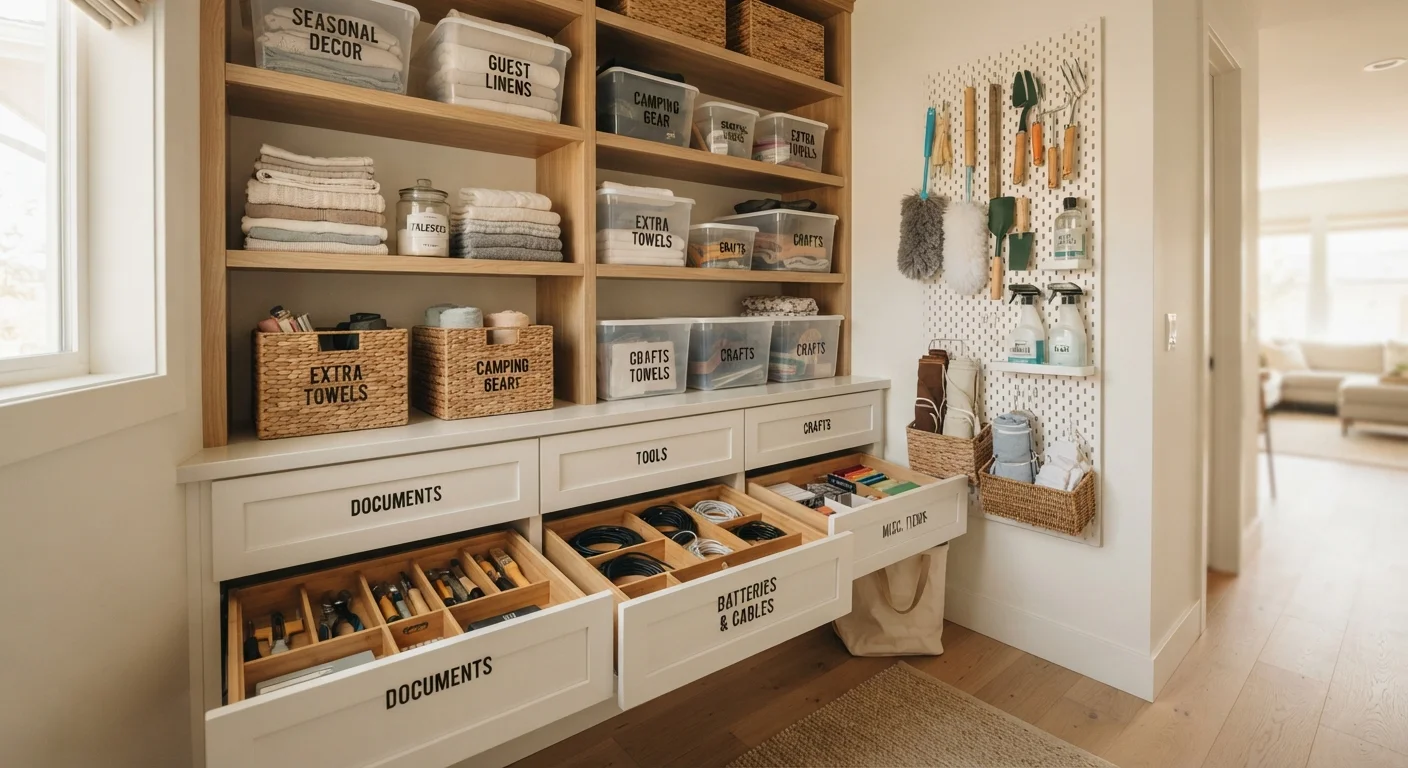
Drawer dividers solve a specific problem called category drift - the gradual mixing of unlike items that happens when everything shares the same open space. Without dividers, a junk drawer becomes uniform chaos within weeks. With dividers, each section holds only what belongs there, and returning items to their spot becomes the path of least resistance.
The principle extends beyond literal dividers. Small trays inside larger drawers, tension-rod separations in a deep kitchen drawer, and even folded fabric caddies in a linen closet all serve the same function: creating defined zones within a confined space so items don't migrate.
Sizing Dividers to Your Drawer
Dividers work best when sections are sized to the actual items - not too large (things shift around) and not too small (nothing fits without forcing). Before buying any divider system, measure both the drawer interior and the items going into it. A rough paper mock-up can save a wasted purchase.
Dividers work best when sections are sized to the actual items - not too large (things shift) and not too small (nothing fits without forcing). Before buying any divider system, measure the drawer and the items going into it.
Labeling and Visibility
Labels seem obvious, but their organizational value is often underestimated. The real function of labeling isn't to remind yourself where things are - it's to make the system usable by anyone in the household. A labeled bin doesn't require institutional knowledge. It communicates the rule of the space without explanation.
Visibility pairs with labeling: if you can't see what's in a container, you're less likely to return items correctly. This is one reason clear-front bins or open-top containers often outperform opaque boxes for frequently accessed items. Closed, opaque storage works well for items that are rarely touched or that would look cluttered in view - but for daily-use zones, visibility reinforces the system. Our comparison of open shelving vs. closed cabinets explores this trade-off in more depth.