

Key Takeaways
- Under-inflated tires reduce fuel economy and increase the risk of blowouts.
- Tread depth below 2/32 of an inch is the legal minimum in most US states - 4/32 is a safer replacement threshold.
- Rotating tires every 5,000-7,500 miles promotes even wear and extends tire lifespan.
- Your vehicle's recommended tire pressure is on the door jamb sticker, not the tire sidewall.
- Consistent tire checks take under five minutes and require only basic, inexpensive tools.
Start here
Why Tire Care Is a Safety Issue First
Next
Tire Pressure: What to Check and How
Then
Tread Depth: Reading What Your Tires Tell You
Continue
Tire Rotation: Extending the Life of All Four Tires
Apply it
Putting It All Together: A Simple Tire Maintenance Routine
Why Tire Care Is a Safety Issue First
Tires are the only part of your vehicle that contacts the road. Every input - braking, steering, accelerating - is transmitted through four palm-sized contact patches. When those patches are compromised by low pressure, worn tread, or uneven wear, the vehicle's ability to respond safely is reduced.
Neglected tires are linked to a significant share of vehicle crashes and roadside emergencies. Blowouts, hydroplaning on wet roads, and extended stopping distances are all influenced by tire condition. The good news is that the most important aspects of tire care - pressure, tread, and rotation - are straightforward to monitor and require minimal tools.
Understanding these three fundamentals is also relevant beyond everyday commutes. Before a long trip, tire condition is one of the most critical checks on any pre-road-trip checklist. And for drivers who want to stay prepared for the unexpected, knowing how tires fail is a core part of handling roadside emergencies confidently.
PSI
Pounds per square inch - the unit used to measure air pressure inside a tire. Your vehicle's recommended PSI is set by the automaker, not the tire manufacturer.
Tread depth
The measurement from the top of the tire's rubber tread to the bottom of the deepest groove. Greater depth means better water channeling and grip, especially on wet roads.
Wear indicator bars
Small raised rubber strips molded into the grooves of most tires at the 2/32-inch level. When the surrounding tread wears flush with these bars, the tire has reached its wear limit.
Tire rotation
Moving each tire to a different position on the vehicle on a set schedule so all four tires wear at a similar rate, maximizing the useful life of the full set.
Cold tire pressure
Tire pressure measured when the vehicle has not been driven for at least three hours. Heat from driving temporarily increases pressure, so cold readings are the accurate baseline for comparison.
Rolling resistance
The force a tire must overcome to roll along a surface. Under-inflated tires create higher rolling resistance, which makes the engine work harder and reduces fuel efficiency.
Tire Pressure: What to Check and How
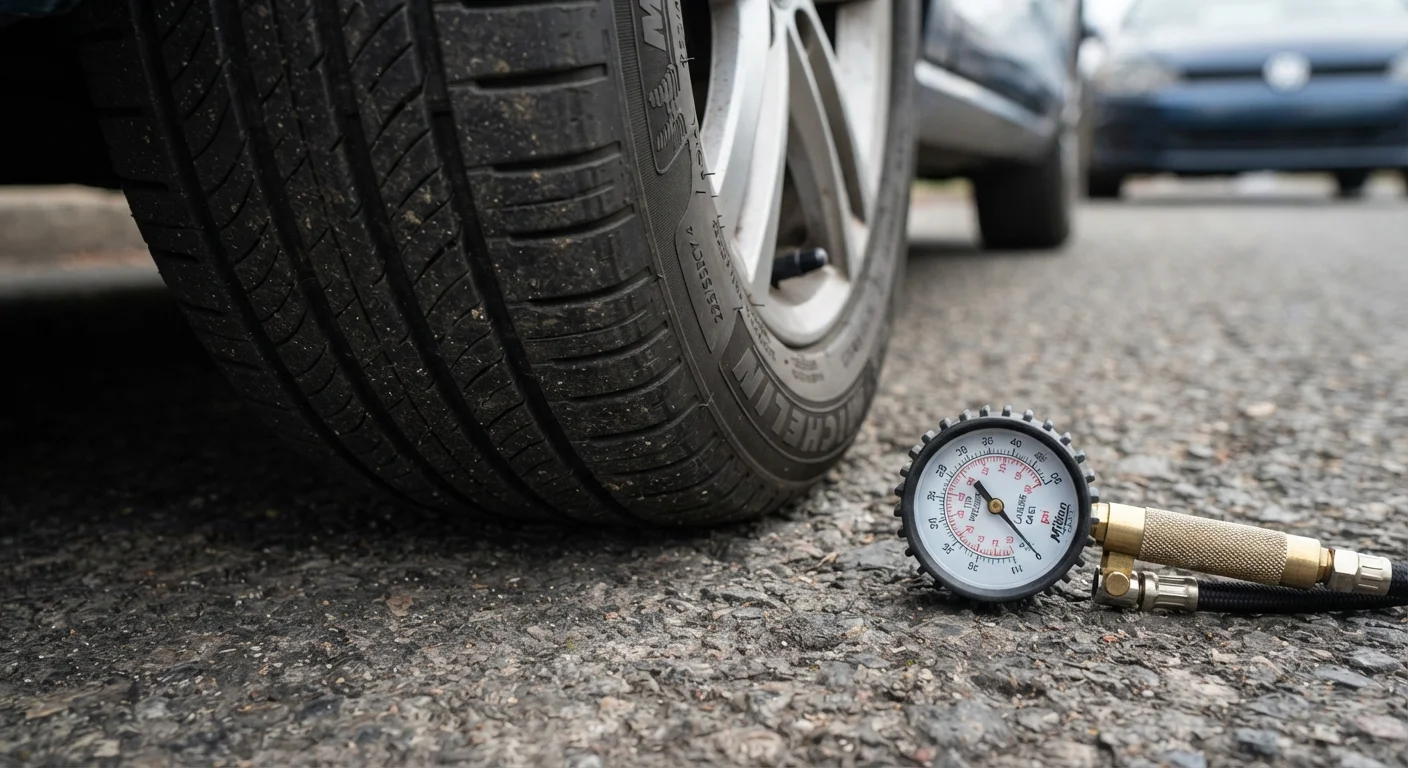
Tire pressure is measured in PSI. Your vehicle's recommended PSI is printed on a sticker inside the driver's door jamb - not on the tire sidewall, which lists a maximum structural limit, not a driving recommendation. Front and rear tires may have different recommended pressures.
To check pressure accurately, use a digital or dial-type tire gauge on a cold tire - meaning the vehicle has been parked for at least three hours or driven fewer than a mile. Heat from driving temporarily raises pressure readings. Remove the valve stem cap, press the gauge firmly onto the valve, and read the result.
Check Pressure Before Driving, Not After
Always measure tire pressure on cold tires - before you've driven more than a mile. Driving heats the air inside the tire and temporarily raises pressure by several PSI, which can make an under-inflated tire appear normal. Early morning, before your first trip of the day, is ideal.
If the reading is below the recommended PSI, add air at a gas station or with a portable compressor. If it is over, press the small pin inside the valve stem briefly to release air. Recheck after each adjustment. Note that tire pressure naturally drops in cold weather and rises in heat - seasonal checks matter. For a broader look at how to adapt your maintenance habits to changing conditions, see seasonal vehicle care.
Tread Depth: Reading What Your Tires Tell You
Tread channels water away from the contact patch, maintaining grip on wet roads. As tread wears down, wet-weather stopping distances increase and hydroplaning risk rises. In most US states, the legal minimum tread depth is 2/32 of an inch. However, many safety organizations suggest considering replacement at 4/32 of an inch for better wet-road performance.
The simplest field check is the coin test. Insert a US penny into a tread groove with Lincoln's head facing down. If the top of his head is visible, the tread is at or near the legal minimum and replacement is warranted. Using a quarter instead of a penny provides an earlier warning: if Washington's head is fully exposed, you're around 4/32 inch.
Dedicated tread depth gauges cost only a few dollars and give a precise reading. Most new tires also have built-in wear indicator bars - small raised rubber bridges sitting in the main grooves. When the tread surface is flush with those bars, the tire has reached its wear limit.
Uneven Wear Is a Symptom, Not Just a Cosmetic Issue
If tread is wearing faster on one edge than another, the tire is likely running at an incorrect angle due to misaligned wheels or worn suspension components. Continuing to drive on a misaligned vehicle accelerates tire wear, can affect straight-line stability, and will waste money replacing tires sooner than necessary. Have alignment checked by a technician if you notice a consistent uneven wear pattern.
Beyond overall depth, inspect tires for uneven wear patterns. Wear concentrated on the outer or inner edges often points to alignment or inflation issues. Center wear can indicate chronic over-inflation. Uneven wear is also a reason to have your wheel alignment checked by a technician, as worn tires compound existing alignment problems and affect how your vehicle's traction and stability systems perform.
Tire Rotation: Extending the Life of All Four Tires
Drive wheels - front wheels on front-wheel-drive vehicles, rear on rear-wheel-drive - carry the load of acceleration and wear faster than non-driven wheels. On front-wheel-drive vehicles, the front tires also handle steering forces, accelerating their wear further. Rotation moves tires to different positions so wear distributes more evenly across the full set.
The general guidance is to rotate tires every 5,000 to 7,500 miles, though your owner's manual may specify a different interval. Many drivers align rotation with oil change intervals as an easy pairing. The specific rotation pattern - straight swap, cross pattern, or including a full-size spare - depends on whether your vehicle is front-, rear-, or all-wheel drive, and whether your tires are directional or non-directional.
Because rotation requires safely lifting and supporting the vehicle and reinstalling wheels at the correct torque, it is a service best performed by a qualified technician unless you have proper equipment and experience. Improperly torqued lug nuts can lead to wheel detachment - a serious safety hazard.
Tracking rotation dates is straightforward when you keep a vehicle maintenance log. A written record also makes it easier to spot if one axle is wearing disproportionately fast, which can signal alignment or suspension concerns worth investigating.
Putting It All Together: A Simple Tire Maintenance Routine
A practical tire care habit combines all three elements without requiring significant time or expense:
- Monthly: Check tire pressure on all four tires (and the spare if full-size) using a gauge on cold tires. Adjust to the door-jamb specification.
- Every fill-up or monthly: Do a quick visual inspection for obvious damage - cuts, bulges, embedded objects, or unusual wear patterns.
- Every 5,000-7,500 miles: Have tires rotated by a qualified technician. Use this appointment to ask about tread depth and alignment if you've noticed uneven wear.
- Periodically: Perform the coin tread test, or use an inexpensive gauge, to track wear over time. Replace tires when tread reaches 4/32 inch for everyday driving, or sooner if you frequently drive in wet conditions.
Tires rarely fail without warning signs. Pressure loss, uneven wear, and reduced wet-road grip are all observable before a tire becomes dangerous. Building these checks into your regular routine is one of the most practical steps any driver can take - and it connects directly to the broader maintenance habits that keep vehicles reliable over time.
Vehicle Owner's Manual
Your owner's manual contains the automaker's exact tire pressure specifications, rotation interval recommendations, and approved rotation patterns for your specific vehicle. It is the most reliable source for tire care guidance tailored to your car.
Tire Pressure Gauge
A basic digital or dial-type tire pressure gauge costs a few dollars and takes seconds to use. Keeping one in your glove box makes monthly pressure checks easy and eliminates the need to rely on gas-station gauge accuracy.
Tread Depth Gauge
A dedicated tread depth gauge provides a precise measurement in 32nds of an inch, giving you more reliable data than coin tests alone. Useful for tracking gradual wear over time and deciding when replacement is approaching.