

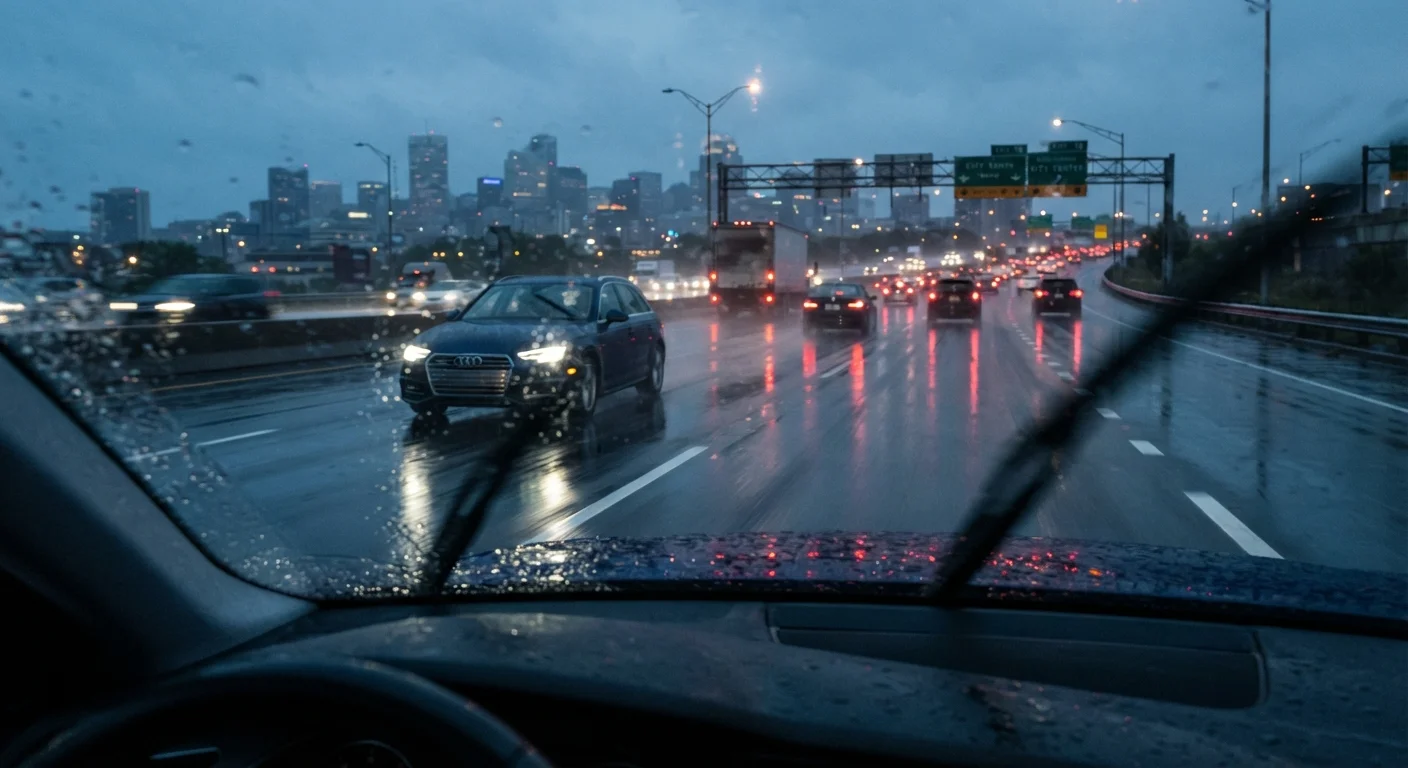
Why Weather Changes More Than Just Your Speed
Most drivers know to slow down when it rains - but that instinct only scratches the surface. Each type of adverse weather reshapes the driving environment in distinct ways: it reduces visibility, extends stopping distances, narrows your margin for error, and changes how your tires interact with the road surface beneath them.
Posted speed limits are legal maximums set for dry, clear conditions. As explained in our guide to speed limits and road design, the appropriate speed in adverse conditions is almost always lower than the posted number - sometimes significantly so. The question is understanding why, and how to adjust deliberately rather than by guesswork.
Rain: Managing Hydroplaning and Reduced Friction
Rain reduces tire traction by creating a thin film of water between rubber and road. At higher speeds, tires cannot channel water away fast enough - a phenomenon called hydroplaning - and the vehicle can lose steering and braking control entirely. This typically begins around 35 mph on wet roads, though worn tires or heavy rainfall lower that threshold considerably.
- Reduce speed by at least 10 mph below normal comfort in light rain; more in heavy downpours.
- Increase following distance to at least 5-6 seconds. Wet pavement can double or triple braking distance compared to dry conditions.
- Use headlights - not just fog lights - to improve your visibility to other drivers.
- Avoid sudden steering inputs or hard braking if you feel the vehicle begin to float. Ease off the accelerator and steer gently in the direction you want to go.
Tire condition is critical here. Tread depth directly affects how effectively water is displaced. If your tires are worn near the wear indicator bars, wet-weather grip is significantly compromised.
Snow and Ice: When Traction Nearly Disappears
Snow and ice present the most severe traction challenges of any common road condition. On glare ice, stopping distances can be ten times longer than on dry pavement. The vehicle may feel stable at low speeds and then respond almost not at all to braking or steering inputs.
- Accelerate and brake gradually. Abrupt inputs break traction on slippery surfaces; smooth, patient inputs keep tires gripping.
- Following distance should extend to 8-10 seconds or more on packed snow or ice.
- Watch for black ice - a thin, nearly invisible layer of ice that forms on bridges, overpasses, and shaded road sections at temperatures near or just below freezing.
- Know your braking system. Anti-lock brakes (ABS) prevent wheel lockup but do not shorten stopping distances on snow and ice - they help you maintain steering control while braking.
ABS Brakes: What They Do and Don't Do
Anti-lock braking systems (ABS) prevent wheels from locking up during hard braking, which helps you maintain steering control. However, ABS does not shorten stopping distances on snow or ice - on loose snow, it may actually increase them slightly. The key benefit is that you can steer around obstacles while braking, which ABS enables by keeping wheels rolling. Always refer to your vehicle owner's manual for guidance specific to your braking system.
Winter tires outperform all-season tires in temperatures below approximately 45°F, even on dry roads, because of their rubber compound and tread pattern. This is a vehicle preparation decision worth evaluating before winter driving season begins.
Weather conditions in winter also compound fatigue risks. See how fatigue affects driving for guidance on recognizing impairment before it becomes dangerous.
Fog: Visibility, Overdriving, and the Vanishing Point
Dense fog can reduce visibility to a few car lengths - or less. The greatest danger in fog is overdriving your headlights: traveling at a speed where you cannot stop within the distance you can see ahead. This is also common at night, as covered in our look at night driving blind spots.
- Use low-beam headlights in fog. High beams scatter light back off the water droplets and reduce your effective visibility.
- Use dedicated fog lights if your vehicle has them - they project a wide, low beam pattern designed for these conditions.
- Slow down to a speed where you can stop within your visible range. If you can see 100 feet ahead clearly, you should be traveling at a speed where 100 feet is a safe stopping distance.
- Increase following distance substantially and avoid relying on the taillights of the car ahead as your primary navigation reference.
21%
Of all US vehicle crashes are weather-related
According to FHWA Road Weather Management data, roughly 1.2 million crashes annually involve adverse weather conditions.
75%
Of weather-related crashes occur on wet pavement
FHWA data indicates wet pavement is the most common weather-related crash surface, underscoring rain as the most frequent hazard.
10×
Stopping distance increase on glare ice vs. dry roads
Engineering estimates show braking distances on black ice can increase tenfold compared to dry pavement at the same speed.
If visibility drops to near zero, consider pulling well off the road - beyond the white edge line - turning off your headlights, and waiting for conditions to improve before continuing.
Preparing Your Vehicle and Driving Habits for Adverse Conditions
Safe driving in poor weather begins before you turn the key. Vehicle maintenance plays a foundational role: tires, brakes, wipers, and lights all directly affect your ability to respond to what the road presents.
If you frequently drive in harsh conditions - short trips in cold weather, stop-and-go traffic in wet seasons, or regular mountain routes - your maintenance schedule may need to be accelerated. Severe driving conditions accelerate wear on fluids, filters, and components in ways the standard mileage-based schedule doesn't capture.
Beyond vehicle condition, driver behavior matters most. The principles that apply in adverse weather - smooth inputs, extended following distances, reduced speed, full attention - are extensions of core safe driving practice. Different road environments present different baseline risks; weather amplifies all of them.
When conditions are genuinely dangerous - heavy ice, near-zero fog, blizzard-level snowfall - the safest choice is often to delay your trip entirely. No destination is worth a collision that proper preparation or patience could have avoided.
This article is intended for general informational purposes only. Always follow local traffic laws and heed official road condition advisories from transportation authorities in your area.