

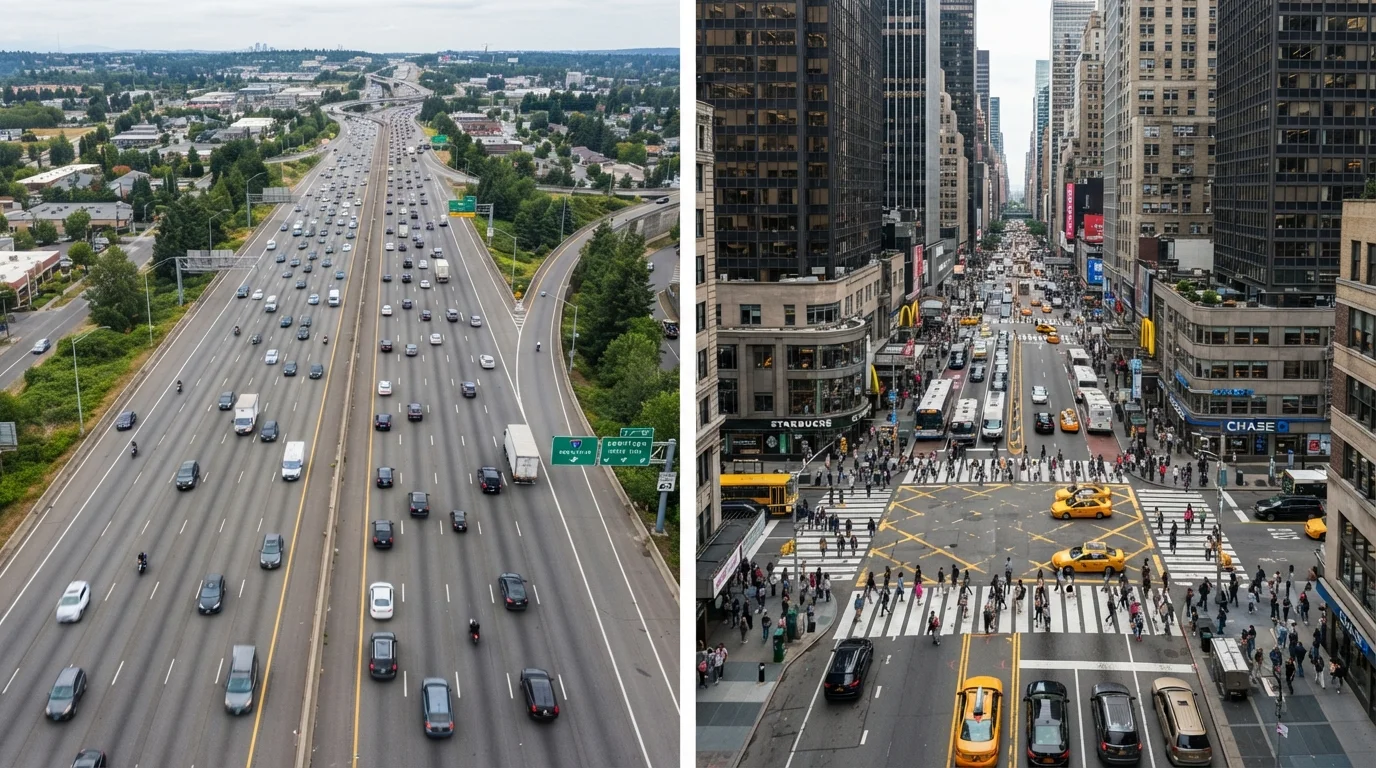
Key Takeaways
- Highway crashes are fewer in number but more often fatal due to high travel speeds.
- City streets produce significantly more total crashes, primarily at intersections and crosswalks.
- Driver fatigue and inattention are leading contributors to highway incidents.
- Urban driving demands rapid, frequent decisions - increasing the risk of judgment errors.
- Tailgating is dangerous in both environments but plays out differently at highway versus city speeds.
- Adapting your attention strategy to the road type is a core component of safe driving.
Option A
Highway Driving
High-speed, structured environment with fewer decision points.
Best for: Covering long distances efficiently, with predictable lane flow and controlled access points.
Option B
City Street Driving
Complex, stop-and-go environment with constant competing demands.
Best for: Short-distance urban navigation requiring frequent decisions, awareness of pedestrians, and intersection management.
If you log frequent long-distance or interstate miles
Highway Driving awareness focus
Fatigue management, proper following distance, and merge discipline are the skills that reduce your greatest risks on the freeway.
If most of your driving is urban commuting or errand runs
City Street Driving awareness focus
Intersection awareness, pedestrian anticipation, and limiting distraction at low speeds will address your highest-frequency crash scenarios.
If you're a new or returning driver building confidence
City Street Driving awareness focus
Urban environments expose you to the widest variety of hazards at manageable speeds, making them a valuable foundation for broader driving skill.
The Core Difference: Frequency vs. Severity
When most drivers picture dangerous roads, highways come to mind first - high speeds, heavy trucks, and long distances all feel threatening. But crash data from the National Highway Traffic Safety Administration (NHTSA) consistently shows a more nuanced picture: urban roads generate more total crashes, while rural highways and interstates produce a disproportionately high share of fatal ones.
City streets account for roughly half of all US traffic fatalities even though urban roads carry the majority of vehicle miles traveled. But the crash-per-mile rate on rural roads - which include many undivided highways - is significantly higher than urban corridors. The takeaway is that frequency and severity don't track together. A fender-bender in city traffic is common; a high-speed highway collision carries a much higher probability of serious injury or death.
Understanding this distinction helps drivers allocate attention and caution appropriately depending on where they're driving, rather than applying a one-size-fits-all vigilance level.
| Criterion | Highway Driving | City Street Driving |
|---|---|---|
| Typical speed range | 55-80 mph | 15-45 mph |
| Primary crash type | High-speed rear-end, run-off-road | Intersection collision, pedestrian strike |
| Crash frequency | Lower total volume | Higher total volume |
| Crash severity | Higher fatality rate per crash | Lower fatality rate per crash |
| Key human factor | Fatigue, inattention, speeding | Distraction, misjudgment, failure to yield |
| Decision frequency | Low - sustained, fewer choices | High - constant, rapid decisions |
| Pedestrian/cyclist exposure | Minimal (controlled access) | Significant and ongoing |
| Primary attention strategy | Long-range scanning, fatigue management | Near-field scanning, intersection vigilance |
What Makes Highways Genuinely Dangerous
Highway driving feels controlled - lanes are marked clearly, access is limited to on-ramps, and there are no pedestrians or traffic signals interrupting flow. That structure, however, creates its own hazards.
Speed amplifies everything. At 70 mph, a vehicle covers roughly 103 feet per second. A moment of inattention - glancing at a phone, adjusting the radio - translates into a significant distance traveled without active awareness. Stopping distances at highway speeds are dramatically longer than at city speeds, leaving less margin for error when traffic slows suddenly. See our guide on tailgating and safe following distance for a breakdown of what the physics actually demand.
Driver fatigue is a disproportionate contributor on highways. Monotonous road conditions - consistent speed, minimal steering input, unchanging scenery - reduce alertness faster than varied urban driving. The NHTSA identifies drowsy driving as a factor in thousands of crashes annually, with rural and highway roads overrepresented in that data.
Merging and lane changes are another concentrated risk point. Matching speed on an on-ramp and identifying a safe gap in traffic requires precise judgment. Our article on reading highway traffic before merging covers the techniques experienced drivers use to manage this moment confidently.
~40%
Urban crashes occurring at intersections
NHTSA research consistently identifies intersections as the most concentrated crash location in urban driving environments.
103 ft/sec
Distance covered at 70 mph
At highway speeds, a single second of inattention means traveling over 100 feet without active driver awareness - nearly the length of a semi-truck with trailer.
~50%
Traffic fatalities occurring on urban roads
Despite being considered lower-risk, urban roads account for roughly half of all US traffic deaths annually, per NHTSA reporting.
What Makes City Streets Persistently Risky
Urban driving's lower speeds don't translate into lower risk - they just shift its character. City streets generate hazards through volume and complexity, not velocity.
Intersections are where the majority of urban crashes occur. Left turns across oncoming traffic, cyclists in blind spots, and pedestrians crossing mid-block all converge in the same confined spaces that drivers must navigate dozens of times during a typical urban commute. According to NHTSA data, intersection-related crashes account for roughly 40 percent of all reported traffic collisions.
Decision frequency is much higher in cities. A highway driver might make one meaningful decision every few minutes. An urban driver may face yield judgments, lane position choices, and pedestrian interactions every few seconds. This sustained cognitive load increases the probability of judgment errors, particularly for newer drivers or those managing distractions.
Distracted driving compounds urban risk significantly. The lower speeds may feel forgiving, but a pedestrian stepping off a curb or a cyclist appearing from a parked car requires fast reaction - reaction that distraction delays. For context on how visibility limitations layer onto these challenges, see our piece on night driving blind spots, which applies directly to urban driving after dark.
Matching Your Attention Strategy to the Road
Safe driving isn't just about following rules - it's about deploying the right kind of attention for the environment you're in.
On highways, the priority is sustained focus over time. Strategies that help include scanning far ahead (at least 12-15 seconds down the road), maintaining consistent following distance - a minimum of three seconds in normal conditions - and taking breaks on long trips before fatigue sets in. Weather changes the equation significantly; our article on driving in rain, snow, fog, and ice explains how to recalibrate speed and spacing when conditions deteriorate.
In cities, the priority is wide, active scanning in the near field. Check mirrors more frequently, identify pedestrian cues (someone stepping toward the curb, a cyclist's shoulder check), and reduce speed approaching intersections even when the light is green. It's also worth remembering that posted speed limits reflect legal maximums, not always ideal conditions - our guide on speed limits and road design addresses why judgment-based speed selection matters.
No environment is inherently safe or inherently dangerous in isolation. Risk is shaped by driver behavior, conditions, and the fit between attention strategy and road demands. Recognizing where you are - and what that environment actually requires - is the foundation of confident, competent driving.
Risk Varies Within Each Environment
Not all highways carry the same risk profile, and not all city streets are equally hazardous. Rural undivided highways - where there are no barriers separating opposing traffic - have among the highest fatality rates per mile of any road type in the US. Similarly, high-volume urban arterials with frequent driveways and uncontrolled crossings are significantly more dangerous than residential streets. Recognizing the specific characteristics of the road you're on, not just its broad category, sharpens your situational awareness further.