

Key Takeaways
- Posted speed limits define the legal maximum, not the always-safe speed for every situation.
- Road geometry, visibility, weather, and traffic density all affect what speed is truly appropriate.
- Speed limits are often set using engineering studies, but conditions constantly change after posting.
- Drivers bear responsibility for adjusting speed when conditions fall below what engineers assumed.
- Reducing speed even modestly can significantly shorten stopping distance and reduce crash severity.
Posted Speed Limit
A posted speed limit is the maximum legal speed a driver may travel on a given road under normal conditions. It is established by traffic engineers and local authorities based on road geometry, land use, and expected traffic. Importantly, it represents a legal upper bound - not a guarantee that driving at that speed is safe in all circumstances.
Many limits in the US are set using the 85th-percentile speed method, which identifies the speed at or below which 85% of drivers travel under free-flow conditions. This method is widely used but also debated among traffic safety researchers.
What a Speed Limit Actually Tells You
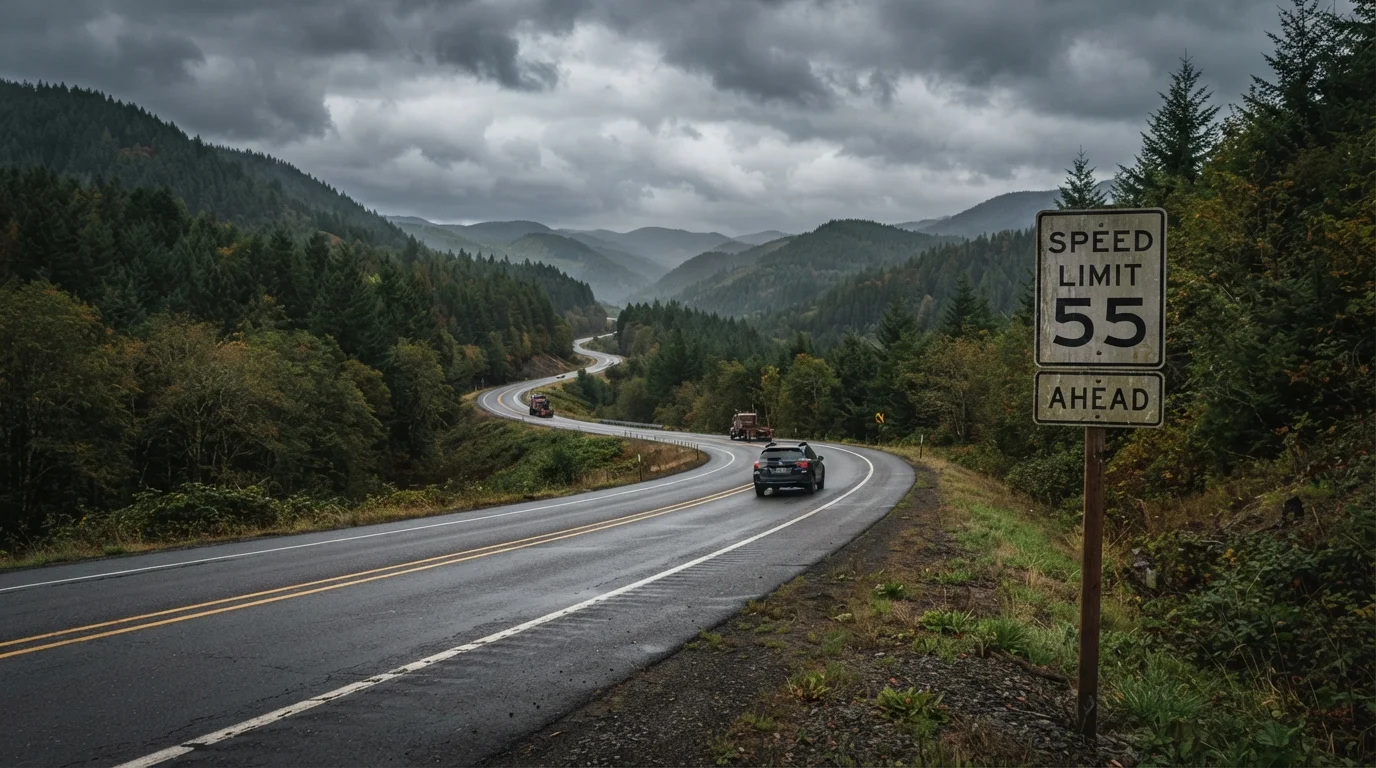
When a speed limit sign reads 55 mph, it communicates one specific thing: the legal maximum speed under normal conditions. It does not tell you the road is engineered to be safe at 55 mph in rain, at night, or through an unexpected curve. That distinction matters more than most drivers recognize.
Speed limits are set through traffic engineering processes that consider road type, lane width, sight distance, and how fast traffic typically moves. But those assessments reflect a snapshot in time - a clear day, an unobstructed road, predictable conditions. The actual conditions you encounter moment to moment may be quite different.
Understanding this gap between posted limit and situationally safe speed is one of the most practical insights a driver can carry. It shifts the question from "Am I under the limit?" to "Is my speed appropriate right now?"
~29%
Fatal crashes involving speeding
According to the National Highway Traffic Safety Administration (NHTSA), speeding is a contributing factor in roughly 29% of all traffic fatalities in the United States.
2x
Braking distance increase from 30 to 60 mph
Physics dictates that doubling speed quadruples the kinetic energy a vehicle carries, roughly doubling the braking distance required under the same road conditions.
~85th percentile
Speed used in many US limit-setting studies
Traffic engineering guidance from the Federal Highway Administration has historically referenced the 85th-percentile speed as a benchmark for evaluating appropriate posted limits.
How Road Design Shapes Safe Speed
Road geometry plays a large role in what speeds are genuinely manageable. A straight, divided highway with wide lanes and clear sight lines tolerates higher speeds well. A two-lane rural road with sharp curves, narrow shoulders, and trees close to the edge demands much more caution - even if the posted limit is the same.
Key design factors that affect how fast you should realistically travel include:
- Curve radius: Tighter curves require lower speeds to maintain vehicle control, especially in wet conditions.
- Sight distance: How far ahead you can see a hazard determines how much time you have to react and stop.
- Lane width: Narrower lanes reduce the margin for error, particularly when sharing the road with larger vehicles.
- Shoulder availability: Roads without adequate shoulders leave little room for emergency maneuvers.
- Intersection density: Frequent cross streets mean more conflict points and less predictability.
Older roads in particular may carry speed limits that were set before modern safety standards. In those cases, the posted number reflects historical norms rather than optimized design. See how these risk factors play out across different environments in our article on where accident risks actually differ by road type.
When Conditions Override the Posted Limit
Most US states include what is commonly called a "basic speed law" - a legal requirement that drivers travel at a speed that is reasonable and prudent given actual conditions, regardless of the posted number. In practice, this means a driver can be cited for going too fast even while staying under the limit.
The conditions most likely to make the posted speed genuinely unsafe include:
- Wet or icy pavement: Braking distances can increase dramatically on slippery surfaces. Our article on adjusting for rain, snow, fog, and ice explains how each condition changes your vehicle's behavior.
- Reduced visibility: Fog, heavy rain, or nighttime driving all shorten the distance within which you can detect and react to hazards.
- Heavy or unpredictable traffic: Dense traffic reduces your margin for error. Following distance becomes critical when surrounding vehicles are braking more frequently.
- Construction zones: Lane shifts, narrowed widths, and workers near the roadway all increase risk.
- Road debris or damage: Potholes, gravel, or unexpected obstacles demand lower speeds and greater alertness.
Adjust Speed Before the Hazard, Not After
The best time to reduce speed is before entering a zone of uncertainty - a curve, a foggy stretch, a congested interchange. Once you are in the hazard, your options narrow quickly. Scanning ahead and slowing proactively is the habit that separates confident drivers from reactive ones.
Understanding how speed relates to stopping distance is also essential. Even modest speed reductions meaningfully shorten the distance your car needs to stop - a physics reality most drivers underestimate. See the science behind stopping distance for a clear breakdown.
Applying This Understanding as a Driver
Practical speed management is less about watching for enforcement and more about reading the road ahead. A few reliable habits help:
- Scan further ahead: The farther ahead you look, the more time you have to respond to changes. This is especially important on winding roads and in low-visibility conditions.
- Enter curves under control: Brake before a curve, not during it. Braking mid-corner can unsettle the vehicle.
- Match speed to sight distance: If you can only see 200 feet ahead, you should be traveling at a speed that allows you to stop within 200 feet.
- Account for the unexpected: Pedestrians, cyclists, animals, and debris can appear suddenly. A speed that leaves reaction time is a safer speed.
When merging onto highways or navigating complex interchanges, matching the flow of traffic and reading surrounding vehicles is equally important. Our guide on reading highway traffic before you merge offers practical techniques for those higher-stakes moments.
Speed limits exist as a necessary legal framework, but safe driving requires going further - treating the posted number as a ceiling, and then using road conditions, design, and traffic as the real inputs for choosing your speed.