

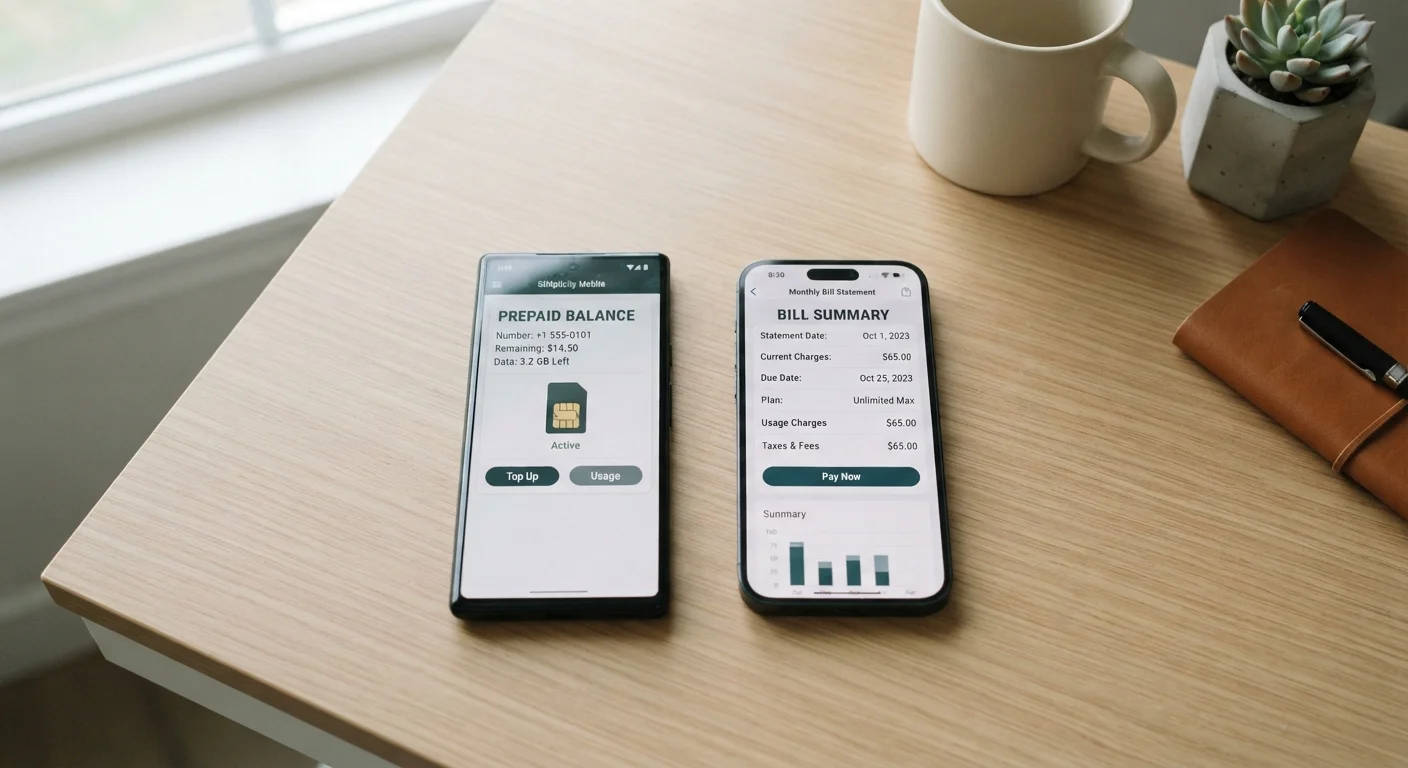
Key Takeaways
- Prepaid plans charge you before you use service; postpaid plans bill you after the month ends.
- Prepaid typically requires no credit check and carries no contract commitment.
- Postpaid plans often offer device installment financing and larger data allowances.
- Many prepaid plans run on the same major network towers as postpaid plans through MVNOs.
- Your usage habits, budget discipline, and device needs are the key factors in choosing.
Option A
Prepaid Plans
Pay upfront, stay in control.
Best for: People who want to avoid contracts, manage spending tightly, or use their phone intermittently.
Option B
Postpaid Plans
Pay later, with more built-in convenience.
Best for: People who want premium device financing, consistent high-data access, and family plan discounts.
If you want predictable monthly spending with no surprises
Prepaid Plans
You pay a fixed amount upfront and simply cannot go over budget since service stops or slows when your balance runs out.
If you need to finance a new flagship device over time
Postpaid Plans
Postpaid carriers typically offer installment plans that spread the device cost across 24-36 months, which prepaid rarely supports.
If you travel internationally with any frequency
Postpaid Plans
Postpaid plans generally include more robust international roaming options and add-on packages than prepaid alternatives.
If you have limited or no credit history
Prepaid Plans
Prepaid plans require no credit check, making them accessible to people who would not qualify for postpaid contracts.
If you manage multiple lines for a household
Postpaid Plans
Multi-line postpaid accounts often unlock per-line discounts that make the per-person cost lower than equivalent individual prepaid plans.
How Each Billing Structure Actually Works
The core difference between prepaid and postpaid is simple: when money changes hands. With a prepaid plan, you pay for a set amount of service - data, minutes, texts - before you use it. When that balance or allowance runs out, your service pauses or slows down until you top up again. With postpaid, your carrier extends you credit throughout the month and then bills you at the end of it based on your chosen plan.
Postpaid accounts typically require a credit check because you are, in effect, receiving a service on credit. Prepaid accounts skip that step entirely - there is no application, no inquiry on your credit report, and no contract locking you in for a set term. You choose a plan, pay, and go.
It is worth noting that the word "prepaid" no longer means what it did a decade ago. Many prepaid plans today offer unlimited data tiers, hotspot access, and international texting - features once exclusive to postpaid. The gap in raw features has narrowed considerably. What remains different is the billing relationship and what that unlocks or restricts.
Prepaid Is Not Just for Basic Phones
A common misconception is that prepaid plans are only suitable for simple or older devices. In practice, any unlocked smartphone - including current flagship models - can run on a prepaid plan. The plan type is determined by your billing arrangement with the carrier, not by the device you use.
Side-by-Side: Key Differences at a Glance
Looking at the two structures across common decision points helps clarify which one fits your situation. The table below covers the criteria most people actually care about when choosing a plan.
| Criterion | Prepaid | Postpaid |
|---|---|---|
| Payment timing | Pay before service | Billed after the month |
| Contract required | No | Often yes (or installment tied) |
| Credit check | None | Typically required |
| Device financing | Rarely available | Common; 24-36 month installments |
| Network priority | Lower during congestion | Higher during congestion |
| International roaming | Limited options | Broader add-on availability |
| Multi-line discounts | Less common | Standard with family plans |
| Overage risk | None (service slows or stops) | Possible on non-unlimited plans |
One detail worth flagging: network priority. On many postpaid plans, your data connection is prioritized over prepaid users during network congestion - meaning if a cell tower is busy, postpaid subscribers may notice less slowdown. For most everyday users in typical urban and suburban environments this rarely causes a noticeable issue, but it can matter in dense crowds or rural areas with limited tower capacity. For a deeper look at how MVNOs and budget carriers fit into this picture, see how MVNOs use the same towers as major networks.
What the Fine Print Can Hide
Both plan types come with terms that are easy to overlook when you are just trying to get service set up. Here are the most common ones to watch for:
- Autopay discounts: Many carriers, on both sides, advertise a monthly rate that only applies when you enroll in autopay with a debit card. Pay by credit card or manually, and the price may be higher.
- Data deprioritization thresholds: Even "unlimited" plans typically slow your speeds after you hit a set data amount - often 22-50 GB per month - during congestion. This applies to both prepaid and postpaid unlimited plans.
- Taxes and fees: Advertised plan prices usually exclude government taxes and carrier fees. Your actual monthly total can be several dollars higher than the headline price.
- Device financing lock-in: Postpaid device installment plans often require you to stay with that carrier until the phone is paid off, or pay the remaining balance if you leave early. For more on what to watch before switching, see what to sort out before upgrading your phone.
If you are curious how technical terms like data speeds and billing codes appear on your actual bill, decoding the terms on your phone bill is a useful companion read.
~40%
US wireless subscribers on prepaid
Industry analyst estimates consistently place prepaid's share of the US wireless market around 40%, reflecting its broad mainstream adoption beyond just budget use cases.
$5-$15
Typical monthly tax and fee add-on
Consumer advocacy research suggests government taxes, regulatory fees, and carrier surcharges routinely add this amount above the advertised plan price for most US subscribers.
Phone Compatibility and Switching Considerations
Your choice of plan structure also intersects with what kind of phone you own. Carrier-locked phones are programmed to work only on a specific carrier's network - which can complicate switching, especially mid-contract. Unlocked phones work with any compatible network and give you more flexibility to move between prepaid and postpaid providers freely. For a full explanation of how this works, see what the difference between locked and unlocked phones actually means.
If you are switching from postpaid to prepaid, the process is usually straightforward: you port your existing number to the new carrier (a process protected by federal regulation), pay for your first month of prepaid service, and insert the new SIM. The main friction points are paying off any remaining device balance and ensuring your phone is unlocked by your current carrier before the move.
Beyond the plan itself, it is easy to underestimate the full cost of smartphone ownership when focusing only on the monthly rate. Accessories, protection plans, and repairs can add meaningfully to what you actually spend. The hidden costs of smartphone ownership covers what most people overlook when they budget for a phone.